
TL;DR
Self-service retail has shifted tasks from staff to customers for more than a century, from selecting groceries at Piggly Wiggly to scanning and paying at automated checkouts. U.S. cashier employment remained about 3.1 million in 2025, while some retailers have reduced self-checkout and others continue expanding it. The sources describe these changes but do not establish how much job decline self-checkout caused.
Retail self-service has shifted parts of store work to customers since Piggly Wiggly opened in Memphis in 1916, according to a historical account published November 26, 2026. The account traces the change from shoppers selecting their own goods to barcode scanning and self-checkout, while reporting that U.S. cashier employment stood at about 3.1 million in 2025 and that retailer adoption remains mixed.

Get kitchen staples and gadgets delivered free with Prime
- Fast, free delivery on millions of items
- Prime Video, Amazon Music and more included
- Member-only deals all year
Before self-service, grocery clerks fetched, weighed and wrapped items at a counter. At Piggly Wiggly, customers selected products from shelves and brought them to a checking station. Clarence Saunders filed a U.S. patent for a “self-serving store” on October 21, 1916; it was granted the following year. The Tennessee Encyclopedia says Saunders did not invent self-service, but helped popularize it.
Barcode technology later made automated price reading possible. GS1 says the first barcode-scanned product was a ten-pack of Wrigley’s Juicy Fruit gum, scanned at a Marsh supermarket in Troy, Ohio, on June 26, 1974. In 1984, David R. Humble and two colleagues filed a patent for a system in which shoppers scanned items and a scale checked their weight. The article says versions were installed at Kroger stores, with machines introduced in 1986.
The account cites Bureau of Labor Statistics figures showing about 3.1 million U.S. cashier jobs in 2025, down from about 3.6 million in 2019. It says the agency projects a further 6% decline by 2035. Those totals cover cashier jobs broadly; they do not isolate the effect of self-checkout. The article also reports that some retailers, including Booths in England and Dollar General and Target in the United States, pulled back self-checkout between 2023 and 2024, while adoption continued in Germany and Japan.
How Self-Checkout Puts Customers to Work
For more than a century, retail self-service has shifted parts of shopping and checkout from staff to customers. Cashier work remains substantial, while retailers’ use of self-checkout is mixed.
How tasks moved to shoppers
Self-service developed through changes to different parts of the shopping and payment process.
Piggly Wiggly opened in 1916, letting shoppers choose goods instead of asking clerks to fetch them.
A barcode was first scanned on a ten-pack of Wrigley’s Juicy Fruit gum in 1974.
A 1984 patent described shoppers scanning items while a scale checked their weight; a cashier collected payment.
Restaurant kiosks moved ordering tasks to customers as well as checkout tasks in stores.
Who does the work?
Self-service changes how customers and employees contribute to a transaction.
- Select products
- Scan and bag items
- Place or pay for orders
- Monitor machines
- Handle problems
- Support other store tasks
Retailer choices are mixed
The account describes both pullbacks and continued adoption.
Some retailers scaled back
Booths, Dollar General and Target pulled back self-checkout between 2023 and 2024.
Adoption continued elsewhere
The account describes continued adoption of self-service formats in Germany and Japan.
Who Does the Checkout Work?
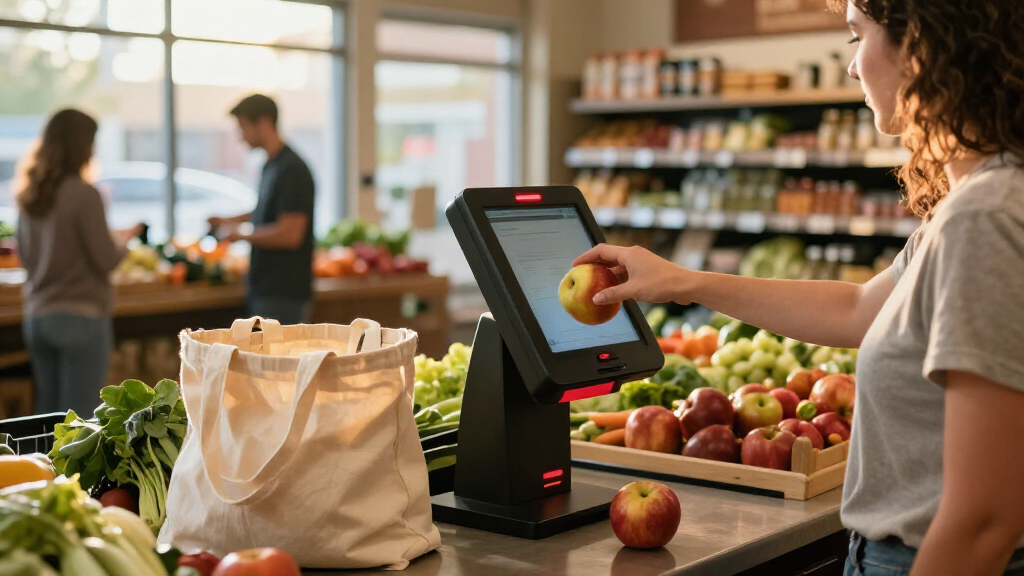
Self-service changes who performs tasks that stores once assigned to employees. Customers may select, scan, bag or pay for purchases themselves, while staff monitor machines, handle problems and support other parts of the store. That shift can affect the pace and feel of a shopping trip as well as retailers’ staffing choices.
The employment figures show that cashier work remains substantial, even after decades of automation. But the figures alone cannot show whether self-checkout caused the decline: they do not separate automation from other forces affecting retail employment. Retailers’ pullbacks also suggest the technology’s costs and benefits can vary by store, including service, losses and checkout speed.
Products Worth Considering

Instant Pot InstantChill Ice Cream Maker Plus Rolled, 2 Pint

Le Creuset Stainless Steel Roasting Pan with Nonstick Rack, 16.25 x 13.25 in

Le Creuset Heritage Rectangular Stoneware Baking Dish Set, 3-Piece, Marseille
As an affiliate, we earn on qualifying purchases.
From Store Aisles to Scanners
The account presents self-service as a series of task shifts rather than a single invention. In 1916, shoppers took goods from shelves instead of asking clerks to fetch them. In 1974, a barcode let a machine read a product’s price. A 1984 patent described shoppers scanning items themselves and a scale checking them against stored product weights.
The early system did not remove staff from the transaction entirely: the patent described a cashier collecting payment after the shopper scanned the goods. Later kiosks expanded self-service beyond grocery checkout. The source says nearly 17,000 McDonald’s restaurants had self-order kiosks by the end of 2018. These examples show how retail and restaurant automation can move different parts of a transaction to customers.
““Instead shoppers selected from items placed on shelves within easy reach.””
— Tennessee Encyclopedia, describing Clarence Saunders’ Piggly Wiggly stores
What the Job Figures Show
The cited employment totals do not establish how many cashier jobs changed because of self-checkout, or how much work moved into other roles. The source gives a BLS projection of a 6% decline by 2035 but does not provide the projection’s underlying assumptions here. It also does not give comparable adoption rates across countries or a consistent measure of how many retailers have reversed or expanded self-checkout since 2024.
The reasons for retailer pullbacks are attributed to service, losses and speed, but the account does not provide company statements or figures measuring those factors. The extent to which shoppers’ added tasks reduce store labor costs also remains unspecified.
Retailers Weigh the Tradeoffs
The next clear employment milestone in the source is the BLS projection for 2035, which calls for a further 6% decline in cashier jobs. Retailers’ near-term choices will also shape how customers encounter automation: some may keep self-checkout, others may limit it, and stores may combine customer payment with staff scanning. The source provides no new company announcements or dates for further deployments, so the scale and pace of those choices remain uncertain.
Key Questions
When did customers first begin selecting their own groceries?
Piggly Wiggly opened in Memphis in 1916 with shoppers selecting goods from shelves. Clarence Saunders filed a patent for a “self-serving store” that October.
What was the first product scanned with a barcode?
GS1 identifies a ten-pack of Wrigley’s Juicy Fruit gum, scanned at a Marsh supermarket in Troy, Ohio, on June 26, 1974.
How many cashier jobs were there in the United States in 2025?
The source cites about 3.1 million cashier jobs in 2025, compared with about 3.6 million in 2019. The figures do not show how much of the change was caused by self-checkout.
Are retailers still using self-checkout?
Adoption is mixed in the source’s account. Booths, Dollar General and Target pulled back between 2023 and 2024, while Germany and Japan were described as continuing to adopt self-service formats.
Source: Thorsten Meyer AI