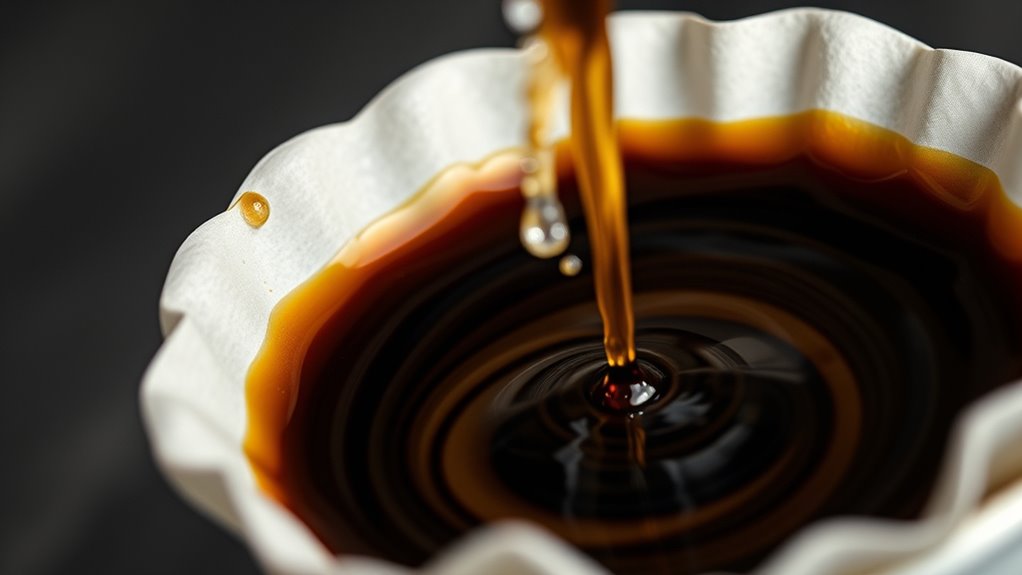

Mastering turbulence and pour technique in pour-over brewing helps you control extraction and flavor clarity. By adjusting your pour speed, pattern, and height, you manage turbulence and aeration to guarantee even saturation of grounds. Gentle, steady pours promote uniform wetting, while a controlled increase in flow stirs grounds for richer flavors. Proper techniques prevent channeling and over-extraction, leading to a balanced cup. Keep exploring these adjustments to perfect your pour-over skill and open better coffee.
Key Takeaways
- Managing pour speed and pattern controls turbulence, preventing channeling and ensuring even saturation.
- Circular pouring promotes consistent aeration and better contact between water and coffee grounds.
- Gentle initial pours set a uniform foundation; later controlled pours stir grounds for complex flavors.
- Adjusting pour height influences aeration and turbulence, balancing saturation and splash risk.
- Fine-tuning flow helps optimize extraction, flavor clarity, and prevent over-extraction or bitterness.
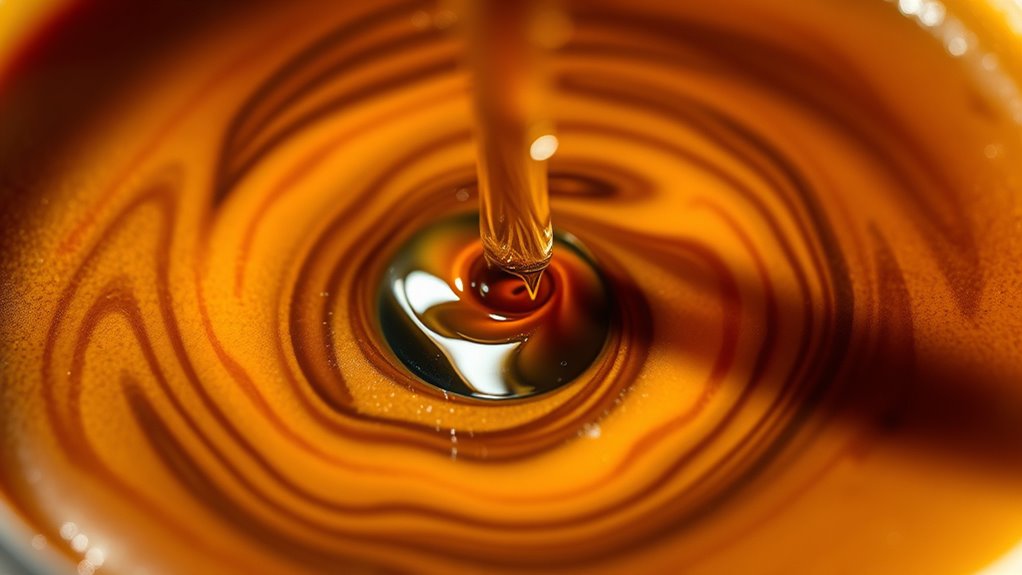
Mastering pour-over coffee begins with understanding how turbulence and pour technique influence extraction. When you pour water over the coffee grounds, turbulence creates a dynamic environment that affects how water interacts with the coffee bed. This turbulence leads to aeration effects, where tiny air bubbles form and increase the contact between water and coffee particles. These bubbles can help break up clumps and promote even saturation, which is fundamentally important for extracting the full range of flavors. The key to harnessing these effects is flow control—by carefully managing the speed and pattern of your pour, you can regulate turbulence to optimize extraction.
Controlling pour speed and pattern optimizes turbulence for better coffee extraction.
Flow control is your primary tool in influencing how turbulence develops during your pour. When you pour too quickly or unevenly, you generate excessive turbulence, which can cause uneven saturation and channeling—where water finds paths of least resistance and bypasses some grounds. This results in under-extraction and a weak, imbalanced cup. Conversely, a slow, steady pour minimizes disruptive turbulence, allowing water to gently and evenly percolate through the coffee bed. This steady flow encourages uniform extraction, highlighting nuanced flavors and reducing the risk of over-extraction that leads to bitterness.
Your pour technique also impacts how aeration effects influence the brewing process. By pouring in a controlled, circular motion, you promote consistent aeration across the coffee bed. This helps create a uniform environment, which ensures that all grounds are equally exposed to water. As you adjust your pour height and rate, you’re fundamentally controlling the level of turbulence created at the surface. A higher pour height can introduce more aeration and turbulence, but if not managed carefully, it can also cause splashing or disturb the bed’s stability. A lower, more deliberate pour reduces turbulence but still allows enough movement to keep the grounds evenly saturated. Additionally, understanding how to control brewing time through pour technique can help optimize extraction and flavor development.
Furthermore, understanding how to modulate turbulence through flow control enables you to improve extraction during different stages of brewing. For example, initial pours that are gentle and controlled set the stage for uniform wetting, while later pours with a slightly increased flow can stir and re-engage the grounds to extract more complex flavors. Mastering these subtle adjustments allows you to fine-tune your pour-over technique, balancing turbulence and aeration effects for a consistently great cup.
Frequently Asked Questions
How Does Turbulence Affect Coffee Flavor Extraction?
Turbulence can disrupt brew bed stability and water flow consistency, leading to uneven extraction. When water flows erratically, it creates channels that miss coffee grounds, resulting in under-extracted or over-extracted flavors. By minimizing turbulence with a steady pour technique, you guarantee uniform saturation, which enhances flavor clarity and balance. Consistent water flow helps extract the coffee’s full potential, delivering a richer, more nuanced cup.
What Tools Help Control Turbulence During Pour-Over Brewing?
Think of controlling turbulence like steering a boat through calm waters—you need the right tools. A gooseneck kettle’s spout design helps you pour smoothly and steadily, reducing unwanted splashes. Maintaining consistent brewing temperature also minimizes sudden turbulence that can disturb extraction. These tools give you precise control, ensuring your coffee flows gently, flavors develop fully, and your pour-over turns out perfectly balanced every time.
Can Turbulence Create Uneven Extraction in Pour-Over Coffee?
Yes, turbulence can cause uneven extraction in pour-over coffee. When turbulence disturbs the coffee bed, it can lead to uneven extraction, resulting in inconsistent flavors and more coffee sediment. Maintaining a steady pour helps control turbulence, ensuring even saturation. Additionally, keeping a consistent brew temperature optimizes extraction, reducing sediment and enhancing flavor clarity. By managing turbulence and temperature, you improve overall brew quality and achieve a more balanced cup.
How Does Pour Technique Influence Turbulence Levels?
Your pour technique directly influences turbulence levels through pouring consistency and water flow. If you pour steadily and smoothly, you minimize turbulence, leading to a more even extraction. Conversely, irregular or rapid pours increase turbulence, which can cause uneven extraction. Controlling your water flow and maintaining a consistent pouring pattern helps achieve ideal turbulence levels, ensuring your coffee brews evenly and highlights the best flavors.
Are There Specific Pouring Patterns to Minimize Turbulence?
Yes, you can minimize turbulence by controlling your pouring speed and choosing the right vessel shape. Pour slowly and steadily to avoid sudden splashes, and opt for a vessel with a wide, rounded opening to promote smooth flow. Using a spiral or circular pouring pattern also helps distribute water evenly, reducing turbulence. Practice these techniques to achieve a more consistent pour-over extraction and a cleaner cup.
Conclusion
Mastering turbulence and pour technique transforms your brew from ordinary to extraordinary. When you control the flow, you’re not just making coffee—you’re orchestrating a symphony of flavor. Each pour becomes a deliberate act, shaping your cup’s destiny. Remember, the art lies in the dance between precision and patience, reminding us that even in simplicity, there’s profound beauty. So, embrace the rhythm, and let your pour tell a story worth savoring.