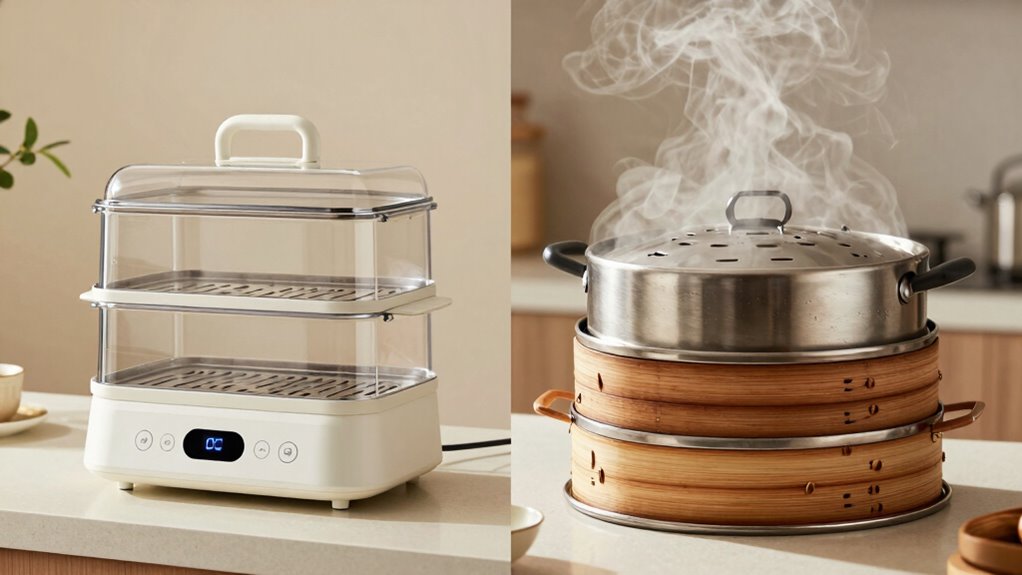
Boilerless steamers are easier to live with because they combine an integrated heating system that’s simple to operate with fewer parts to manage or maintain. You won’t need to handle separate water tanks or worry about complex assembly. Plus, their lightweight, compact design makes them convenient for everyday use and storage. If you want a straightforward, low-maintenance option that still offers good performance, boilerless models might be the way to go; stay tuned for more details.

Get kitchen staples and gadgets delivered free — and shop member deals
- Fast, free delivery on millions of items
- Access to Prime Big Deal Days deals on October 6–7
- Prime Video, Amazon Music and more included
Key Takeaways
- Boilerless steamers have integrated heating, eliminating the need for separate water chambers, simplifying setup and operation.
- They require less maintenance due to fewer components and reduced risk of malfunction.
- Boilerless models are more compact and lightweight, making them easier to handle, store, and use.
- Traditional steamers offer more precise control but involve more complex assembly and ongoing management.
- Overall, boilerless steamers are generally easier and more convenient for quick, everyday use.
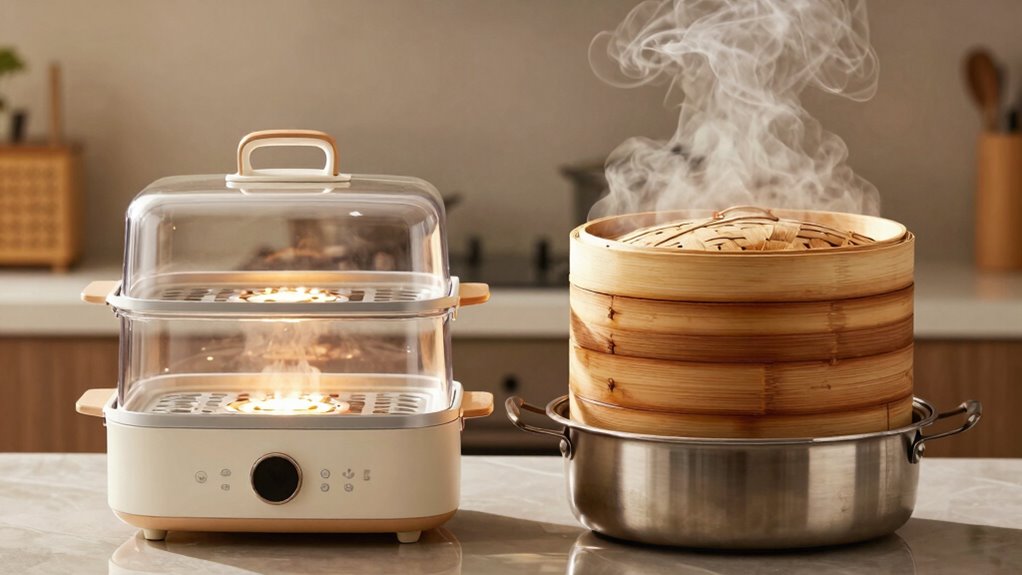
When choosing a steamer for your cooking or cleaning needs, understanding the differences between boilerless and traditional steamers can help you make an informed decision. Both types serve similar purposes but differ significantly in design, operation, and convenience. If you’re looking for ease of use, it’s worth considering how each setup impacts your daily routines. Boilerless steamers operate without a separate water boiler; instead, water is heated directly within the unit, often through integrated heating elements. This design simplifies the setup because there’s no need to manage a separate boiler chamber or refill a water reservoir separately. As a result, boilerless models tend to be more straightforward to operate and maintain, making them a convenient choice for quick cooking or cleaning tasks. Additionally, their heating process often results in less maintenance and fewer parts that can malfunction over time. Because of their simplified design, boilerless steamers are generally more compact and lightweight, which adds to their ease of handling and storage. Moreover, their less complex construction can contribute to a longer lifespan, as there are fewer components subject to wear and tear. Furthermore, advancements in technology have improved the efficiency and performance of boilerless models, making them increasingly popular among consumers. In contrast, traditional steamers often require more setup and can be bulkier, but they offer benefits like precise control over steam production that some users find valuable for specific tasks.
As an affiliate, we earn on qualifying purchases.
Frequently Asked Questions
Can Boilerless Steamers Handle Large Quantities of Food Quickly?
Boilerless steamers can handle large quantities of food quickly, especially if they have a high capacity and efficient water circulation. You’ll notice better cooking speed with boilerless models, making them ideal for preparing bigger food volumes in less time. However, their performance depends on the specific model’s size and power. So, for frequent large batches, choose a boilerless steamer designed for high food volume to guarantee quick, even cooking.
Are Boilerless Steamers Suitable for Professional Kitchen Use?
Boilerless steamers are suitable for professional kitchens because they improve kitchen ergonomics and enhance energy efficiency. You’ll find these machines easier to operate and maintain, reducing clutter and streamlining workflow. Their energy-efficient design helps save on utility costs, making them ideal for busy culinary environments. Plus, their compact size frees up space, allowing you to focus on cooking quality without sacrificing efficiency or comfort in your workspace.
Do Boilerless Steamers Require Special Maintenance or Cleaning?
Imagine a sleek, modern boilerless steamer sitting on your counter, ready to go without extra fuss. You don’t need frequent cleaning, but you should wipe it down regularly to prevent mineral buildup. Descaling isn’t as demanding as traditional models, often needing only occasional attention. Overall, it’s easier to maintain, saving you time and effort while keeping your equipment in top shape with minimal hassle.
How Long Do Boilerless Steamers Typically Last?
Boilerless steamers typically last around 5 to 10 years, depending on usage and maintenance. Durability concerns are common, but if you keep it clean and handle it properly, it can serve you well longer. Replacement costs are generally lower than traditional models, making them a cost-effective choice. Regularly inspecting the unit helps prevent unexpected breakdowns, ensuring you get the most out of your steamer’s lifespan.
Are There Safety Concerns Specific to Boilerless Steamers?
You should know that boilerless steamers come with safety features like automatic shut-off and pressure release valves, reducing electrical hazards. However, since they’re electric appliances, you need to make sure proper wiring and avoid overloading outlets to prevent shocks or fires. Always follow manufacturer instructions and keep the unit dry to minimize risks. Staying vigilant with safety precautions makes living with a boilerless steamer safer and more convenient.
Conclusion
Choosing between boilerless and traditional steamers depends on your lifestyle. If you crave simplicity, convenience, and quick setup, boilerless steamers make your cooking easier. If you prefer durability, larger capacity, and steady performance, traditional steamers might suit you better. Both options aim to make your kitchen life smoother, your meals healthier, and your time more efficient. Ultimately, whether you prioritize ease or reliability, your perfect steamer is the one that fits seamlessly into your routine.
Fall Picks
fall essentials
As an affiliate, we earn on qualifying purchases.