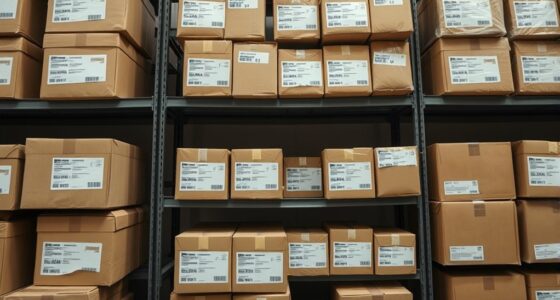

A pick list guides you to gather the right items from storage to fulfill orders, showing details like descriptions, quantities, and locations, which helps you avoid mistakes and work efficiently. A prep list, on the other hand, is used after picking to prepare products for shipping, including packaging, labeling, and quality checks. Understanding these differences guarantees smoother order processing. Keep going, and you’ll discover more about how each list supports your warehouse operations.

Get kitchen staples and gadgets delivered free with Prime
- Fast, free delivery on millions of items
- Prime Video, Amazon Music and more included
- Member-only deals all year
Key Takeaways
- A pick list guides item collection from storage to fulfill orders, while a prep list focuses on preparing items for shipping after picking.
- The pick list contains item descriptions, quantities, and locations for efficient retrieval; the prep list includes packaging, labeling, and quality checks.
- Picking occurs immediately after order receipt, whereas prepping happens after items are gathered for final packaging.
- The pick list minimizes errors during product retrieval; the prep list ensures order accuracy and quality before dispatch.
- Both lists streamline warehouse operations but serve distinct stages: picking vs. final order preparation.

When managing inventory and order fulfillment, understanding the difference between a pick list and a prep list is essential. Both are indispensable tools within an efficient inventory management system, but they serve distinct purposes that impact how quickly and accurately you process orders. Knowing how to use each effectively can streamline your operations, reduce errors, and improve customer satisfaction.
Understanding pick and prep lists is essential for efficient, accurate order fulfillment and improved customer satisfaction.
A pick list is primarily a document or digital instruction that guides you in collecting items from storage locations to fulfill customer orders. When an order comes in, the pick list provides details such as item descriptions, quantities, and specific locations within your warehouse. Your focus is on locating each product quickly and gathering the correct quantities. This step is critical for order fulfillment because it ensures you pick the right products and assemble orders accurately. A well-designed pick list minimizes mistakes, speeds up the picking process, and helps keep your inventory counts precise. It acts as a roadmap, guiding you through your warehouse efficiently and reducing the time spent searching for items. Incorporating inventory accuracy principles can further enhance your efficiency during this stage. Additionally, clear labeling and organized storage can significantly reduce search time during picking. Implementing organized storage strategies can further optimize this process and lead to faster order processing.
On the other hand, a prep list comes into play after items are picked and is used mainly for preparing those products for shipping or final delivery. It often includes tasks like packaging, labeling, quality checks, or consolidating items if an order contains multiple products. Think of the prep list as your checklist to ensure everything is ready for dispatch. It helps maintain quality standards and guarantees that each order is properly prepared, reducing returns or complaints caused by packaging errors. Using a prep list guarantees that no step gets overlooked before an order leaves your facility, which is essential for customer satisfaction and smooth order fulfillment. Additionally, incorporating caffeine science principles can optimize your alertness and efficiency during these tasks. Fostering attention to detail is crucial at this stage to prevent costly mistakes.
In essence, your inventory management system relies on both lists to keep operations running smoothly. The pick list streamlines the process of gathering products, reducing picking errors and saving time. Meanwhile, a prep list ensures that these products are correctly packaged and ready to go, preventing delays or mistakes in the final stages of order fulfillment. When you combine these tools, you create a seamless workflow from inventory to delivery, improving accuracy and efficiency. Understanding their differences and proper application can help you optimize your processes, manage inventory more effectively, and meet customer expectations consistently. Whether you’re scaling up or refining your existing system, mastering the use of pick lists and prep lists is a key step toward more efficient and reliable order fulfillment.
As an affiliate, we earn on qualifying purchases.
Frequently Asked Questions
How Are Pick Lists and Prep Lists Generated Automatically?
You see pick lists and prep lists generated automatically through your inventory management system. It uses real-time updates from sales and stock levels, reducing manual customization. The system analyzes data continuously, creating accurate lists based on current demand and stock conditions. This automation streamlines your workflow, minimizes errors, and guarantees you always have the right items prepared without needing to manually adjust or update the lists.
Can a Single List Serve as Both a Pick List and a Prep List?
A single list can serve as both a pick list and a prep list through list customization and synchronization. While they have distinct purposes—picking items versus preparing ingredients—integrating them streamlines operations. You can customize one list to include necessary details for both tasks, ensuring real-time updates and consistency. This approach reduces errors, saves time, and simplifies inventory management, making your workflow more efficient and cohesive.
What Software Tools Are Best for Managing These Lists?
You should consider software like Fishbowl or Sortly, which excel in list optimization and offer user-friendly interfaces. These tools help you efficiently manage pick and prep lists, streamline workflows, and reduce errors. Their intuitive design makes it easy to update and track inventory in real time. Opt for options that prioritize a clear user interface, so you can quickly access, modify, and organize your lists for maximum productivity.
How Do These Lists Impact Inventory Accuracy?
Like a well-tuned orchestra, these lists keep your warehouse organized and improve inventory accuracy. When you use pick and prep lists properly, you reduce errors, avoid stockouts, and boost inventory turnover. They guarantee you pick the right items quickly, minimizing mistakes that can lead to misplaced stock. In turn, your inventory remains precise, making your warehouse more efficient and responsive to customer needs.
Are There Industry Standards for Creating These Lists?
Industry best practices suggest that there aren’t strict standards for creating pick and prep lists, as they should be customized to your operation’s needs. Focus on clarity, accuracy, and efficiency when designing these lists. Tailor them to your inventory system, product types, and workflow. Regularly review and update your list customization to guarantee they support accurate inventory management and streamline your picking and preparation processes effectively.
Conclusion
Understanding the difference between a pick list and a prep list helps you streamline your workflow and reduce errors. Imagine a busy restaurant where the kitchen staff efficiently uses prep lists to gather ingredients, while servers use pick lists to deliver orders swiftly. When both tools work together seamlessly, customer satisfaction soars. By mastering these lists, you guarantee smooth operations and happier customers — making your workday more manageable and your service more memorable.
Halloween Picks
halloween
As an affiliate, we earn on qualifying purchases.