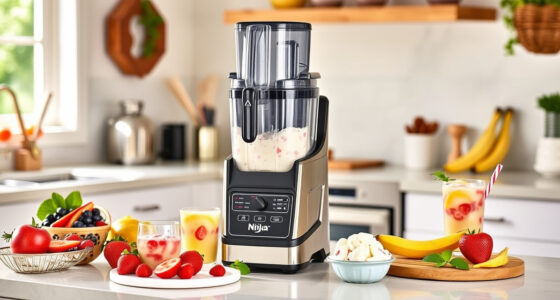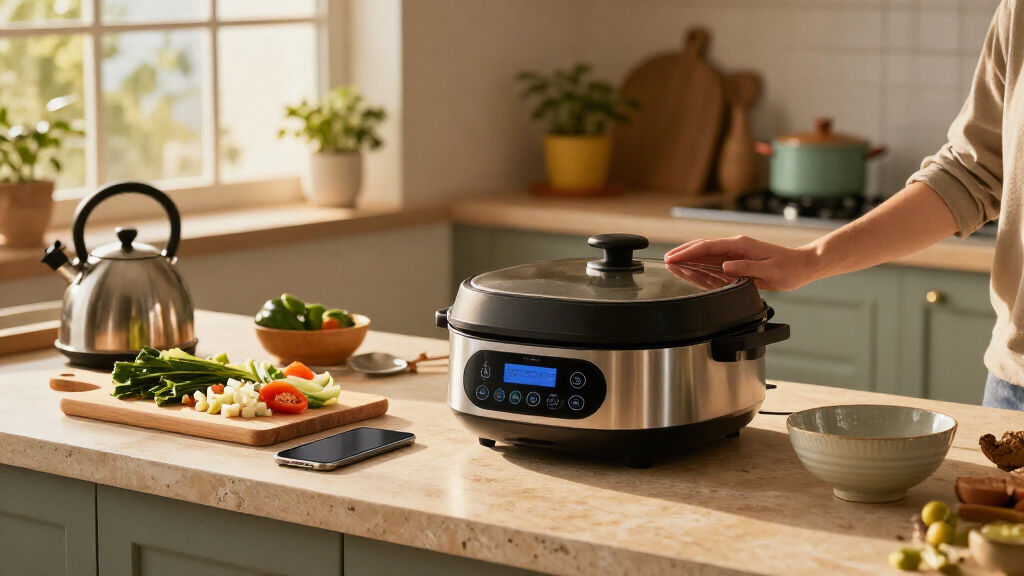
Shopping for smart kitchen gadgets usually means choosing between two kinds of convenience: connected devices that work with an app or smart-home system, and standalone devices that add a useful feature without depending on one. A connected multicooker may send cooking alerts to your phone; a standalone appliance may simply use a timer, sensor, or preset to handle the same job at the counter. The difference matters most when deciding whether remote control and automation will change how you cook, or whether they will add another app to maintain.

Get kitchen staples and gadgets delivered free with Prime
- Fast, free delivery on millions of items
- Prime Video, Amazon Music and more included
- Member-only deals all year

Rechargeable Electric Salt and Pepper Grinder Set, 2-Piece, Black
- ✔ Brand: Gaivis
- ✔ Set size: 2 grinders
- ✔ Capacity: 100 ml per grinder
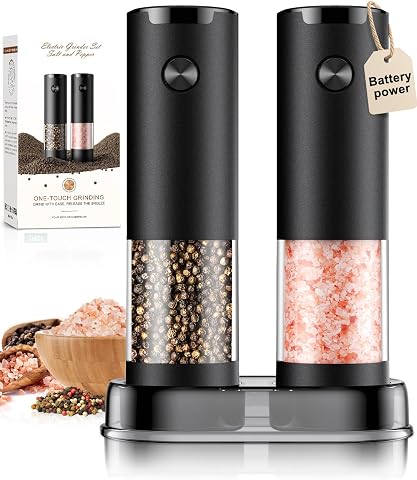
ioion Electric Salt and Pepper Grinder Set with LED
- ✔ Brand: ioion
- ✔ Set contents: 2 grinders
- ✔ Coarseness settings: 5 levels

CIRCLE JOY Automatic Gravity Salt and Pepper Grinder Set with LED Light, Adjustable Coarseness, Black
- ✔ Brand: CIRCLE JOY
- ✔ Set contents: 2 grinders
- ✔ Operation: Automatic, gravity-activated
Connected gadgets are a stronger fit for cooks who use guided recipes, want remote monitoring, or already manage a smart home. Standalone gadgets tend to suit people who want a direct control panel, predictable operation, and fewer accounts or compatibility questions. Neither category is automatically better: the right choice depends on how often you will use its smart features, how long you expect the device to last, and whether the added cost solves a real kitchen problem.
At a Glance
| Criteria | Connected smart kitchen gadgets | Standalone smart kitchen gadgets | Winner |
|---|---|---|---|
| Convenience and control | Remote controls, alerts, and automation may be available through an app or smart-home system. | Controls and feedback are usually on the device itself. | A |
| Cooking guidance | Some models offer guided recipes, saved settings, and cooking notifications. | Often relies on presets, timers, or the user’s own recipes. | A |
| Setup and compatibility | May require an account, Wi-Fi, app setup, and compatible devices or platforms. | Typically simpler to install and use, with fewer platform dependencies. | B |
| Reliability and longevity | Core functions may work locally, but connected features can depend on software and services. | Fewer connected services to maintain, though appliance quality and repairability still vary. | B |
| Privacy and data | May collect usage or account data; policies differ by brand and product. | Usually involves less app-based data collection. | B |
| Price and value | Often costs more; worthwhile when app features are used regularly. | Usually lower priced; stronger value when the main task is all that matters. | Depends |
Rechargeable Electric Salt and Pepper Grinder Set, 2-Piece, Black
For cooks who want an electric grinder they can use often without keeping spare disposable batteries nearby, the Gaivis rechargeable set makes the strongest overall case. Its Type-C charging gives it a different kind of convenience from the battery-powered ioion and CIRCLE JOY sets: we trade the need to replace batteries for the need to recharge the grinders. Six external coarseness settings also give us the most explicitly defined range in this lineup, with adjustments made without touching the grinding outlet.The 100 ml hoppers and wide openings are practical strengths. They help reduce refill interruptions and make filling or cleaning less fiddly than a narrow opening might be. Like the other options, Gaivis includes a built-in light for seasoning one-handed, plus ceramic grinding cores. Storage bases, two cleaning brushes, and charging cables round out the set. Compared with ioion, Gaivis offers one more stated grind setting and rechargeable power; compared with CIRCLE JOY, it uses external adjustment rather than relying on a flip to start grinding.There is a clear compromise: its plastic construction may not feel as substantial as metal, and rechargeable operation still depends on keeping the units charged. The available description does not specify battery life or charging time, so we cannot predict how often they will need a cable. For a buyer who wants the broadest feature mix and is comfortable with charging, Gaivis is the easiest set to recommend. Those who value a press button or want a bigger stated capacity should compare the other two first.
Pros:
- Six external grind settings are easy to adjust.
- Type-C charging avoids disposable batteries.
- 100 ml hoppers and wide openings support easier filling and cleaning.
- Includes lights, storage bases, cleaning brushes, and charging cables.
Cons:
- Plastic construction may feel less durable than metal.
- Needs charging to operate, and the description does not specify battery life.
Best for: Home cooks who want rechargeable grinders, several readily adjustable grind settings, and included cleaning accessories.
Not ideal for: Buyers who prefer metal construction, want to avoid charging routines, or need a stated capacity larger than 100 ml per grinder.
Bottom line: Choose Gaivis for the most balanced mix of rechargeable power, adjustment range, and everyday upkeep support.
“Choose Gaivis for the most balanced mix of rechargeable power, adjustment range, and everyday upkeep support.”
ioion Electric Salt and Pepper Grinder Set with LED
The ioion set is the most straightforward choice for cooks who want press-to-grind control. Each grinder works with one hand, so we can season while holding a spoon or steadying a pan. That deliberate press is useful when we want to decide exactly when grinding begins; CIRCLE JOY’s gravity-activated design starts when flipped, while Gaivis is described as automatic without a button-control detail. The ioion’s five coarseness levels are fewer than Gaivis’s six, but they still give us a defined way to adjust grind size.Transparent, large-capacity chambers make it easy to see when salt or pepper is running low, a useful everyday cue that the other descriptions do not explicitly offer. Built-in LED lights help illuminate the area being seasoned, and ceramic grinding mechanisms are paired with an included cleaning brush. The storage bases also give the set a place to rest between uses. These are modest conveniences rather than advanced connectivity, but they align well with the product’s simple, task-focused approach.The main drawback is the four AAA batteries required for the pair, which are not included. That makes ioion less convenient to maintain than rechargeable Gaivis if we want to avoid buying replacements, though it avoids CIRCLE JOY’s larger eight-battery requirement. The chamber volume is not specified, so the “large-capacity” description cannot be directly compared with Gaivis’s 100 ml or CIRCLE JOY’s 135 ml. Choose ioion when visibility and button control matter more than rechargeability or the highest stated capacity.
Pros:
- One-hand press operation gives deliberate control over when grinding starts.
- Five adjustable coarseness levels suit different seasoning needs.
- Transparent chambers make spice levels easy to check.
- Includes LED lights, storage bases, and a cleaning brush.
Cons:
- Requires four AAA batteries for the set, and they are not included.
- The chamber capacity is described as large but has no stated volume.
Best for: Cooks who want a simple press-button grinder with visible spice levels and defined coarseness choices.
Not ideal for: People who want rechargeable operation or need a clearly stated hopper volume before choosing.
Bottom line: Pick ioion if a clear press control and visible spice supply matter more to us than rechargeable power.
“Pick ioion if a clear press control and visible spice supply matter more to us than rechargeable power.”
CIRCLE JOY Automatic Gravity Salt and Pepper Grinder Set with LED Light, Adjustable Coarseness, Black
CIRCLE JOY is the pick for cooks who want the grinder to start with a simple change in position. Flip it and it grinds, which makes seasoning feel quick when our other hand is occupied. That trigger is the defining difference from ioion’s press-to-start control: it removes the button press, but it also gives us less explicit control over activation. Gaivis is the more versatile daily-use choice overall, with six stated settings and rechargeable power; CIRCLE JOY’s appeal is its uncomplicated gravity-activated routine.Each grinder has an adjustable ceramic grinding core and a blue LED that turns on during use. Its stated 135 ml capacity per grinder is the largest specified in this group, exceeding Gaivis’s 100 ml. That can mean fewer refills if we season frequently, although the descriptions do not give ioion a comparable volume. The set weighs 340 g according to the provided specifications, and its black finish keeps the look restrained on a counter or table.Power is the key tradeoff. The pair requires eight AAA batteries, and the listing details do not say whether those batteries are included. That is twice the stated battery count of ioion’s set and avoids neither replacement purchases nor battery storage. There is also no button-operated control described, so cooks who want to pause and start grinding with a press may prefer ioion. CIRCLE JOY earns its place for buyers who prioritize a flip-trigger and a larger stated capacity, but it is a narrower fit than rechargeable Gaivis.
Pros:
- Gravity activation starts grinding when the unit is flipped.
- 135 ml capacity per grinder is the largest stated here.
- Adjustable ceramic grinding core accommodates different seasoning textures.
- Blue LED illuminates during grinding.
Cons:
- Requires eight AAA batteries for the set; inclusion is not specified.
- No button-operated start or stop control is described.
- The number of coarseness settings is not specified.
Best for: Cooks who prefer a flip-triggered grinder and want the largest explicitly stated capacity in this comparison.
Not ideal for: Buyers who want rechargeable power, button-operated control, or fewer disposable batteries to keep on hand.
Bottom line: Choose CIRCLE JOY when gravity activation and a larger stated hopper matter more than charging convenience or button control.
“Choose CIRCLE JOY when gravity activation and a larger stated hopper matter more than charging convenience or button control.”
As an Amazon Associate we earn from qualifying purchases.
Key Differences
The biggest gap is how much the gadget can do away from the appliance. Connected models can send alerts while you are in another room, let you adjust certain settings remotely, or guide a recipe step by step. Those features can make a busy cooking routine easier, particularly if a device is used several times a week. They add little for a gadget that already runs unattended or for a cook who prefers to check the appliance directly.
Standalone models put more of the experience on the device: buttons, dials, displays, and built-in presets. That can mean less setup, fewer compatibility surprises, and a cooking workflow that does not depend on an app or internet connection. The tradeoff is less flexibility and remote feedback. For most households buying a single-purpose gadget, a good standalone model is the better value; a connected model earns its premium when its specific app features solve a repeated problem.
Detailed Comparison
Convenience and control (Connected smart kitchen gadgets wins — moderate)
Connected gadgets win this criterion by a moderate margin when remote monitoring or control is useful. A phone alert can tell you a cycle has finished, and some devices let you change settings without returning to the kitchen. Standalone gadgets keep controls at the appliance, which is often faster for a simple task and avoids pulling out a phone. If you rarely leave the kitchen while cooking, the practical gap is minor; if you routinely multitask, connected feedback can save attention.
Cooking guidance (Connected smart kitchen gadgets wins — moderate)
Connected models often have the advantage when they include guided recipes, downloadable programs, or tailored instructions. Those tools can help newer cooks follow unfamiliar steps, though their usefulness depends on the quality and range of the recipe library. Standalone models may have useful presets but typically offer less instruction. This is a moderate advantage for people who want structured help and a minor one for experienced cooks who already know their preferred method.
Setup and compatibility (Standalone smart kitchen gadgets wins — moderate)
Standalone gadgets win by a moderate margin because they generally need only power and basic setup. Connected products can require Wi-Fi, a phone app, an account, software permissions, and sometimes a compatible smart-home platform. That is manageable for someone who already uses those systems, but it creates extra steps and possible points of failure. Choose standalone if you want an appliance that is ready to use without account setup.
Reliability and longevity (Standalone smart kitchen gadgets wins — moderate)
Standalone gadgets have a modest practical edge because their main controls do not depend on app support or cloud services. A connected appliance can still cook locally if its maker designed it that way, but features may change if software support ends or a service becomes unavailable. Hardware quality, warranty, parts access, and repairability matter more than connectivity alone, so the gap is moderate rather than decisive. Check what functions remain available offline before buying a connected model.
Privacy and data (Standalone smart kitchen gadgets wins — minor)
Standalone gadgets usually win, though the difference is minor for many buyers. They tend to require less account and app data because they are not designed to report usage through an online service. Connected devices may collect device or account information, with the details varying by manufacturer. If minimizing connected products at home is a priority, standalone is the straightforward choice; otherwise, review the product’s privacy settings and policy.
Price and value (major difference)
Standalone gadgets usually cost less, but value depends on whether the connected features will earn their keep. Paying more for remote alerts or recipe guidance can make sense for frequent cooks who will use those functions several times a week. For an occasional task, the extra cost often buys features that sit unused. This is a genuine depends category: compare the price difference with the specific benefit, not the number of features listed.
Connected smart kitchen gadgets: Pros and Cons
Pros:
- Remote monitoring and alerts can help with multitasking.
- App features may include guided recipes and customizable programs.
- Can fit neatly into an existing smart-home routine.
Cons:
- Often costs more than a similar standalone device.
- Setup can involve Wi-Fi, accounts, apps, and compatibility checks.
- Some features may rely on software support or online services.
Standalone smart kitchen gadgets: Pros and Cons
Pros:
- Usually simpler to set up and operate.
- Core controls are available on the appliance itself.
- Often costs less and requires less app-based data sharing.
Cons:
- Limited remote control and notifications.
- May offer fewer guided recipes or ways to customize programs.
- Less suited to people who want to coordinate appliances through a smart-home system.
Who Should Choose What
Choose Connected smart kitchen gadgets if:
- You cook often and will use remote alerts or app controls several times a week.
- You want guided recipes or customizable programs built into the device experience.
- You already use a compatible smart-home system and value a connected routine.
Choose Standalone smart kitchen gadgets if:
- You want a gadget that works without an account or phone setup.
- You mainly need a dependable appliance for one repeated task.
- You prefer physical controls, lower upfront cost, or fewer connected devices at home.
Skip both if: Skip both categories if the gadget duplicates appliances you already own or adds a task you rarely cook; spend on a better version of a tool you use every week instead.
Value for Money
Standalone gadgets are the better default value because they deliver the main kitchen function at a lower price and with fewer dependencies. Paying more for a connected model makes sense when a specific feature—such as alerts from another room, guided cooking, or integration with equipment you already own—will change how you use it on a regular basis. Do not pay a connectivity premium just because an app exists. Compare the exact models, check whether essential functions work offline, and judge the added cost against the time or effort it will save.
Final Verdict
For most buyers choosing one smart kitchen gadget, start with a well-reviewed standalone model: it is easier to operate, usually costs less, and keeps the essential controls on the appliance. Choose connected instead when you cook frequently and can name the app feature you will use—remote alerts, recipe guidance, or smart-home control. The deciding factor is not whether a gadget connects to Wi-Fi; it is whether that connection improves a routine you actually have. If it does, the premium can be worthwhile. If it does not, standalone is the clearer buy.
Frequently Asked Questions
Are connected smart kitchen gadgets worth the extra cost?
They can be for frequent cooks who rely on remote alerts, guided recipes, or smart-home integration. If you mainly use the appliance’s basic function, a standalone model is usually better value.
Can a connected kitchen gadget work without Wi-Fi?
That depends on the model. Some retain their core controls and cooking programs offline, while app features may stop working. Check the product details for offline operation before buying.
Are standalone smart kitchen gadgets less capable?
Not necessarily. A standalone device can still use sensors, timers, and automatic presets. It generally offers less remote control and app-based guidance, rather than a weaker core cooking function.
Which type is better for a beginner cook?
A connected model may be more helpful if its recipe guidance is clear and covers the food you make. A standalone model with reliable presets can be just as approachable and requires less setup.
What should I check before buying a connected gadget?
Confirm which functions work without internet access, what phone or smart-home platforms it supports, whether an account is required, and how long the maker expects to provide software support.