
TL;DR

Get kitchen staples and gadgets delivered free with Prime
- Fast, free delivery on millions of items
- Prime Video, Amazon Music and more included
- Member-only deals all year
Building your own AI workstation used to be cheaper and more customizable. Now, due to market shortages and rising component prices, prebuilt systems often match or beat DIY costs, with added validation, support, and optimized thermals. The choice hinges on your priorities: speed, control, or support.
If you’ve ever thought building your own AI workstation was automatically the cheaper route, think again. The AI boom, coupled with chip shortages and skyrocketing component prices, has flipped that script, making building vs buying a prebuilt AI workstation more relevant than ever. Suddenly, prebuilt systems offer prices that are hard to beat—sometimes even cheaper than DIY parts.
This isn’t just about saving a few bucks. It’s about whether you want a machine ready to run out of the box, or you’re willing to spend time tuning, troubleshooting, and upgrading—consider build vs buy a prebuilt AI workstation. In 2026, the decision is more nuanced—and more critical—than ever.
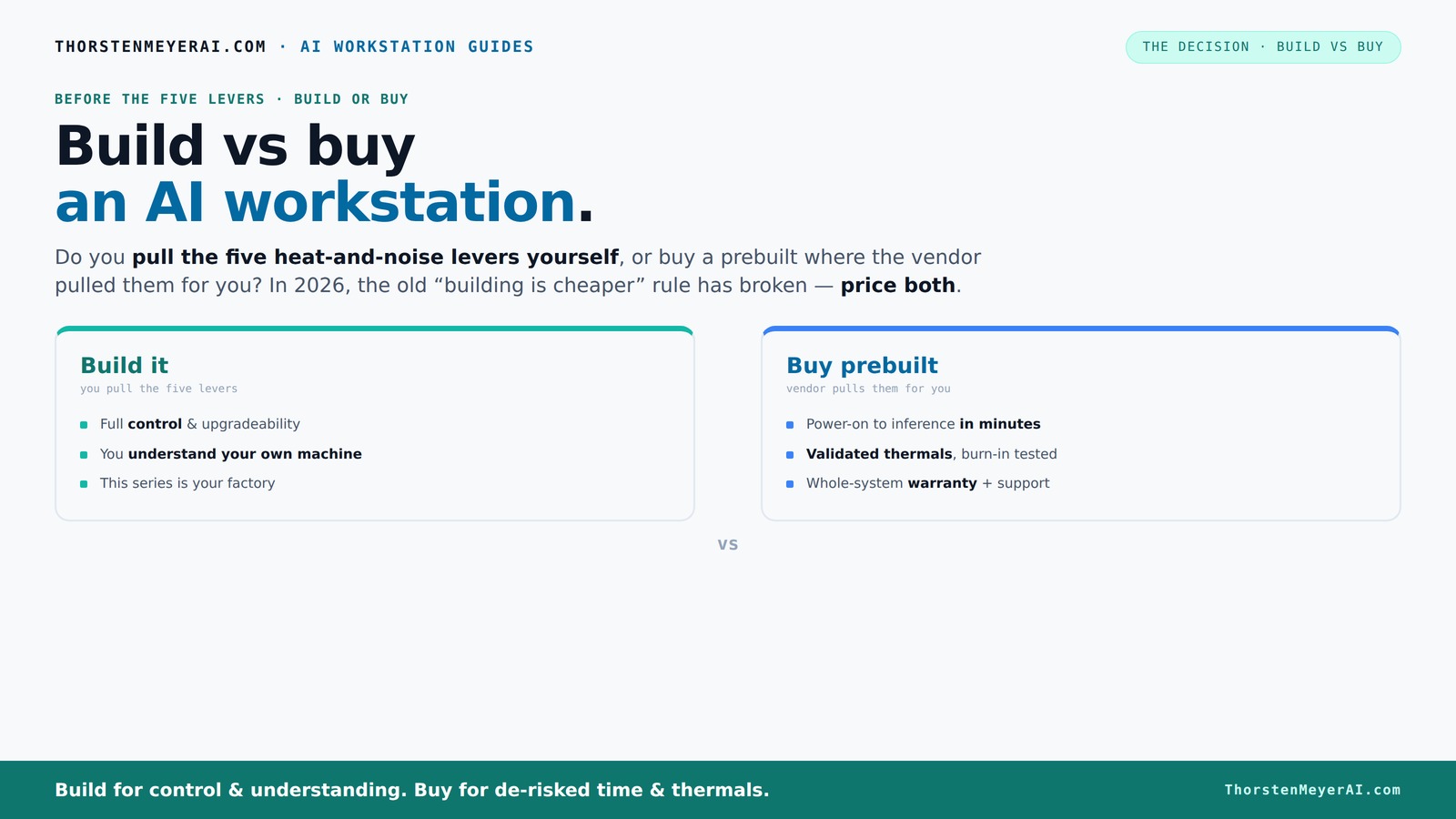
Build vs buy
an AI workstation.
The real question behind this whole series: do you pull the five heat-and-noise levers yourself, or buy a prebuilt where the vendor pulled them for you? And in 2026, the old “building is cheaper” rule has broken. Match your situation in Part 3.
Key Takeaways
- Component shortages and rising prices mean prebuilt AI workstations often match or beat DIY costs in 2026.
- Prebuilts handle thermal tuning, validation, and support—saving you time and reducing risk.
- DIY gives control over specific hardware choices and upgrade paths, but requires technical skill and patience.
- Match your hardware to your AI workload—heavy training needs more VRAM, cooling, and power than light inference.
- Decide based on whether you prioritize speed, control, or support—each suits different user profiles.
As an affiliate, we earn on qualifying purchases.
Why the 'Build is Cheaper' Myth Got Crushed in 2026
Building a high-end AI workstation used to be a clear money saver. Component prices were stable, and DIY enthusiasts could source parts at retail or wholesale prices. But that’s no longer true. The market has shifted dramatically.
According to recent data, prices for DDR5 RAM, GPUs, and SSDs have surged 20-50% since 2024, driven by supply chain issues and AI hardware demand. This means that the cost savings from sourcing individual components have diminished or disappeared, especially when factoring in the time and effort required to assemble and troubleshoot your system.
Meanwhile, big vendors like Dell and ASUS have stocked up on bulk components. They can buy at wholesale prices, which often beat retail, and pass those savings onto you—sometimes at the same or lower price than you’d build yourself. Their economies of scale, combined with rigorous validation and thermal testing, mean their systems are optimized for reliability and performance out of the box.
This means that the traditional advantage of DIY—lower cost—has been eroded. Instead, the decision now hinges on whether you value customization and control enough to justify potentially higher costs or complexity, or if the convenience and support of prebuilt systems outweigh the price difference. The market shift pushes us to re-evaluate what 'cheaper' really means in 2026—more info at build vs buy a prebuilt AI workstation.
The Five Levers of a Thermally Optimized AI Workstation — Who Controls Them?
Making a high-power AI rig run cool and quiet is a balancing act, and many opt for build vs buy a prebuilt AI workstation to simplify thermal management. The five key levers are: undervolting the GPU, matching the cooling system, optimizing airflow, tuning fans, and proper placement.
When you buy a prebuilt, the vendor handles these levers. They validate thermals, run stress tests, and tune fan curves—often with water-cooling or custom solutions—so your system stays silent and cool under load. This process involves extensive testing, which ensures thermal stability and reduces the risk of overheating or throttling during critical AI workloads—more easily achieved through build vs buy a prebuilt AI workstation options. It’s a form of quality assurance that saves you time and technical effort, especially if you’re not experienced in thermal tuning.
If you build yourself, you pull all five levers. You choose a quiet GPU, like the RTX 4060 Ti with a custom BIOS, pick a case with sound-dampening features, and set up airflow that pushes hot air out efficiently. This approach allows you to fine-tune your system for the perfect balance of noise and cooling—crucial for long training sessions or quiet office environments. However, it requires technical skill, patience, and a good understanding of thermal dynamics. Poor tuning can lead to overheating, increased noise, or reduced component lifespan, which underscores why many prefer prebuilt validation.
In 2026, many prebuilt vendors claim their systems run 30% cooler and quieter, thanks to factory tuning and validation processes that are difficult to replicate at home. This not only enhances performance stability but also extends component longevity. Do you want to invest the time and expertise into tuning your own system, or would you rather pay for a system already optimized for thermals and acoustics? The choice reflects your priorities—control versus convenience—and impacts long-term reliability and user experience.
Cost, Performance, and Support: The Reality Check
When deciding build vs buy, most focus on initial cost. But in AI, performance per dollar, support, and reliability matter just as much. The true value of a system isn’t only in its purchase price but in how it performs over its lifespan and how easily issues are resolved.
Prebuilts often come with a warranty, dedicated support, and validated thermals. For example, a BIZON or Lambda system undergoes extensive testing, including thermal validation, stress testing, and compatibility checks, ensuring consistent performance during prolonged workloads. This validation reduces the risk of unexpected failures or performance throttling, which can be costly in terms of downtime and troubleshooting. Additionally, having a single support point simplifies problem resolution, saving time and frustration.
Building your own offers control—selecting specific GPUs, RAM, and cooling that match your workload. But it also means juggling compatibility, troubleshooting driver issues, and managing fragmented support across multiple vendors. This can lead to longer downtimes and more troubleshooting, which could offset initial cost savings. Moreover, DIY systems often lack the comprehensive validation that prebuilt systems undergo, increasing the risk of thermal or stability issues that could impact your project timelines.
Recent data shows that in 2026, prebuilt systems can match or beat DIY prices for complex configurations, especially when factoring in the time spent troubleshooting, tuning, and maintaining a custom-built rig. The real value, therefore, lies in the total cost of ownership, including support, reliability, and time saved. Your decision should weigh these long-term considerations against initial costs, depending on whether you prioritize peace of mind or full control.
Frequently Asked Questions
Is it cheaper to build or buy an AI workstation in 2026?
It’s not always cheaper to build anymore. Due to market shortages and bulk buying, prebuilt systems often match or beat DIY costs, especially when factoring in time and troubleshooting. Always price both options for your specific configuration.How much performance do I lose by buying prebuilt?
High-quality prebuilt systems are often optimized for thermal and power efficiency, sometimes outperforming homemade rigs in sustained loads. The key is selecting a vendor known for validated thermals and support, which ensures your system maintains peak performance without overheating or throttling, thus minimizing the performance gap.Can I upgrade a prebuilt AI workstation later?
Upgradeability varies. Some prebuilts use proprietary parts, making upgrades tricky or voiding warranties. Others now feature modular designs, allowing easier upgrades. However, these often come at a premium and may still have limitations compared to custom builds. Evaluate the vendor’s upgrade policies and component compatibility before purchasing.What hardware matters most for AI workloads?
GPU VRAM, core count, and thermal management are critical. For training large models, high VRAM and robust cooling are essential to prevent bottlenecks and overheating. For inference tasks, a well-optimized GPU with sufficient VRAM and power delivery can deliver excellent performance while maintaining stability. The choice depends on your specific workload and scaling needs.Do I need ECC memory or workstation-grade components?
For most AI training tasks, ECC memory isn’t mandatory but can improve stability and data integrity during long, intensive training sessions. Workstation components typically offer better durability and support, reducing downtime and hardware failures, which is crucial for professional or long-term projects. Weigh the cost against your workload’s reliability requirements to make the best choice.Conclusion
In 2026, the choice between build and buy isn’t just about savings. It’s about what you value: ready-to-run systems with support and validation, or full control and customization without support. Think about your workload, your skills, and your patience.
The best approach depends on your needs, but one thing’s clear: the old rule that building is always cheaper no longer holds. Sometimes, paying a premium for a prebuilt means gaining peace of mind—and more time to focus on your AI projects.
NFL season / tailgating Picks
team gear
As an affiliate, we earn on qualifying purchases.