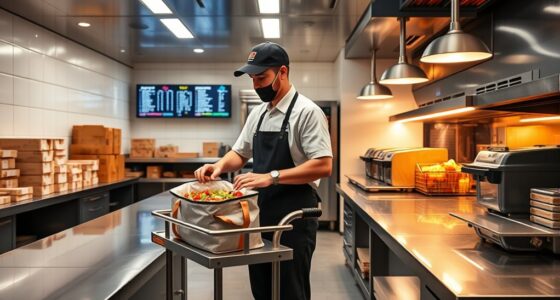

When choosing between station and assembly line layouts, consider how each design impacts your workflow. Station layouts divide tasks into dedicated zones, making it easy for staff to work efficiently within specific areas, reducing movement and confusion. Assembly lines emphasize a linear flow, ideal for high-volume, quick-service environments. Both layouts aim to streamline operations, but understanding their characteristics helps you optimize your kitchen for better productivity. Keep exploring to discover which setup best suits your needs.
Key Takeaways
- Station layouts divide the kitchen into dedicated task zones, optimizing workflow for specific functions.
- Assembly line layouts follow a linear, step-by-step process focusing on high-volume, rapid service.
- Stations facilitate multitasking and team collaboration within specialized areas, reducing congestion.
- Assembly lines emphasize sequential movement from prep to plating, minimizing backtracking.
- Choice depends on kitchen size, volume, and efficiency goals, balancing task specialization and speed.
Are you wondering how to organize your kitchen for maximum efficiency? When it comes to choosing between a station layout and an assembly line, understanding how equipment placement impacts workflow efficiency is essential. A well-designed kitchen layout isn’t just about aesthetics; it’s about streamlining your operations so you can serve faster and with less hassle. The key lies in positioning equipment thoughtfully, ensuring each station flows smoothly into the next without unnecessary movement or confusion.
Efficient kitchen design depends on strategic equipment placement for smooth workflow and seamless station transitions.
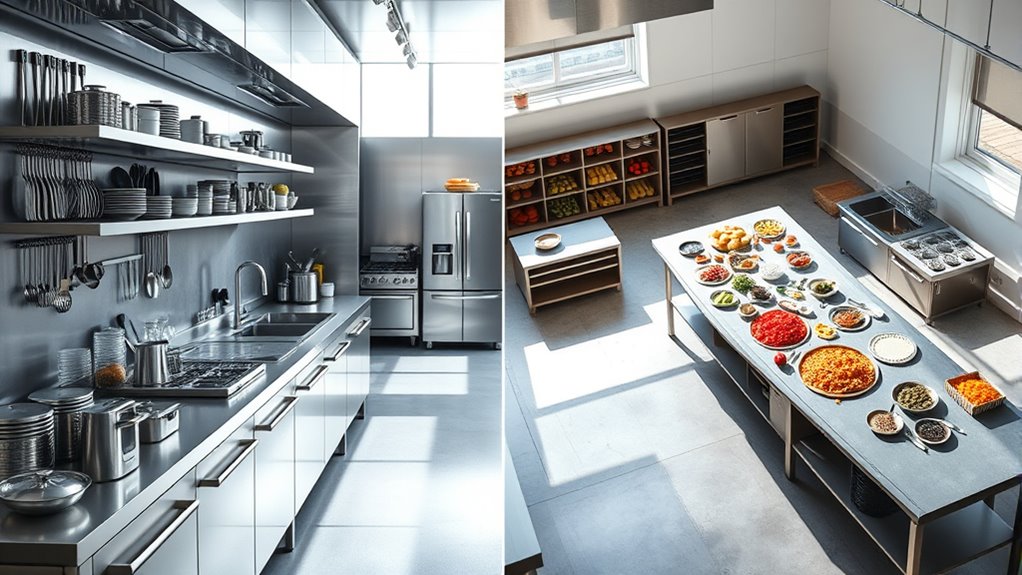
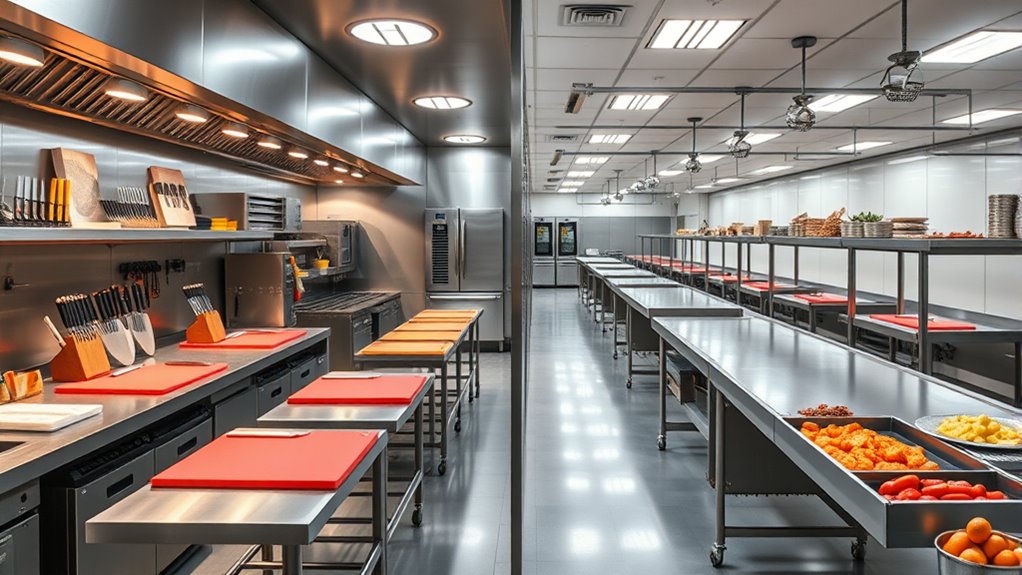
In a station layout, you divide your kitchen into dedicated areas, each equipped for specific tasks like prepping, cooking, or plating. You’re responsible for placing equipment within each zone logically. For example, your cutting boards, knives, and prep tools should be close together to minimize movement during prep work. Similarly, placing your stove, oven, and sauté station near the prep area reduces the need to carry ingredients across the kitchen. The goal is to create a logical flow within each station, which improves workflow efficiency by reducing clutter and unnecessary steps. This setup allows multiple team members to work simultaneously without crowding each other, making it easier to manage large orders or busy service times.
On the other hand, an assembly line layout emphasizes a linear flow, where ingredients move from one station to the next in a sequence. Here, equipment placement becomes even more critical. You want to position stations in a way that minimizes backtracking and bottlenecks. For example, placing the prep station at the start, followed by cooking, then plating and finishing touches, creates a natural progression. Each station should have everything needed within arm’s reach, so staff can work efficiently without constantly moving around. This layout is particularly effective for high-volume kitchens, where speed and consistency are priorities. Proper equipment placement along the line ensures that each step flows seamlessly into the next, maintaining a steady rhythm and reducing the time it takes to complete orders.
Ultimately, whether you prefer a station or assembly line layout, your success depends on how well you optimize equipment placement to support workflow efficiency. Thoughtful arrangement of tools, appliances, and workspaces minimizes wasted movement, prevents congestion, and helps your team work more cohesively. When you consider how each piece of equipment interacts with others and plan your layout accordingly, you create a kitchen environment that’s not only more productive but also more comfortable for your staff. The right setup makes a significant difference, allowing you to deliver quality dishes quickly and with less stress.
Frequently Asked Questions
How Do I Choose the Best Layout for My Kitchen Size?
You should choose a layout that maximizes storage optimization and streamlines equipment placement based on your kitchen size. For small spaces, an assembly line or compact station setup works best to save room and improve efficiency. If you have a larger kitchen, consider dedicated stations to reduce traffic and improve workflow. Assess your menu, staff, and available space to find a layout that enhances productivity while ensuring easy access to essential equipment and storage.
What Are Common Challenges With Station Layouts?
Think of your kitchen as a symphony, where harmony depends on precise instrument placement. Common challenges with station layouts include inefficient workflow, awkward equipment placement, and bottlenecks during busy hours. These issues can slow prep, increase errors, and frustrate staff. To avoid this, focus on optimizing workflow and strategic equipment placement. Regularly review and modify your layout to guarantee smooth operation, just like fine-tuning an orchestra for flawless performance.
Can a Hybrid Layout Improve Kitchen Efficiency?
Yes, a hybrid layout can improve your kitchen efficiency by enhancing workflow optimization and equipment placement. By combining elements of station and assembly layouts, you can streamline tasks and reduce unnecessary movement. This flexible setup allows you to customize your space based on your menu and staff, making processes more seamless. Ultimately, a hybrid layout helps your team work faster, minimize congestion, and deliver better service.
How Does Layout Affect Staff Communication?
You’ll notice that a well-designed layout boosts staff communication markedly—studies show teams in optimized kitchens communicate 30% faster. A clear layout enhances team coordination by positioning equipment accessibility within easy reach, reducing delays and misunderstandings. When everyone knows where to find tools and how the space flows, communication becomes more natural, and your kitchen runs smoothly. Prioritizing layout design helps your team stay synchronized and efficient under pressure.
What Safety Considerations Are Unique to Each Layout?
In station layouts, you face higher cross contamination risks because stations often handle raw and cooked items separately, so maintaining strict hygiene is essential. Assembly lines, however, require ergonomic safety measures to prevent repetitive strain, as staff work continuously along the line. Both layouts demand attention to safety, but station layouts focus on contamination prevention, while assembly lines prioritize ergonomics to keep staff safe and efficient.
Conclusion
Choosing between station and assembly line layouts isn’t just a decision; it’s a game-changer that can make or break your kitchen’s efficiency. Imagine a kitchen where everything runs smoother than a well-oiled machine, where chaos turns into harmony in seconds, and productivity skyrockets like a rocket reaching the stars. Whether you go for stations or an assembly line, the right layout will transform your kitchen into a powerhouse of speed, precision, and perfection—ready to conquer any culinary challenge.