
To calculate safety stock for perishables, you need to take into account demand variability, supply lead times, and product shelf life. Analyze past sales data to identify demand fluctuations and seasonal patterns. Adjust safety stock levels based on supplier reliability and potential delays. Remember, perishables require a balance between inventory and freshness, so regularly review and update your safety stock to prevent waste and stockouts. Staying informed about these factors helps you manage time-sensitive stock effectively.
Key Takeaways
- Analyze demand variability and seasonal patterns to determine appropriate safety stock levels for perishables.
- Incorporate shelf life, supply lead times, and supplier reliability into safety stock calculations.
- Use historical sales and spoilage data to adjust safety stock for perishable inventory.
- Apply demand forecasting and real-time analytics to proactively manage safety stock.
- Regularly review and revise safety stock considering changes in demand, supply disruptions, and product freshness.
Understanding the Importance of Safety Stock for Perishables

Perishables are highly time-sensitive products that require careful inventory management. Without proper safety stock, you risk running out of stock before new supplies arrive, leading to spoiled goods and lost sales. Safety stock acts as a buffer, helping you maintain product availability despite demand fluctuations or supply delays. It’s especially vital for perishables because their short shelf life means you can’t afford excess inventory or shortages. By holding an appropriate safety stock, you guarantee customer satisfaction and reduce waste. Knowing how much safety stock to keep depends on understanding your demand variability and lead times. Additionally, electric bikes can be used to optimize delivery routes for perishable goods, ensuring quicker restocking and fresher products. Ultimately, safety stock helps you balance the risk of stockouts with the costs of holding extra inventory, keeping your perishable inventory fresh and profitable.
Factors Influencing Safety Stock Levels in Perishable Inventory

Several key factors directly influence how much safety stock you should hold for perishables. First, the shelf life of your products determines how quickly stock must be used or sold before it expires. Longer shelf lives allow for lower safety stock needs, while shorter ones require more. Second, supplier lead times impact your inventory planning; unpredictable or long lead times mean you need extra safety stock to cover delays. Third, your sales volatility plays a role—if demand fluctuates greatly, holding more safety stock helps prevent stockouts. Fourth, storage conditions and product perishability rates influence safety levels; fragile or highly perishable goods demand tighter inventory control. Additionally, understanding the performance of your projection methods can help you more accurately estimate future demand and avoid excess or insufficient safety stock. By understanding these factors, you can optimize safety stock levels to balance freshness, costs, and customer satisfaction.
Calculating Demand Variability for Perishable Goods

Understanding demand fluctuations is essential for accurate safety stock calculations. You need to analyze how demand varies over time and identify patterns that impact inventory levels. By estimating the key factors driving demand variability, you can better prepare for unexpected changes in customer needs. Incorporating real-time analytics can further enhance your ability to respond to sudden demand shifts effectively.
Analyzing Demand Fluctuations
Analyzing demand fluctuations is essential for accurately calculating safety stock for perishable goods, as it helps you anticipate variability and avoid shortages. By examining past sales data, you can identify patterns and irregularities that impact inventory needs. This process involves measuring fluctuations over different periods to understand demand consistency. Recognizing these variations allows you to adjust safety stock levels appropriately, ensuring freshness and minimizing waste. Here’s a simple way to visualize demand patterns:
| Demand Pattern | Impact on Safety Stock |
|---|---|
| Steady Demand | Lower safety stock |
| Seasonal Peaks | Higher safety stock |
| Sudden Spikes | Need for quick response |
| Drops in Demand | Reduce safety stock |
| Irregular Fluctuations | Increase buffer |
This analysis sharpens your inventory strategy, making your safety stock more reliable. Additionally, understanding demand variability can help optimize inventory levels and reduce spoilage.
Estimating Variability Factors
Estimating demand variability is a crucial step in setting accurate safety stock levels for perishable goods. To do this, you need to analyze historical sales data, focusing on fluctuations over time. Calculate the standard deviation of demand during your chosen period, which measures how much demand varies day-to-day. Remember, demand for perishables can be influenced by seasonality, promotions, or trends, so adjust for these factors if necessary. Use demand data at a consistent time interval, such as daily or weekly, to guarantee accuracy. Additionally, consider external factors such as air quality impacts that may affect demand patterns for certain perishable items. By quantifying demand variability, you can better determine the safety stock needed to prevent stockouts without overstocking, ultimately reducing waste and maintaining product freshness. Accurate variability estimates lead to more reliable inventory management for perishables.
Assessing Lead Time and Supply Chain Reliability

Evaluating lead time and supply chain reliability is crucial for determining accurate safety stock levels for perishables. If lead times fluctuate or your supply chain faces uncertainties, your stock levels must adapt to prevent shortages. To assess this effectively: 1. Track average lead times and identify variations over time. 2. Analyze supplier delivery consistency and history. 3. Measure delays caused by transportation, customs, or supplier issues. 4. Incorporate historical data to understand patterns and risks. Paying attention to supply chain vulnerabilities can help anticipate potential disruptions and adjust safety stock accordingly.
Determining Shelf Life and Its Impact on Safety Stock

Understanding shelf life variability is essential because it directly affects how much safety stock you need. When shelf life fluctuates, you must adjust your stock levels to prevent shortages or waste. By accurately determining shelf life, you can optimize safety stock and improve inventory management. Incorporating limits and constraints into your planning can further enhance your ability to manage perishables effectively.
Shelf Life Variability
Since shelf life can vary substantially among perishable items, accounting for this variability is essential when calculating safety stock levels. Understanding how different factors influence shelf life helps prevent stockouts or waste. Proper installation and venting are crucial for maintaining safety and efficiency in storage environments.
Stock Level Adjustment
Adjusting stock levels effectively requires accurately determining the shelf life of your perishable items. Knowing the precise expiration date helps you set appropriate safety stock levels, reducing waste and stockouts. Consider factors like storage conditions, product variability, and historical data to estimate shelf life precisely. If items tend to expire sooner than expected, increase safety stock to accommodate this risk. Conversely, if shelf life is longer, you can lower safety stock, reducing holding costs. Regularly review and update these estimates based on actual product performance and spoilage rates. Monitoring product deterioration over time can help refine your estimates and improve accuracy. This proactive approach ensures your inventory remains fresh and balanced, minimizing losses while maintaining customer satisfaction. Proper shelf life assessment directly impacts your safety stock calculations, making your inventory management more efficient and responsive.
Standard Methods for Safety Stock Calculation
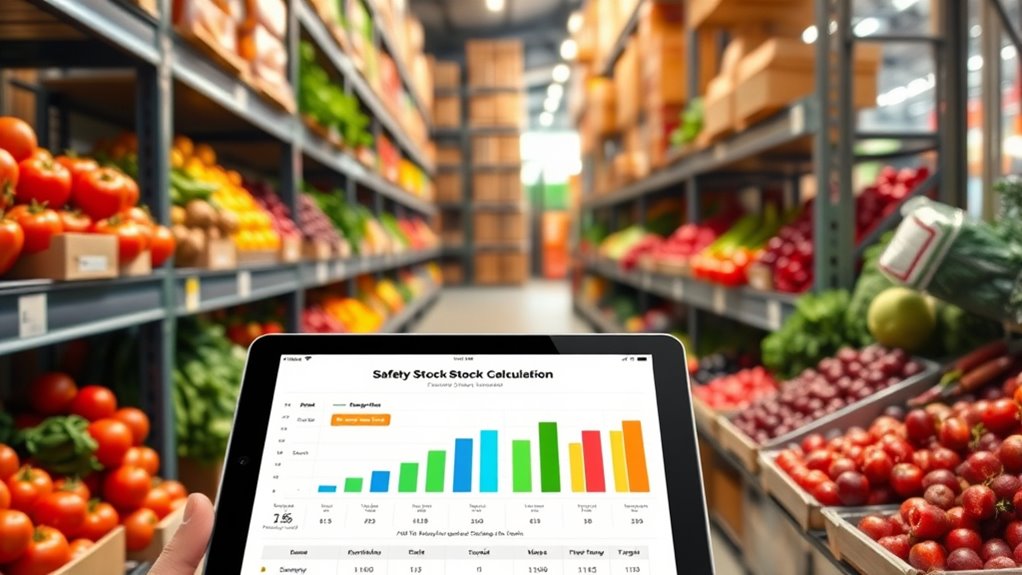
Standard methods for calculating safety stock provide a structured way to maintain inventory levels that can absorb demand variability and lead time uncertainties. These approaches help you avoid stockouts and manage perishables effectively. Incorporating seasonal variations into your safety stock calculations can further improve inventory management during fluctuating demand periods.
Adjusting Safety Stock for Seasonal Fluctuations and Trends
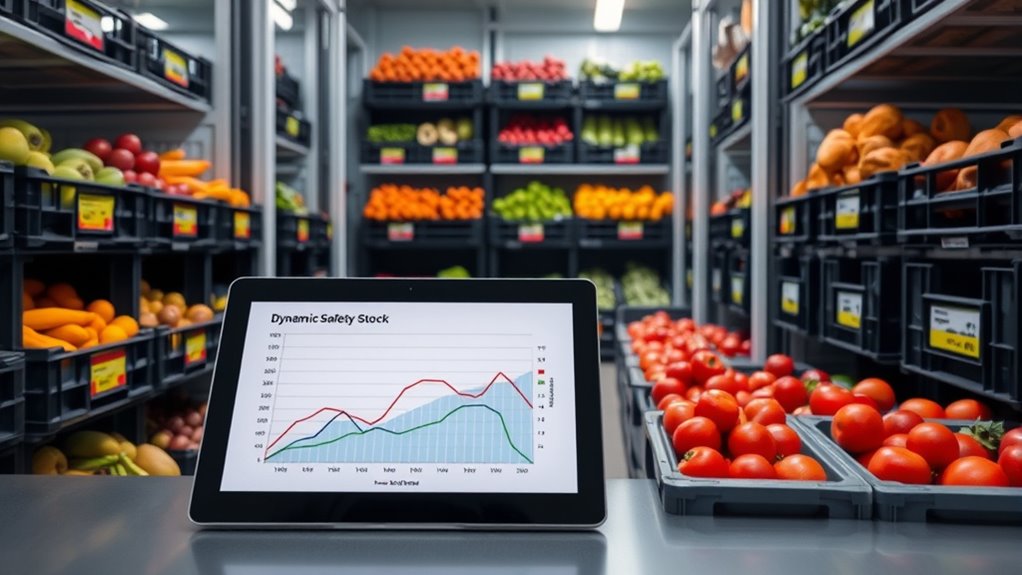
To keep your safety stock accurate, you need to account for seasonal changes and trends that affect demand. Tracking these fluctuations helps you adjust your safety stock levels proactively. By incorporating seasonal variability and trend data, you can prevent stockouts and reduce excess inventory.
Incorporating Seasonal Variability
Seasonal fluctuations and evolving trends can substantially impact demand for perishable goods, making it essential to account for these variations when calculating safety stock. To incorporate seasonal variability effectively, you should:
- Analyze historical sales data to identify recurring seasonal patterns.
- Adjust safety stock levels during peak and off-peak periods accordingly.
- Use seasonal indices to quantify demand fluctuations.
- Regularly update these indices to reflect recent trends and guarantee accuracy.
Tracking Trend Changes
Tracking trend changes is essential for maintaining accurate safety stock levels amid shifting demand patterns. When you identify upward or downward trends, you can adjust your safety stock accordingly to prevent stockouts or excess inventory. Use tools like moving averages or regression analysis to spot persistent increases or decreases in demand over time. Recognize that sudden spikes may be seasonal, but sustained changes indicate a true trend. Incorporate these insights into your safety stock calculations to reflect current market conditions. Regularly reviewing sales data helps you stay ahead of demand shifts. By proactively tracking and responding to trend changes, you ensure your inventory levels remain balanced, reducing waste and improving service levels for perishables.
Implementing Technology for Accurate Safety Stock Management

Implementing technology is essential for achieving accurate safety stock management, especially for perishables where timing and freshness are critical. Proper tools help you track demand fluctuations, optimize inventory levels, and reduce waste. To do this effectively, consider these four key points:
- Use inventory management software with real-time updates to monitor stock levels continuously.
- Integrate demand forecasting tools that analyze historical data and predict future needs.
- Automate reorder processes to prevent stockouts and overstocking.
- Utilize sensors and IoT devices for precise tracking of perishables’ freshness and expiration dates.
Monitoring and Revising Safety Stock Levels Over Time

Monitoring and revising safety stock levels over time is crucial to maintaining ideal inventory for perishables. You need to regularly review sales data, spoilage rates, and supply chain disruptions to identify any shifts in demand or supply. Track how often stockouts or overstock situations occur, and analyze the reasons behind them. If demand increases, you might need to raise safety stock to prevent shortages; if it decreases, lowering stock helps reduce waste and costs. Keep an eye on lead times, supplier reliability, and inventory turnover rates. Regular adjustments ensure your safety stock remains aligned with current conditions, minimizing waste and stockouts. By consistently monitoring and revising, you stay responsive to fluctuations, maintaining freshness and meeting customer expectations efficiently.
Best Practices for Balancing Freshness, Cost, and Customer Satisfaction
Balancing freshness, cost, and customer satisfaction requires a strategic approach that considers all aspects of inventory management. To achieve this, prioritize the following practices:
Effective inventory strategies balance freshness, costs, and customer satisfaction through data-driven, efficient practices.
- Implement Just-in-Time Ordering: Minimize waste by aligning deliveries closely with demand, ensuring products stay fresh.
- Set Realistic Safety Stock Levels: Use data-driven calculations to avoid overstocking or stockouts, maintaining quality without excess costs.
- Optimize Rotation Schedules: Rotate perishable items efficiently to prioritize older stock and reduce spoilage.
- Gather Customer Feedback: Understand preferences and adjust inventory accordingly to meet expectations without unnecessary surplus.
Frequently Asked Questions
How Does Spoilage Affect Safety Stock Calculations for Perishables?
Spoilage considerably impacts safety stock calculations because it reduces the actual usable inventory available. When you account for perishables, you need to increase safety stock levels to compensate for potential losses due to spoilage. This ensures you meet customer demand without running out of stock. By considering spoilage rates, you can better plan inventory, minimize waste, and maintain service levels, ultimately improving your supply chain efficiency.
What Role Does Demand Forecasting Accuracy Play in Safety Stock Levels?
Demand forecasting accuracy plays a vital role in determining safety stock levels. When your forecasts are precise, you can set safety stock more accurately, reducing excess inventory or stockouts. If your predictions are off, you risk holding too much or too little stock, which affects costs and customer satisfaction. By improving forecasting methods, you guarantee your safety stock is aligned with actual demand, optimizing inventory management effectively.
How Can Emergency Supply Disruptions Impact Safety Stock Strategies?
Emergency supply disruptions can severely impact your safety stock strategies by creating unexpected shortages, increasing the risk of stockouts, and forcing you to adjust inventory levels rapidly. You might find yourself scrambling to find alternative sources, increase safety stock unexpectedly, or accept potential spoilage. These disruptions highlight the importance of flexible planning, maintaining good supplier relationships, and regularly reviewing your safety stock levels to adapt quickly and minimize disruptions.
Are There Industry-Specific Safety Stock Standards for Perishables?
You ask if industry-specific safety stock standards exist for perishables. While no universal standards apply, you should tailor safety stock levels based on factors like product shelf life, demand variability, and supplier reliability. Perishable goods require more dynamic safety stock strategies to buffer against spoilage and supply disruptions. By analyzing your industry trends and adjusting inventory accordingly, you guarantee freshness, minimize waste, and meet customer demands effectively.
How Does Packaging Influence Shelf Life and Safety Stock Requirements?
You should consider how packaging impacts shelf life and safety stock needs. Effective packaging extends perishables’ freshness, reducing spoilage and decreasing the safety stock required to meet demand. Conversely, poor packaging shortens shelf life, increasing safety stock to prevent stockouts. By choosing appropriate packaging materials and methods, you can better manage inventory levels, minimize waste, and guarantee product safety, ultimately optimizing your supply chain efficiency.
Conclusion
Remember, managing safety stock for perishables isn’t just a numbers game—it’s about preserving freshness and satisfying your customers. By understanding demand fluctuations, lead times, and shelf life, you can strike the perfect balance. Think of safety stock as your secret ingredient; without it, your inventory could spoil your reputation. Stay vigilant, adapt, and leverage technology to keep your perishables fresh and your business thriving. After all, in this game, freshness is your greatest asset.