For most restaurants, my best overall pick is the ALORAIR 180 PPD Commercial Dehumidifier with Pump, which pairs high stated moisture-removal capacity with pumped drainage and a long warranty. The Waykar 155-Pint is a strong alternative for large spaces where a washable filter and pump matter, while the 305-Pint model is aimed at sites with unusually heavy moisture loads. The main tradeoffs are capacity versus power and space needs, plus pump convenience versus simpler gravity drainage. Restaurant conditions vary by kitchen heat, ventilation, operating hours, and room layout, so a basement coverage figure alone cannot determine the right fit. Continue reading for my full comparison and guidance on matching a unit to your restaurant.
Complete the kit


Key Takeaways
- The 180-PPD ALORAIR models stand out for balanced commercial capacity and pumped drainage; the listed 6-year warranty is a differentiator, but buyers should verify which warranty terms apply to the exact listing.
- Several entries cluster around 150–155 pints, so their distinctions are less about headline capacity and more about drainage setup, filters, stated coverage, and available documentation.
- The 260– and 305-pint models are the high-capacity choices for substantial moisture loads, but a restaurant should not pay for that capacity without checking electrical requirements, placement, noise, and room conditions.
- Pump and hose options can matter more than a large tank in a restaurant that needs ongoing operation and cannot rely on staff to empty condensate manually.
- The product names often emphasize basements or crawl spaces rather than food-service use; confirm sanitation, temperature range, operating noise, and manufacturer guidance before placing a unit near food-preparation or dining areas.
| 200 Pints Commercial Dehumidifier with Pump for Basements |  | Best for Maximum Moisture Removal | Moisture removal: Up to 200 pints per day | Listed floor area: 7,500 sq ft | Power: 1,200 W | VIEW ON AMAZON | See Our Full Breakdown |
| Waykar 155-Pint Commercial Dehumidifier with Pump and Washable Filter – Covers up to 8,000 sq ft |  | Best for Long-Reach Pump Drainage | Moisture removal: 155 pints per day | Listed floor area: 8,000 sq ft | Pump lift: 16.4 ft | VIEW ON AMAZON | See Our Full Breakdown |
| ALORAIR 180 PPD Commercial Dehumidifier with Pump, 6-Year Warranty |  | Best Compact Commercial-Style Pick | Capacity figures provided: 180 pints; separate dehumidification figure: 85 pints per day | Listed floor area: 2,300 sq ft | Airflow: 210 CFM | VIEW ON AMAZON | See Our Full Breakdown |
| Waykar 150 Pint Commercial Dehumidifier with Pump & Drain Hose for Basement |  | Best for Easier Restaurant Repositioning | Moisture removal: 150 pints per day | Listed floor area: 7,000 sq ft | Tank volume: 1.85 gallons | VIEW ON AMAZON | See Our Full Breakdown |
| Waykar 150 Pint 7000 Sq.Ft Dehumidifier for Basement with Drain Hose & Tank | 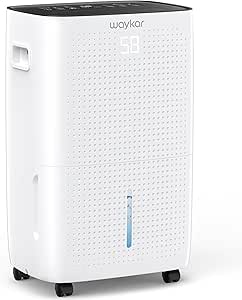 | Best for Simple, Flexible Drainage | Moisture removal: 150 pints per day | Listed floor area: 7,000 sq ft | Tank: 8 L (2.11 gal) | VIEW ON AMAZON | See Our Full Breakdown |
| 155 Pint Commercial Dehumidifier with Drain Hose for Crawl Spaces |  | Best for Crawl-Space-Adjacent Restaurant Areas | Capacity: 155 pints per day | Airflow: 265 CFM | Tank volume: 145 pints | VIEW ON AMAZON | See Our Full Breakdown |
| Kesnos 150 Pint Dehumidifier for Basement with Drain Hose, 7,500 Sq. Ft. |  | Best for Lower-Power Large-Area Control | Capacity: 150 pints | Coverage area: 7,500 sq ft | Wattage: 500 watts | VIEW ON AMAZON | See Our Full Breakdown |
| Alorair 180 PPD Commercial Dehumidifier with Pump, 6-Year Limited Warranty |  | Best for Automatic Drainage in a Fixed Service Area | Capacity: 180 pints per day | Coverage area: 2,300 sq ft | Airflow: 210 CFM | VIEW ON AMAZON | See Our Full Breakdown |
| TURBRO 165 Pint Commercial Dehumidifier with Pump, Drain Hose, Industrial Use for Large Spaces up to 7,500 sq. ft. |  | Best for Moving Between Large Back-of-House Areas | Capacity: 165 pints | Coverage area: 7,500 sq ft | Airflow: 276 CFM | VIEW ON AMAZON | See Our Full Breakdown |
| 305-Pint Commercial Dehumidifier with Pump, Auto Defrost |  | Best for Severe Moisture Loads | Capacity: 305 pints per day (130 PPD AHAM) | Airflow: 412 CFM | Coverage area: 8,500 sq ft | VIEW ON AMAZON | See Our Full Breakdown |
| 125 Pints Commercial Dehumidifier for Crawl Space & Basement |  | Best for Low-Clearance Restaurant Service Areas | Maximum daily extraction: 125 pints | AHAM capacity: 60 pints | Listed coverage: 6,000 sq ft | VIEW ON AMAZON | See Our Full Breakdown |
| Yaufey 155 Pints Commercial Dehumidifier with Pump for Basement and Large Rooms |  | Best for Pump-Assisted Drainage | Daily capacity: 155 pints | Maximum area: 8,000 sq ft | Airflow: 164.7 CFM | VIEW ON AMAZON | See Our Full Breakdown |
| 155 Pint Commercial Dehumidifier with Pump and Drain, Energy Star |  | Best Certified 155-Pint Option | Daily capacity: 155 pints | Airflow: 220 CFM | Power: 860 W | VIEW ON AMAZON | See Our Full Breakdown |
| 260 Pints Commercial Dehumidifier with Pump for Basements |  | Best for Very High Moisture Loads | Daily capacity: 260 pints | Listed floor area: 8,500 sq ft | Airflow: 442 CFM | VIEW ON AMAZON | See Our Full Breakdown |
| AEOCKY 8000 Sq Ft Commercial Dehumidifier – ENERGY STAR Most Efficient 2025 |  | Best for Quieter, Efficiency-Focused Operation | Coverage area: 8,000 sq ft | Capacity in hot conditions: 140 pints per day | Capacity in cooler basements: 95 pints per day | VIEW ON AMAZON | See Our Full Breakdown |
| commercial dehumidifier for restaurant | Airflow | Dimensions | Weight |
|---|---|---|---|
| 200 Pints Commercial Dehumidif | — | 14 × 16.6 × 29 in | 78 lb |
| Waykar 155-Pint Commercial Deh | 164.7 CFM | — | — |
| ALORAIR 180 PPD Commercial Deh | 210 CFM | 22.8 × 13.7 × 17.3 in | 64.3 lb |
| Waykar 150 Pint Commercial Deh | 212 CFM | — | — |
| Waykar 150 Pint 7000 Sq.Ft Deh | 90-degree automatic swing | — | — |
| 155 Pint Commercial Dehumidifi | 265 CFM | — | 63 pounds |
| Kesnos 150 Pint Dehumidifier f | 159 CFM | 11.73 x 15.47 x 24.57 inches | 38.1 pounds |
| Alorair 180 PPD Commercial Deh | 210 CFM | 22.8 x 13.7 x 17.3 inches | 64.3 pounds |
| TURBRO 165 Pint Commercial Deh | 276 CFM | 17 x 12.8 x 27.2 inches | — |
| 305-Pint Commercial Dehumidifi | 412 CFM | 19.49 x 16.14 x 32.68 inches | 106.4 pounds |
| 125 Pints Commercial Dehumidif | 265 CFM | 19.2 × 12.2 × 13.4 in | 50 lb |
| Yaufey 155 Pints Commercial De | 164.7 CFM | 18.11 × 15.75 × 26.37 in | 79.4 lb |
| 155 Pint Commercial Dehumidifi | 220 CFM | 14.2 × 24.3 × 15 in | 59 lb |
| 260 Pints Commercial Dehumidif | 442 CFM | 15.8 × 16.7 × 32.5 in | 95 lb |
| AEOCKY 8000 Sq Ft Commercial D | — | 17.68 × 11.14 × 24.09 in | 43.4 lb |
More Details on Our Top Picks
200 Pints Commercial Dehumidifier with Pump for Basements
For a restaurant with persistent dampness across a large back-of-house area, this model offers the roundup’s highest stated capacity among these five: up to 200 pints per day. That extra headroom may suit storage rooms or broad prep and dishwashing zones better than the 150-pint Waykar models, though actual performance depends on operating conditions. Its built-in pump can move collected water away automatically, while wheels and handles help with repositioning. The tradeoff is substantial: at 78 pounds and 1,200 watts, it is heavier and draws more power than the 155-pint Waykar, listed at 520 watts. I would rank it for capacity rather than day-to-day efficiency. Restaurants with modest dampness or limited electrical capacity should look at a lower-wattage option instead.
Pros:- Stated capacity of up to 200 pints per day suits demanding, large-area drying needs.
- Built-in pump supports automatic drainage without relying on a nearby floor drain.
- Large wheels and handles help with repositioning the heavy unit.
- Metal construction and overheat protection suit demanding operating environments.
Cons:- At 78 pounds, moving it between restaurant areas may take two people.
- Its 1,200-watt draw is substantially higher than the listed 520-watt Waykar 155-pint model.
- The large capacity can be excessive for a small dining room or isolated damp spot.
Best for: Restaurants with extensive damp storage or other large areas that need high moisture-removal capacity and automatic pumped drainage.
Not ideal for: Small cafés or restaurants with only a localized humidity problem, where its 1,200-watt draw and large capacity may be more than needed.
- Moisture removal:Up to 200 pints per day
- Listed floor area:7,500 sq ft
- Power:1,200 W
- Voltage:120 V
- Drainage:Built-in pump
- Dimensions:14 × 16.6 × 29 in
- Weight:78 lb
- Additional features:Adjustable humidity control, automatic defrost, overheat protection
Our verdict“Choose this for large restaurant spaces where maximum listed capacity matters more than low power draw or easy lifting.”
Waykar 155-Pint Commercial Dehumidifier with Pump and Washable Filter – Covers up to 8,000 sq ft
The Waykar’s clearest restaurant advantage is its 16.4-foot pump lift, which gives more flexibility when the nearest drain is well above or away from the unit. Its stated 155-pint daily capacity is below the 200-pint model, but the listed 520-watt draw is also much lower than that unit’s 1,200 watts. The washable filter adds a practical maintenance option in busy spaces where airborne kitchen dust can accumulate. Compared with the lighter, 38.6-pound Waykar 150 Pint Commercial Dehumidifier with Pump & Drain Hose, this model is roughly twice the weight, so its wheels matter more than easy lifting. I’d favor it when the drainage route drives the choice; restaurants needing adjustable airflow should note its single fan speed.
Pros:- 16.4-foot pump lift offers flexible placement where a drain is not nearby.
- 155-pint daily capacity is suited to large damp areas.
- Washable filter avoids routine filter replacement.
- Auto-defrost and overload protection add useful safeguards for ongoing operation.
Cons:- At 79.4 pounds, it is difficult to move without using its wheels.
- One fan speed gives less airflow control than models with two speeds.
- Its 520-watt draw is higher than the stated draw of some lower-capacity household-oriented options.
Best for: Restaurant operators who need a high-capacity unit and must pump condensate up to a distant or elevated drain.
Not ideal for: Teams that regularly carry equipment between floors or want multiple fan-speed settings to tailor airflow.
- Moisture removal:155 pints per day
- Listed floor area:8,000 sq ft
- Pump lift:16.4 ft
- Power:520 W
- Voltage:115 V
- Airflow:164.7 CFM
- Filter:Washable
- Dimensions and weight:13.58 × 16.14 × 26.18 in; 79.4 lb
Our verdict“Pick this Waykar when a long pump lift is more useful to your restaurant layout than lighter weight or variable fan speeds.”
ALORAIR 180 PPD Commercial Dehumidifier with Pump, 6-Year Warranty
The ALORAIR pairs a stated 180-pint capacity with a low, wide body that may fit beneath counters or into tight service areas more readily than the taller 200 Pints Commercial Dehumidifier. Its 210 CFM airflow and built-in pump suit restaurant back rooms where space and drainage access both affect placement. There is a data caveat: the product information gives a separate dehumidification figure of 85 pints per day, so buyers should verify which capacity applies to their intended conditions rather than assuming the higher number. Its 64.3-pound weight is still substantial, though lower than the 79.4-pound Waykar 155-pint unit. I’d shortlist it for constrained layouts, but not where clear capacity documentation or lightweight portability is the priority.
Pros:- Low, compact form factor can fit in spaces where taller units are awkward.
- Built-in pump supports automatic condensate removal.
- 210 CFM airflow is specified for moving air through the treated area.
- Auto-defrost and adjustable humidistat support managed operation.
Cons:- Product data lists both 180 pints and 85 pints per day as capacity figures, creating uncertainty about the applicable rating.
- At 64.3 pounds, it remains heavy to lift into or out of a service space.
- Its stated 640-watt draw is higher than the 520-watt Waykar models listed here.
Best for: Restaurants with tight utility or crawl-space-style service areas that need a pump-equipped commercial-format unit.
Not ideal for: Buyers who need an unambiguous rated capacity before sizing equipment or who must carry the dehumidifier frequently.
- Capacity figures provided:180 pints; separate dehumidification figure: 85 pints per day
- Listed floor area:2,300 sq ft
- Airflow:210 CFM
- Power and voltage:640 W; 115 V
- Drainage:Built-in pump
- Dimensions:22.8 × 13.7 × 17.3 in
- Weight:64.3 lb
- Controls and operation:Adjustable humidistat, auto-defrost, auto on/off, memory starting
Our verdict“Consider this ALORAIR for a cramped restaurant service area only after confirming which capacity rating applies to your conditions.”
Waykar 150 Pint Commercial Dehumidifier with Pump & Drain Hose for Basement
Among the high-capacity choices here, this Waykar stands out for weighing 38.6 pounds, well below the 79.4-pound Waykar 155-pint model and the 78-pound 200-pint unit. That difference can matter in restaurants that need to roll equipment between a damp storeroom and a prep-area perimeter. It lists 150 pints per day, two speeds, 212 CFM airflow, and pump and gravity-drain options, giving it a practical mix of capacity and setup flexibility. The tradeoff is that the description calls it quiet and offers several drainage modes, but does not provide a pump lift figure; the 155-pint Waykar is a clearer choice when drain height is the deciding factor. Multiple drainage choices may also take more setup than a simple hose arrangement.
Pros:- Listed 38.6-pound weight is much lower than the other commercial-style units in this group.
- 150-pint capacity and 7,000-square-foot coverage suit broad damp areas.
- Pump and gravity-drain options allow different installation approaches.
- Two speeds and 212 CFM airflow provide more airflow choice than the single-speed Waykar 155-pint model.
Cons:- Pump lift height is not specified, making elevated drainage planning less certain.
- Several drainage options may add setup decisions for staff.
- Its listed capacity is lower than the 180- and 200-pint options.
Best for: Restaurant staff who need a 150-pint-class unit that can be repositioned between rooms and connected to different drainage setups.
Not ideal for: Sites where the condensate must be pumped a known vertical distance, since no pump lift height is provided in the product data.
- Moisture removal:150 pints per day
- Listed floor area:7,000 sq ft
- Tank volume:1.85 gallons
- Power:520 W
- Airflow:212 CFM
- Fan speeds:2
- Dimensions and weight:10.48 × 14.89 × 24.22 in; 38.6 lb
- Operating modes:Auto, continuous
Our verdict“Choose this Waykar for a large restaurant area that needs substantial capacity with less lifting effort and flexible drainage.”
Waykar 150 Pint 7000 Sq.Ft Dehumidifier for Basement with Drain Hose & Tank
This Waykar makes the most sense for restaurant buyers who want a large-area rating but do not need a built-in pump. It offers 150 pints per day, an 8 L tank, and continuous gravity drainage through the included 3.3-foot hose. That setup is less flexible than the pump-equipped Waykar 150 Pint Commercial Dehumidifier with Pump & Drain Hose when the drain sits above the unit, but it avoids relying on a pump for routine discharge. A 30%–80% humidity range, two fan speeds, and 90-degree auto-swing airflow give staff useful control over operation and air direction. The main restaurant tradeoff is that continuous drainage requires the hose to reach a suitable lower drain; without that, someone must empty the tank.
Pros:- 150-pint daily capacity is specified for large areas.
- Adjustable humidity range from 30% to 80% RH offers broad control.
- 90-degree auto-swing airflow helps distribute air across a room.
- An 8 L tank and gravity-drain option provide two ways to manage water.
Cons:- Gravity drainage depends on a suitable nearby drain and hose routing.
- The included hose is only 3.3 feet long, which can limit placement.
- Without continuous drainage, staff need to empty the tank during operation.
Best for: Restaurants with a nearby floor drain or staff available to empty the tank, seeking adjustable humidity and broad-area drying.
Not ideal for: Kitchens or storage areas where the only drain is elevated or farther away than the included 3.3-foot hose can reach.
- Moisture removal:150 pints per day
- Listed floor area:7,000 sq ft
- Tank:8 L (2.11 gal)
- Humidity control:30%–80% RH
- Fan speeds:2
- Operating modes:Continuous, dry, fan
- Airflow:90-degree automatic swing
- Drainage and timer:Manual tank or 3.3 ft gravity-drain hose; 24-hour programmable timer
Our verdict“Choose this model when a restaurant has a low, nearby drain or can manage tank emptying and values adjustable humidity control.”
155 Pint Commercial Dehumidifier with Drain Hose for Crawl Spaces
For a restaurant with persistent dampness in a basement, storage room, or service area, this model pairs 155 pints per day of stated removal with a relatively compact form intended for tight spaces. Its auto drain and auto defrost reduce routine attention, while the five-year warranty is a useful support point for equipment expected to run regularly. Compared with the Kesnos 150 Pint, it lists 265 CFM airflow and a much larger 145-pint tank, but it is also substantially heavier at 63 pounds and draws 860 watts. That tank figure may suit a setup where a drain is not always available, though a restaurant should confirm how it connects and empties before relying on it for continuous operation. I would skip it for dining rooms or small back rooms: it is designed for demanding spaces, not discreet, light-duty moisture control.
Pros:- Stated 155-pint daily capacity suits substantial moisture loads.
- Auto drain and auto defrost can reduce routine monitoring.
- 265 CFM airflow is higher than the Kesnos 150 Pint’s stated 159 CFM.
- Five-year warranty provides a longer stated coverage period.
Cons:- At 63 pounds, it may take more than one person to position.
- The 860-watt draw is higher than the Kesnos model’s stated 500 watts.
- Its crawl-space and industrial orientation may be excessive for smaller restaurant areas.
Best for: Restaurant operators managing damp crawl spaces, basements, or large back-of-house areas who want high stated capacity and automatic drainage features.
Not ideal for: Small restaurants seeking a light, low-power unit for a dining room or occasional moisture; its 63-pound weight and 860-watt draw are a poor fit.
- Capacity:155 pints per day
- Airflow:265 CFM
- Tank volume:145 pints
- Coverage area:6,000 sq ft
- Wattage:860 watts
- Weight:63 pounds
- Material:Alloy steel
- Warranty:5 years
Our verdict“Choose this for a damp, large back-of-house area where airflow and automatic operation matter more than low weight or power draw.”
Kesnos 150 Pint Dehumidifier for Basement with Drain Hose, 7,500 Sq. Ft.
The Kesnos stands out for its stated 500-watt draw, lower than the 860 watts listed for the 155 Pint Commercial Dehumidifier, while still claiming 150 pints of daily moisture removal. That makes it worth a look for restaurants with a broad basement or storage zone where power use is a concern, provided the space and operating conditions suit its capacity claims. Its casters and 38.1-pound weight make repositioning easier than with the heavier Alorair 180 PPD, and adjustable humidity control plus a real-time display help staff monitor conditions. The tradeoff is a small 2.12-gallon tank, which can mean frequent emptying if continuous drainage is not set up. I would not pick it for quiet dining areas because the noise level is not specified and may be noticeable.
Pros:- Listed 500-watt draw is lower than the 155 Pint Commercial Dehumidifier’s 860 watts.
- 38.1-pound weight and casters make it easier to move than the 64.3-pound Alorair 180 PPD.
- Adjustable humidity control and a real-time display support routine monitoring.
- Continuous drainage is available as an alternative to using the tank.
Cons:- The 2.12-gallon tank can require frequent emptying in humid conditions.
- Noise level is not specified, so it may be a poor fit near guests or staff.
- Plastic construction may be less suited to rough handling than a metal-bodied unit.
Best for: Restaurant managers seeking a comparatively light, lower-wattage unit for a large basement or storage area with access to continuous drainage.
Not ideal for: Restaurants without a drain connection or staff available to empty a small tank during humid conditions, and operators needing a clearly documented quiet unit.
- Capacity:150 pints
- Coverage area:7,500 sq ft
- Wattage:500 watts
- Tank volume:2.12 gallons
- Airflow:159 CFM
- Speeds:2
- Dimensions:11.73 x 15.47 x 24.57 inches
- Weight:38.1 pounds
Our verdict“Pick the Kesnos for a large back-of-house zone where lower stated wattage and easier movement outweigh tank size and noise uncertainty.”
Alorair 180 PPD Commercial Dehumidifier with Pump, 6-Year Limited Warranty
The Alorair is a strong fit when a restaurant needs substantial moisture removal without relying on staff to empty a collection bucket. Its built-in pump supports automatic drainage, and auto defrost and restart features help it operate with less hands-on attention. Against the TURBRO 165 Pint, the Alorair lists a higher 180-pint daily capacity and a six-year limited warranty on the refrigeration system, while the TURBRO offers a longer 16.4-foot drain hose and large transport wheels. The Alorair’s listed coverage is only 2,300 square feet, so its capacity figure should not be read as a promise for every large restaurant footprint. At 64.3 pounds, it is also not an easy unit to move routinely. I’d favor it for a defined basement or utility area, not a guest-facing space where bulk and sound could be disruptive.
Pros:- Built-in pump supports automatic water removal.
- Stated capacity of 180 pints per day exceeds the TURBRO 165 Pint’s 165-pint claim.
- Auto defrost and restart reduce manual intervention.
- Six-year limited warranty covers the refrigeration system.
Cons:- At 64.3 pounds, moving it between restaurant areas may require assistance.
- Listed 2,300-square-foot coverage is lower than the TURBRO’s stated 7,500 square feet.
- Its 646-watt draw and commercial capacity may be unnecessary for a small, lightly damp room.
Best for: Restaurants with a fixed, damp basement or utility area that need pump-assisted drainage and higher stated removal capacity.
Not ideal for: Operators who need to move the unit often, cover a very large open floor, or place it close to guests; it weighs 64.3 pounds and lists 2,300-square-foot coverage.
- Capacity:180 pints per day
- Coverage area:2,300 sq ft
- Airflow:210 CFM
- Wattage:646 watts
- Voltage:115 V
- Dimensions:22.8 x 13.7 x 17.3 inches
- Weight:64.3 pounds
- Warranty:6 years on refrigeration system parts
Our verdict“Choose the Alorair for a fixed service area where pump drainage and higher stated capacity matter more than easy relocation or wide listed coverage.”
TURBRO 165 Pint Commercial Dehumidifier with Pump, Drain Hose, Industrial Use for Large Spaces up to 7,500 sq. ft.
For a restaurant with several damp zones, the TURBRO’s mobility setup is its clearest advantage: 8-inch wheels, side handles, and a 16.4-foot pump hose make it easier to reposition and drain than the heavier, less transport-focused Alorair 180 PPD. Its stated 276 CFM airflow and 165-pint capacity are aimed at large spaces, including warehouses and flood-recovery settings, so it is better matched to a broad storage or service area than a small room. The compromise is less certainty around day-to-day use: noise is not specified, and the product data calls for regular filter and pump maintenance. A restaurant should also plan where the long drain hose can discharge safely. I’d skip it for guest-facing areas or sites that need a light appliance; its industrial build and size favor utility over discretion.
Pros:- Stated 165-pint capacity and 276 CFM airflow suit large back-of-house areas.
- Built-in pump and 16.4-foot hose simplify drainage placement.
- Eight-inch wheels and handles support movement between work areas.
- Continuous operation mode suits ongoing moisture control.
Cons:- Its bulk and weight may make movement difficult despite the wheels.
- Noise level is not specified, limiting confidence for use near guests.
- Filters and pump require regular maintenance.
Best for: Restaurant facilities teams that need to move one dehumidifier among large storage, basement, or service areas and can route its pump hose to a drain.
Not ideal for: Small dining rooms, noise-sensitive spaces, or operations without staff time for filter and pump upkeep.
- Capacity:165 pints
- Coverage area:7,500 sq ft
- Airflow:276 CFM
- Drain hose length:16.4 feet
- Built-in pump:Yes
- Dimensions:17 x 12.8 x 27.2 inches
- Wheels:8-inch diameter
- Operation mode:Continuous
Our verdict“Choose the TURBRO when a mobile, pump-draining unit needs to serve multiple large utility areas rather than a quiet guest space.”
305-Pint Commercial Dehumidifier with Pump, Auto Defrost
When a restaurant faces a severe moisture problem across a large basement, warehouse, or recovery area, the VP320 sits well above the rest of this group: its 305-pint daily rating and 412 CFM airflow exceed the TURBRO 165 Pint’s 165-pint and 276-CFM figures. Its built-in pump can lift water 16.4 feet, while auto defrost, restart after power loss, and humidity controls help support continuous operation. That capacity comes with real site requirements. At 106.4 pounds, it is difficult to handle without its casters, and the NEMA 5-20 plug calls for a 20-amp outlet. Its 1,700-watt draw is also the highest stated here. I would reserve it for a demanding, large-area job rather than routine humidity management in a small restaurant room.
Pros:- Highest stated capacity in this group at 305 pints per day.
- 412 CFM airflow and stated 8,500-square-foot coverage target large areas.
- Pump lift of 16.4 feet supports flexible continuous drainage.
- Auto defrost, humidity control, and power-loss restart support ongoing operation.
Cons:- At 106.4 pounds, it is difficult to move without the casters.
- Requires a 20-amp NEMA 5-20 outlet.
- The 1,700-watt draw and large dimensions may be excessive for routine small-room use.
Best for: Restaurant facilities operators handling major moisture loads in a large basement, warehouse, or water-recovery area with a dedicated 20-amp outlet.
Not ideal for: Small restaurants or sites with standard outlets, narrow access routes, or no need for very high moisture removal; its weight, footprint, and electrical requirement can complicate placement.
- Capacity:305 pints per day (130 PPD AHAM)
- Airflow:412 CFM
- Coverage area:8,500 sq ft
- Pump lift height:16.4 feet
- Wattage:1,700 watts
- Voltage and plug:120 V; NEMA 5-20, 20 A
- Dimensions:19.49 x 16.14 x 32.68 inches
- Weight:106.4 pounds
Our verdict“Pick the VP320 for unusually heavy moisture loads in a large restaurant facility that has the power supply and access space it requires.”
125 Pints Commercial Dehumidifier for Crawl Space & Basement
The Airecoler GT-X5 is a practical choice for a restaurant that needs to control dampness in a low-clearance basement, storage area, or crawl space rather than dry a huge open dining or production floor. Its compact 19.2 × 12.2 × 13.4-inch footprint is easier to fit into tight utility spaces than the taller Yaufey 155-pint model, while its stated maximum removal of 125 pints per day gives it more headroom than a small residential unit. The tradeoff is that the 125-pint figure is a maximum; the listed AHAM capacity is 60 pints, so I would not size it for a demanding restaurant solely from the larger number. Continuous drainage, auto-defrost, and outage restart support unattended use, but its 50-pound weight complicates positioning. The five-year split warranty is a useful differentiator, though this is not the strongest pick for a large, wet kitchen.
Pros:- Compact dimensions suit low-clearance and restricted utility spaces.
- Continuous operation supports ongoing moisture control with a drain hose.
- Auto-defrost and power-outage restart help with unattended operation.
- Five-year total warranty includes separate coverage for the unit and dehumidification system.
Cons:- The 125-pint maximum substantially exceeds its listed 60-pint AHAM capacity.
- At 50 pounds, it may be awkward to place or reposition in a tight space.
- Its capacity is less suited to a large, persistently humid restaurant than the 155-pint Yaufey or 260-pint Moiswell.
Best for: Restaurant operators targeting a damp, cramped basement or utility space who value a compact footprint and continuous drainage.
Not ideal for: Restaurants needing high, verified moisture removal across a large kitchen or dining area; its 60-pint AHAM figure is well below the 125-pint maximum.
- Maximum daily extraction:125 pints
- AHAM capacity:60 pints
- Listed coverage:6,000 sq ft
- Airflow:265 CFM
- Power:830 W
- Voltage:115 V
- Dimensions:19.2 × 12.2 × 13.4 in
- Weight:50 lb
- Warranty:5 years total: 2 years for unit, 3 years for dehumidification system
Our verdict“Choose the Airecoler GT-X5 for a compact, drain-connected restaurant utility space, not as the main moisture-control unit for a large wet kitchen.”
Yaufey 155 Pints Commercial Dehumidifier with Pump for Basement and Large Rooms
The Yaufey 155-pint makes sense where a restaurant cannot place a drain hose at floor level: its built-in condensate pump can move water away without relying on gravity drainage. That convenience sets it apart from the Airecoler GT-X5, which supplies a drain hose but no pump in the listed features. Yaufey also specifies 155 pints per day and coverage up to 8,000 square feet, giving it a stronger stated capacity than the Airecoler for larger back-of-house areas. Its 164.7 CFM airflow is lower than the Airecoler’s 265 CFM, however, and the listed 155-pint capacity should not be treated as a guaranteed result in every room condition. At 79.4 pounds, it is a substantial machine despite its wheels and handle. I’d favor it for a fixed, pump-drained basement or warehouse area, not frequent moves between restaurant rooms.
Pros:- Built-in condensate pump simplifies drainage where gravity flow is impractical.
- 155-pint stated daily capacity is suited to larger damp spaces.
- Automatic defrost and humidity control support ongoing operation.
- Wheels and a handle assist with moving it across a facility.
Cons:- At 79.4 pounds, it is heavy to lift or move over steps.
- Its 164.7 CFM airflow is lower than the Airecoler GT-X5’s listed 265 CFM.
- Large-space capacity may be excessive for a small restaurant or a single compact room.
Best for: Restaurant facilities teams managing a large basement or storage area where condensate must be pumped to a drain above the unit.
Not ideal for: Small restaurants or staff who need to carry the dehumidifier between rooms; it weighs 79.4 pounds and is designed for larger spaces.
- Daily capacity:155 pints
- Maximum area:8,000 sq ft
- Airflow:164.7 CFM
- Power:520 W
- Voltage:115 V
- Dimensions:18.11 × 15.75 × 26.37 in
- Weight:79.4 lb
- Drainage:Built-in condensate pump
Our verdict“Pick the Yaufey when pump-assisted drainage is the deciding need for a large restaurant service area and the unit can stay mostly in one place.”
155 Pint Commercial Dehumidifier with Pump and Drain, Energy Star
This 155-pint commercial model is a strong fit for restaurant operators who want pump drainage plus stated efficiency credentials, without stepping up to the much larger Moiswell 260-pint unit. Its Energy Star and TUV certifications, 220 CFM airflow, and built-in water pump make it a more balanced choice for a substantial basement, stockroom, or other damp service area. Compared with the Yaufey, it lists higher airflow and a lower weight of 59 pounds, though its 860-watt draw is higher than Yaufey’s stated 520 watts. The product data also gives a 6.56-foot hose and auto-defrost and auto-drain safety functions, which suit continuous operation near a suitable drain. The listed tank volume matches its daily capacity, so I would confirm the actual drainage setup rather than assume the unit is intended for manual tank emptying.
Pros:- Energy Star and TUV certifications are stated in the product data.
- Built-in pump and included 6.56-foot hose support flexible drainage.
- 220 CFM airflow is higher than the Yaufey 155-pint model’s listed 164.7 CFM.
- Auto-defrost and auto-drain functions are suited to continuous operation.
Cons:- Listed power draw of 860 watts is higher than the Yaufey’s 520 watts.
- At 59 pounds, it is still a heavy unit to reposition.
- Its 24.3-inch width can limit placement in a narrow restaurant utility area.
Best for: Restaurant operators seeking a certified 155-pint unit with a pump for a large basement, attic, or back-of-house area.
Not ideal for: Energy-conscious buyers prioritizing the lowest stated wattage, or kitchens with very limited installation space; it lists 860 watts and a broad 24.3-inch width.
- Daily capacity:155 pints
- Airflow:220 CFM
- Power:860 W
- Dimensions:14.2 × 24.3 × 15 in
- Weight:59 lb
- Tank volume:155 pints
- Drain hose length:6.56 ft
- Maximum operating temperature:95°F
- Certifications:Energy Star, TUV
Our verdict“Choose this model over the Yaufey when certification and stronger listed airflow matter more than the lower stated wattage.”
260 Pints Commercial Dehumidifier with Pump for Basements
For a restaurant dealing with persistent, heavy moisture across a large basement, production-adjacent space, or warehouse, the Moiswell 260-pint offers the highest stated daily capacity in this group. Its 442 CFM airflow and built-in pump, which can lift water up to 16.4 feet, target situations where both moisture removal and drain placement are demanding. That is a substantial step up from the 155-pint Yaufey and certified 155-pint model, but the extra capacity brings a 1,300-watt draw and a 95-pound body. Large wheels and detachable handles help with transport; they do not make it easy to carry through stairs or tight service corridors. I’d reserve it for a genuinely large or wet area with room for installation, rather than buying excess capacity for a modest dining room or pantry.
Pros:- Highest stated capacity in this batch at 260 pints per day.
- 442 CFM airflow suits larger areas with heavy moisture loads.
- Pump can lift condensate up to 16.4 feet for flexible drainage.
- Large wheels and detachable handles aid movement on level floors.
Cons:- Its 1,300-watt power draw is the highest listed in this batch.
- At 95 pounds, it is difficult to lift and may need help during placement.
- The 32.5-inch height and broad footprint can constrain installation.
Best for: Restaurant operators with a large, persistently damp basement or industrial back-of-house space and a drain located above the unit.
Not ideal for: Small restaurants, narrow utility rooms, or teams that must carry equipment between floors; it is 95 pounds and has a tall, bulky body.
- Daily capacity:260 pints
- Listed floor area:8,500 sq ft
- Airflow:442 CFM
- Power:1,300 W
- Dimensions:15.8 × 16.7 × 32.5 in
- Weight:95 lb
- Pump lift:Up to 16.4 ft
- Dehumidification capacity:27 gallons per day
Our verdict“Select the Moiswell when a large restaurant facility needs far more capacity than the 155-pint alternatives and can accommodate its power and size.”
AEOCKY 8000 Sq Ft Commercial Dehumidifier – ENERGY STAR Most Efficient 2025
The AEOCKY RHEA-003 is the quieter, lighter alternative for restaurant spaces where staff work nearby and the largest possible extraction rate is not the only priority. Its minimum stated noise level of 50 dB and 43.4-pound weight compare favorably with the 79.4-pound Yaufey and 95-pound Moiswell, making placement and day-to-day repositioning less burdensome. Capacity varies by conditions: the listing gives 140 pints per day in hot, humid conditions and 95 pints in cooler basements. That makes it a less direct choice for extreme moisture loads than the Moiswell’s 260-pint claim, but more compelling for a restaurant seeking quieter operation and stated ENERGY STAR Most Efficient 2025 recognition. The product data does not list a built-in pump, so I would confirm drainage needs before choosing it for a site without a floor drain.
Pros:- Minimum stated noise level of 50 dB is suited to spaces near staff.
- At 43.4 pounds, it is lighter than the other large-capacity models in this batch.
- ENERGY STAR Most Efficient 2025 recognition is stated in the product data.
- Listed capacity reaches 140 pints per day in hot, humid conditions.
Cons:- Capacity is listed as 95 pints per day in cooler basements, below its hot-condition figure.
- No built-in pump is specified, which may limit drainage options.
- Its stated capacity is well below the Moiswell’s 260-pint maximum for very wet spaces.
Best for: Restaurant operators who need moisture control near staff areas and value lower stated noise, easier handling, and efficiency credentials.
Not ideal for: Facilities with severe moisture loads or drainage points that require pumped water removal; its listed capacity is condition-dependent and no built-in pump is specified.
- Coverage area:8,000 sq ft
- Capacity in hot conditions:140 pints per day
- Capacity in cooler basements:95 pints per day
- Noise level:As low as 50 dB
- Weight:43.4 lb
- Dimensions:17.68 × 11.14 × 24.09 in
- Low-temperature performance:Listed to operate down to 65°F
- Certification:ENERGY STAR Most Efficient 2025
Our verdict“Choose the AEOCKY for a staff-adjacent restaurant area where quieter operation and easier handling matter more than maximum extraction or pump drainage.”

How We Picked
I ranked these options around restaurant-relevant needs rather than treating listed square-foot coverage as a guarantee. My criteria include stated pint capacity, drainage method, practical maintenance features, suitability for prolonged operation, warranty information, and how clearly the product details support commercial use. I also looked for tradeoffs a restaurant operator would feel: whether a pump can move condensate to a drain, whether a washable filter may simplify upkeep, and whether a larger unit is likely to demand more room or operating resources.
The ALORAIR 180-PPD options lead because they combine substantial stated capacity, a pump, and a listed 6-year warranty. I place the Waykar 155-pint and comparable mid-capacity units next, since they may fit a wider range of restaurant areas without jumping to the largest capacities. The 260- and 305-pint models rank for high-load situations rather than as default choices, while the 125-pint unit and products with less restaurant-specific information are better treated as targeted or lower-confidence picks. Near-duplicate listings are kept separate because their stated features and warranty wording differ; buyers should verify the exact model and terms before ordering.
Factors to Consider When Choosing Commercial Dehumidifier For Restaurant
Choosing a commercial dehumidifier for a restaurant starts with the moisture problem, not the biggest number on the label. The factors below help translate product specs into a workable choice for a kitchen, dining room, storage area, or other back-of-house space.
Match capacity to the moisture source and room conditions
Pint-per-day ratings give a useful comparison point, but they do not tell you exactly how a unit will perform in every restaurant. Heat, humidity, ventilation, open doors, dishwashing, cooking, and the size of the affected area all change the workload. A 150- to 180-pint model may be a more sensible starting point for a defined damp area than a 260- or 305-pint unit. For recurring moisture across multiple zones, have an HVAC professional assess airflow and the source before buying a larger machine. Oversizing can add operating burden without fixing a ventilation or plumbing problem.
Plan the condensate route before choosing a pump
Continuous drainage reduces staff involvement, but the right setup depends on where the water can go. A gravity hose needs a drain below the outlet and a route that will not cross a walkway or create a trip hazard. A built-in pump can send water upward or to a more distant drain, though its lift limit and hose arrangement must suit the site. Check whether the included hose reaches the drain and whether the discharge point can handle continuous flow. A tank-only arrangement may work for occasional use, but it creates an emptying task that is easy to miss during busy service.
Treat restaurant placement as a sanitation and safety decision
Many products in this roundup are described for basements or crawl spaces, which does not automatically establish suitability beside food preparation. Keep the unit and its airflow away from exposed food, clean equipment, and areas where condensation or dust could create a hygiene issue. Ask the manufacturer about filter access, cleaning procedures, materials, and approved operating conditions. Check local health and building requirements before adding equipment in a kitchen or other regulated area. A separate utility or storage location may be a better fit if it can still control humidity in the target zone.
Check power, heat, noise, and clearance requirements
Higher-capacity equipment may need more floor space and can affect the room through fan noise and heat output. Those effects may be acceptable in a back-of-house area but disruptive in a dining room or quiet service space. Confirm the voltage and circuit requirements with the product documentation and a qualified electrician rather than assuming the unit can share an existing circuit. Leave the manufacturer’s recommended clearance around air intake and exhaust. If the unit must run during service, ask for noise and operating-condition details before choosing a large model.
Compare maintenance demands, not just included features
Filters, coils, drains, and pump lines need routine attention in a commercial environment. A washable filter can reduce replacement errands, but it still needs a cleaning schedule and proper drying before reinstalling. Make sure staff can reach the filter and drain connections without moving heavy equipment or interrupting service. Ask how the unit signals a full tank, clogged drain, or fault, and assign responsibility for checks. A model that is easy to maintain can be a better fit than a higher-capacity unit that is difficult to access.
Buy for the site’s documented need and service support
Before choosing the largest unit, record humidity readings over several operating days and note when and where moisture is highest. This can help distinguish a localized problem from a whole-building issue that calls for HVAC changes. Compare warranty length and coverage details, including whether commercial use, labor, shipping, and pump components are covered. Product titles can repeat similar capacities while describing different hoses, pumps, or warranty terms, so match the listing to the exact model number. Paying more for capacity or a longer warranty makes sense only when the site can use those advantages and the terms are clear.
Frequently Asked Questions
Is a basement-rated dehumidifier suitable for a restaurant kitchen?
Not automatically. A basement or crawl-space designation does not confirm that a unit is appropriate near food preparation, exposed ingredients, or washdown areas. Review the manufacturer’s operating and cleaning guidance, then check local health and electrical requirements for the proposed location. You may find a utility room or storage area is a better placement if air can circulate between that space and the damp zone. Address any ventilation, leak, or exhaust problem as well, since a dehumidifier cannot replace those systems.
Should I choose a 150-pint, 180-pint, or larger unit for my restaurant?
Choose based on measured humidity, moisture sources, room conditions, and the intended area rather than square footage alone. The 150- to 155-pint options in this roundup suit buyers comparing mid-capacity equipment, while the 180-PPD ALORAIR models add stated capacity and a listed 6-year warranty. The 260- and 305-pint models are aimed at heavier loads, but their larger ratings do not make them the right default for every site. If humidity affects several rooms or returns quickly after treatment, ask an HVAC professional to review the building before stepping up in capacity.
Do I need a built-in pump, or is a drain hose enough?
A hose can be sufficient when you have a nearby floor drain below the unit’s outlet and can route the hose safely. A pump is useful when condensate must travel upward or to a drain that sits farther away, and it can reduce the need for staff to empty a tank. Check the pump’s lift capability and the included hose length against the actual site layout. Any hose route should avoid food-contact areas, electrical hazards, and busy walkways. If the route cannot be made reliable, a professional drain solution may be safer than relying on a tank.
Can I run a commercial dehumidifier during restaurant service?
That depends on its placement, noise, heat output, power needs, and effect on airflow. A unit in a back-of-house utility area may be less disruptive than one beside diners or food preparation. Check the manufacturer’s operating guidance and electrical requirements, and keep the intake and exhaust clear. Consider whether the unit could interfere with HVAC balance or move dust toward clean areas. If it must operate near customers or staff for long periods, confirm noise and heat details before purchase.
When should I pay more for a high-capacity model or longer warranty?
A higher-capacity model makes sense when monitoring or a professional assessment points to a sustained, heavy moisture load that a mid-capacity unit cannot address. A longer warranty can add value when its terms clearly cover the parts likely to matter in commercial operation, but the headline duration is not the whole policy. Check exclusions for business use, labor, shipping, and pump components, and confirm who handles service. If the issue comes from a leak, poor exhaust, or inadequate HVAC, spending more on dehumidification alone may not solve it. For a defined smaller area, a mid-capacity unit with practical drainage and accessible maintenance may be the better fit.
Conclusion
Best overall: I’d start with the ALORAIR 180 PPD Commercial Dehumidifier with Pump for its combination of stated capacity, pumped drainage, and listed 6-year warranty. Best value: the Waykar 155-Pint is a strong fit for buyers who want a mid-capacity option with a pump and washable filter, subject to checking the exact listing. Best premium or high-load choice: consider the 305-Pint model only when the site has a documented need for very high moisture removal and the power and placement requirements work. Best for beginners: a 150- to 155-pint model with straightforward hose drainage is easier to size for a defined area than jumping straight to an industrial-scale rating. Best for specific needs: choose a pump-equipped model when the drain sits above or away from the unit, and prioritize service terms and verified restaurant suitability for installations near food-service areas. Before ordering, confirm the exact model, drainage route, electrical requirements, and warranty coverage.