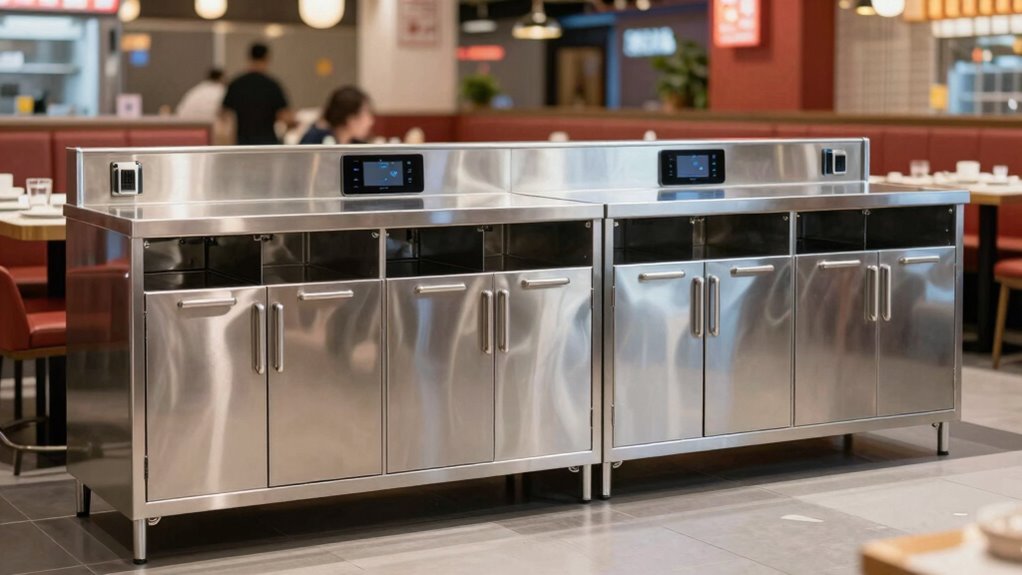

Choosing a commercial waiter station cabinet comes down to matching the storage layout and construction to the work your team actually does. I rank the 48-Inch Stainless Steel Waitress Workstation first for its foodservice-ready material, shelving, and stated load capacities. The Walnut Waitress Station is my pick for a more furniture-like dining room, while the 60-Inch Stainless Steel Bussing Station suits operations that need a long work surface and dedicated holders.

Get kitchen staples and gadgets delivered free with Prime
- Fast, free delivery on millions of items
- Prime Video, Amazon Music and more included
- Member-only deals all year
The tradeoffs are practical: stainless steel handles frequent wiping and heavier loads, but can feel oversized in a compact dining room; laminated wood brings a warmer appearance and enclosed storage, but is less suited to wet or hard-use areas. I also include the Displays2go cabinet for buyers who want a contained cabinet-and-drawer layout, and a metal condiment station for open, tiered service. I rank these by how clearly their supplied features support waiter-station work, while flagging gaps in the available specifications.
Complete the kit
Key Takeaways
- The 48-inch Type 304 stainless workstation is my strongest all-around fit for high-traffic service, with three shelves and stated capacities of 300 pounds on the top and bottom shelves.
- The walnut laminated-melamine station adds a self-closing drawer and adjustable storage while blending more naturally into dining rooms than the stainless options.
- The 60-inch bussing station offers the longest stated footprint and dedicated pan and menu holders, but its 15-inch depth should be checked against the tasks and space available.
- Displays2go provides a cabinet door, pull-out drawer, and five shelf-height settings, though its 96.5-pound weight makes repositioning harder.
- The 78.74-inch-wide metal condiment station has a tiered open-counter layout rather than a conventional enclosed waiter-station cabinet, so I would choose it for condiment service rather than general server storage.
| 48-Inch Stainless Steel Waitress Workstation with Shelving and Tray Slot |  | Best Overall for High-Traffic Service | Material: Type 304 stainless steel | Width: 48 inches | Shelves: 3 | VIEW ON AMAZON | See Our Full Breakdown |
| Walnut Waitress Station with Drawer, Brown Laminated Melamine, 36x24x36 Inches, Adjustable Shelf, Server Storage |  | Best for Dining-Room Style and Organized Storage | Dimensions: 35 15/16 in W x 23 11/16 in D x 36 3/16 in H | Material: Laminated melamine with PVC edging | Finish: Brown walnut | VIEW ON AMAZON | See Our Full Breakdown |
| Stainless Steel Bussing Station, 60 x 15 x 36 Inch, Server Waitress Station with Pan Holder, Menu Holder, Adjustable Shelf |  | Best for Long, Specialized Bussing Setups | Dimensions: 60 x 15 x 36 inches | Material: Stainless steel | Weight: 85 lbs | VIEW ON AMAZON | See Our Full Breakdown |
| Displays2go Serving Station for Restaurants, Black |  | Best Enclosed Cabinet Layout | Dimensions: 24.5 in D x 24 in W x 40 in H | Weight: 96.5 lbs | Material: Engineered wood with melamine coating | VIEW ON AMAZON | See Our Full Breakdown |
| Commercial Freestanding Condiment Station Cabinet, Perforated Metal Lattice |  | Best for Open Condiment Service | Dimensions: 78.74 x 15.75 x 39.37 inches | Weight: 35,000 g | Material: Metal | VIEW ON AMAZON | See Our Full Breakdown |
| commercial waiter station cabinet | Material | Dimensions | Weight |
|---|---|---|---|
| 48-Inch Stainless Steel Waitre | Type 304 stainless steel | — | — |
| Walnut Waitress Station with D | Laminated melamine with PVC edging | 35 15/16 in W x 23 11/16 in D x 36 3/16 in H | — |
| Stainless Steel Bussing Statio | Stainless steel | 60 x 15 x 36 inches | 85 lbs |
| Displays2go Serving Station fo | Engineered wood with melamine coating | 24.5 in D x 24 in W x 40 in H | 96.5 lbs |
| Commercial Freestanding Condim | Metal | 78.74 x 15.75 x 39.37 inches | 35,000 g |
More Details on Our Top Picks
48-Inch Stainless Steel Waitress Workstation with Shelving and Tray Slot
This is my top pick for a restaurant that needs a workhorse rather than a piece of dining-room furniture. The Type 304 stainless steel body is suited to repeated wiping and foodservice use, and the three-shelf layout gives staff separate places for dishes, trays, glassware, or flatware. Its stated capacity is 300 pounds on the top and bottom shelves and 200 pounds on the middle shelf, useful information for teams storing substantial service items.
Compared with the walnut station, this workstation puts cleanability and load support ahead of a warm, furniture-style finish. It also has a more clearly specified capacity than the 60-inch bussing model, though the latter names dedicated pan and menu holders. The tradeoff is its 48-inch width and substantial construction: it may be too much station for a small dining room, and the listing does not provide a full footprint or weight here. I would verify the complete dimensions and moving access before committing.
Pros:- Type 304 stainless steel is designed for demanding foodservice environments.
- Three shelves provide distinct storage levels for dishes, trays, glassware, and flatware.
- Stated capacities reach 300 pounds on the top and bottom shelves.
- Smooth stainless surfaces are straightforward to wipe clean.
Cons:- Heavy construction may make placement and later repositioning difficult.
- The stainless finish may look industrial in a furniture-led dining room.
- A 48-inch width may be excessive for smaller service areas.
Best for: Restaurants, hotels, bars, and banquet operations that need a durable stainless work area with three shelves and stated load limits.
Not ideal for: Small dining rooms, low-volume operations, or buyers who want enclosed cabinet storage and a warmer wood appearance.
- Material:Type 304 stainless steel
- Width:48 inches
- Shelves:3
- Top and bottom shelf capacity:300 lbs each
- Middle shelf capacity:200 lbs
- Intended use:Restaurants, hotels, bars, and banquet halls
Our verdict“I would choose this as the most capable general-purpose option when service volume and easy-clean construction matter more than a furniture-style look.”
Walnut Waitress Station with Drawer, Brown Laminated Melamine, 36x24x36 Inches, Adjustable Shelf, Server Storage
When a waiter station sits in view of guests, appearance can matter nearly as much as storage. This model pairs a brown walnut finish with a self-closing drawer and adjustable shelf, creating a more furniture-like alternative to the stainless workstations. It also lists a maximum capacity of 450 pounds, giving buyers a useful overall figure to compare against the lighter-duty impression some wood-look cabinets can create.
Its 36-inch height and roughly 36-by-24-inch footprint make it a more compact choice than the 48-inch workstation or 60-inch bussing station. The tradeoff is material: laminated melamine with PVC edging does not offer the same stainless surface as the foodservice-focused metal models, so I would be more careful around standing water and heavy abrasion. It requires assembly, and the available description is not fully clear about whether the “two adjustable shelves + bottom shelf” includes the bottom shelf in the count. I would confirm the internal layout before purchase.
Pros:- Walnut-look laminated finish suits dining rooms better than an industrial metal station.
- Self-closing drawer keeps smaller server items organized.
- Adjustable shelf positions let the storage accommodate different supplies.
- Listed maximum capacity is 450 pounds.
Cons:- Assembly is required.
- Laminated melamine is not the same as a stainless work surface for wet, heavy-duty use.
- Shelf count and internal arrangement should be confirmed before ordering.
Best for: Restaurants seeking a warmer, guest-facing station with a drawer, adaptable storage, and a smaller footprint than the long stainless models.
Not ideal for: Kitchens or high-splash service zones where an all-stainless surface is the priority, or teams needing dedicated tray and pan holders.
- Dimensions:35 15/16 in W x 23 11/16 in D x 36 3/16 in H
- Material:Laminated melamine with PVC edging
- Finish:Brown walnut
- Drawer:1 self-closing drawer
- Shelving:Two adjustable shelves plus bottom shelf, as listed
- Maximum capacity:450 lbs
- Assembly:Required
Our verdict“I would select this when guest-facing appearance and drawer organization matter more than an all-metal construction.”
Stainless Steel Bussing Station, 60 x 15 x 36 Inch, Server Waitress Station with Pan Holder, Menu Holder, Adjustable Shelf
This station stands out for its 60-inch length and named organizational features: a pan holder, menu holder, and adjustable shelf. Those additions make it more task-specific than the 48-inch stainless workstation, which is described around general shelf storage and a tray slot. The long top can help staff sort materials along one run, while the stainless surface supports routine wipe-downs.
The key limitation is the listed 15-inch depth. That narrow dimension may help it fit along a wall or service corridor, but it leaves less front-to-back work area than the Displays2go cabinet’s 24-inch depth or the walnut station’s roughly 24-inch depth. Its stated top and bottom capacities are 300 pounds, with 200 pounds for the middle shelf. At 85 pounds, it is heavy enough to plan for during installation, although lighter than the much heavier Displays2go cabinet. I would check whether its holders match the trays, pans, and menus your team uses.
Pros:- 60-inch length gives staff a long surface for organizing service tasks.
- Pan and menu holders add dedicated storage beyond standard shelving.
- Stainless construction resists scratches and water damage.
- Stated shelf capacities are 300 pounds on top and bottom and 200 pounds on the middle shelf.
Cons:- The 15-inch depth may limit usable staging space.
- At 85 pounds, it may require help to move into place.
- Silver stainless appearance offers little choice for matching warmer interiors.
Best for: Restaurants that need a long stainless station with dedicated places for pans and menus and have a suitable narrow wall-side run.
Not ideal for: Buyers needing a deep staging surface, enclosed cabinet storage, or a station that is easy to move frequently.
- Dimensions:60 x 15 x 36 inches
- Material:Stainless steel
- Weight:85 lbs
- Top and bottom shelf capacity:300 lbs each
- Middle shelf capacity:200 lbs
- Storage features:Pan holder, menu holder, adjustable shelf
- Color:Silver
Our verdict“I would pick this over the 48-inch workstation when length and dedicated pan or menu organization matter more than a deeper work surface.”
Displays2go Serving Station for Restaurants, Black
Unlike the open stainless stations, the Displays2go is built around a single cabinet door, pull-out drawer, and adjustable interior shelf. That arrangement is useful when staff need to keep supplies less visible while separating smaller items from bulkier stock. The shelf has five height settings, giving this cabinet more explicit adjustment flexibility than the walnut station’s listed adjustable shelving.
The 24-by-24.5-inch footprint is fairly compact, but the cabinet weighs 96.5 pounds, so it is not a casual repositioning choice. Its melamine-coated engineered wood offers a black, modern appearance rather than stainless steel’s utilitarian finish; I would favor it in a front-of-house area where concealed storage matters and exposure to spills is manageable. Compared with the walnut station, it has a clearly stated single adjustable shelf and one drawer, but fewer described storage levels. It also lacks the stainless models’ stated shelf load capacities, so heavy dish loads deserve caution.
Pros:- Cabinet door hides stored supplies from guest view.
- Pull-out drawer separates smaller service items.
- Interior shelf offers five height settings.
- Freestanding melamine-coated cabinet has a modern black finish.
Cons:- At 96.5 pounds, it can be difficult to move.
- Engineered wood is less suited than stainless steel to frequent wet cleanup.
- One door and one shelf provide less open storage than the multi-shelf metal stations.
Best for: Dining rooms and reception areas that need a compact, freestanding cabinet with concealed storage, a drawer, and adjustable shelf height.
Not ideal for: Wet or high-impact service zones, teams that move their station often, or buyers needing multiple open shelves and stated load limits.
- Dimensions:24.5 in D x 24 in W x 40 in H
- Weight:96.5 lbs
- Material:Engineered wood with melamine coating
- Doors:1
- Drawers:1 pull-out drawer
- Shelf:1 adjustable shelf with 5 height settings
- Installation:Freestanding; hardware included
- Color:Black
Our verdict“I would choose this for tidy, concealed front-of-house storage, not for the heaviest or wettest service work.”
Commercial Freestanding Condiment Station Cabinet, Perforated Metal Lattice
This is the most specialized option in the lineup. Its tiered open-counter layout, upper and lower storage zones, and raised back lip are aimed at condiment service, where bottles and bowls need to stay organized and less likely to slide off. Perforated lattice doors add some shielding while allowing airflow, a different approach from the fully enclosed Displays2go cabinet or the open stainless shelving stations.
The listed width is 78.74 inches, making this by far the broadest unit here. That can support a spread of condiment items, but it also demands substantial wall space and is not a compact waiter cabinet. The all-metal construction is described as scratch- and corrosion-resistant, though the listing gives little detail about gauge, load capacity, or warranty. Its mounting specification says adhesive despite the description calling it freestanding, and the “360 Degree Rotation” feature is not explained. I would clarify the assembly and installation details before buying; compared with the more clearly specified stainless stations, this one carries more uncertainty.
Pros:- All-metal construction is described as resistant to scratches and corrosion.
- Tiered upper and lower zones separate condiment items.
- Perforated lattice doors allow airflow while screening stored items.
- Raised back lip helps keep bottles and bowls from sliding off.
Cons:- At 78.74 inches wide, it needs far more space than the other options.
- No shelf load capacity or detailed warranty information is supplied.
- Mounting and rotation specifications are unclear for a unit described as freestanding.
Best for: Restaurants or caterers building a wide, dedicated condiment area with tiered access and protected storage zones.
Not ideal for: Buyers seeking a conventional waiter cabinet, a compact footprint, detailed load ratings, or clear installation instructions.
- Dimensions:78.74 x 15.75 x 39.37 inches
- Weight:35,000 g
- Material:Metal
- Storage layout:Tiered upper and lower zones
- Doors:Perforated metal lattice
- Additional feature:Raised back lip
- Mounting listed:Adhesive
- Additional specification:360-degree rotation listed; details unclear
Our verdict“I would reserve this for a dedicated condiment station after confirming its installation details and available footprint.”

How We Picked
I compared these options as working front-of-house stations, not as generic storage furniture. The main questions were whether each product offers useful access during service, what kind of work surface and storage it provides, and whether its stated materials and capacities fit a restaurant setting. I gave more weight to details that help buyers picture daily use: adjustable shelves, drawers, tray or pan holders, raised lips, and stated shelf load limits.
The ranking reflects distinct jobs rather than a claim that one design fits every restaurant. The 48-inch Type 304 workstation leads because its stainless construction, three shelves, and load figures make it the clearest fit for demanding service. The walnut station follows for a more dining-room-friendly balance of drawer and adjustable storage. The 60-inch bussing station has a wider footprint and specialized holders, but the listed depth is modest. Displays2go offers enclosed storage and flexible shelf placement, while the metal condiment unit is last because its open, tiered format is more specialized than a conventional waiter station.
I have used only the supplied product information. Where details such as assembly, warranty, mounting, or exact internal clearances are missing or unclear, I treat that as a point for buyers to verify rather than filling in the gaps. In particular, I would confirm dimensions, service clearances, and installation requirements before ordering any large freestanding unit.
| commercial waiter station cabinet | Material |
|---|---|
| 48-Inch Stainless Steel Waitre | Type 304 stainless steel |
| Walnut Waitress Station with D | Laminated melamine with PVC edging |
| Stainless Steel Bussing Statio | Stainless steel |
| Displays2go Serving Station fo | Engineered wood with melamine coating |
| Commercial Freestanding Condim | Metal |
Factors to Consider When Choosing Commercial Waiter Station Cabinet
I would start with the tasks the station must support, then match material and footprint to its location. A waiter station may serve as a landing zone for dishes, an enclosed supply cabinet, a bussing point, or a condiment bar; those jobs call for different layouts.Choose the layout around the service task
For mixed front-of-house storage, drawers and adjustable shelves help separate flatware, napkins, glassware, and backup supplies. The Displays2go cabinet is the clearest enclosed option, while the walnut station combines a drawer with adjustable storage in a more furniture-like form. For open access to dishes and trays, the three-shelf 48-inch stainless workstation is better aligned with busy service. The 60-inch unit adds pan and menu holders; the broad metal condiment station is a purpose-built choice rather than a universal server cabinet.
Match the material to cleanup and appearance
Stainless steel is the straightforward choice for frequent wiping, wet work, and a professional kitchen-adjacent look. The two stainless options list substantial shelf capacities, but their silver finish may not suit a dining room where furnishings are part of the atmosphere. Laminated melamine offers a warmer or more discreet appearance, though I would keep it away from persistent moisture and confirm care instructions. Metal lattice offers a different compromise: open airflow and partial screening, without the concealed storage of a cabinet door.
Measure the full route and operating footprint
Compare width, depth, and height against both the final location and the route used to bring the station in. The 60-inch bussing unit is long but only 15 inches deep; the condiment station is nearly 79 inches wide. Displays2go is much narrower, yet weighs 96.5 pounds. I would also allow room for drawers and doors to open, staff to stand beside the unit, and service traffic to pass without bottlenecks. Confirm full product dimensions when a listing supplies only one dimension or a partial measurement.
Treat capacity and installation details as buying checks
Published load figures can help compare stations, but they are not interchangeable: the stainless models give shelf-specific capacities, while the walnut unit lists a maximum capacity. Do not assume a cabinet without a load rating is suited to heavy dish stacks. Check whether assembly is required, whether hardware or anchoring is supplied, and whether the product is genuinely freestanding. The condiment station’s adhesive mounting entry conflicts with its freestanding description, so I would request clarification before placing it in a service area.
Prioritize access, not just storage volume
A station that holds everything may still slow staff if frequently used items are behind the wrong door or too far apart. Think through the service sequence: where trays land, where clean glassware sits, which supplies need to stay out of guest view, and whether condiments need dedicated presentation space. Open stainless shelves favor fast reach and visibility; the Displays2go door favors a tidier appearance; dedicated holders on the 60-inch unit can keep particular items in their place. I would choose the layout that reduces extra steps during a normal shift.
Frequently Asked Questions
What is the best material for a commercial waiter station cabinet?
I would choose stainless steel for wet, high-use areas where frequent cleaning and load support matter. It is the strongest fit among these options for demanding foodservice work. Laminated melamine is a reasonable choice for a guest-facing room where a warmer appearance and enclosed storage matter more, provided the station is not exposed to constant moisture or rough handling.
Should I choose an open station or an enclosed cabinet?
Open shelving makes dishes and supplies quick to reach, which can help during busy service, but it leaves contents visible. An enclosed cabinet such as the Displays2go keeps supplies out of sight and includes a drawer for smaller items. I would base the choice on whether speed of access or a tidy guest-facing appearance is the stronger need.
Which option is best for a small dining room?
The walnut station and Displays2go cabinet have smaller stated footprints than the 60-inch bussing unit and the 78.74-inch condiment station. The walnut model is roughly 36 by 24 inches, while Displays2go is 24 by 24.5 inches at the base. I would also account for drawer and door clearance, staff movement, and delivery access before deciding that either one will fit.
Are stainless waiter stations better for heavy loads?
These stainless products provide shelf-specific capacities, which makes their stated load limits easier to evaluate: both list 300 pounds for top and bottom shelves and 200 pounds for the middle shelf. The walnut station lists a 450-pound maximum, but that is not presented as a shelf-by-shelf figure. I would follow the maker’s capacity guidance and avoid treating those two types of figures as directly equivalent.
What should I confirm before ordering a waiter station?
I would verify the full dimensions, material and care requirements, shelf capacity, assembly needs, and whether the unit must be anchored. Check the width of doorways and corridors as well as the space available at the station’s final location. For the condiment unit in this roundup, I would specifically clarify its mounting details because the listing describes it as freestanding but also specifies adhesive mounting.
Conclusion
For a busy operation that prioritizes stainless construction, shelf capacity, and broad utility, I would start with the 48-inch workstation. If the station will sit in guest view and needs a warmer finish with a drawer, the walnut model is the more suitable match. Choose the 60-inch bussing station when a long layout and its pan and menu holders fit your workflow; choose Displays2go when enclosed storage is the priority. I would buy the wide metal condiment station only for a dedicated condiment area, after resolving its installation questions.
Before ordering, I would measure the station location and delivery route, check how the team will use each shelf or holder, and confirm any missing capacity or mounting details. The right choice is the one that fits the space and service routine without adding unnecessary bulk or sacrificing the storage access staff need.
NFL season / tailgating Picks
team gear
As an affiliate, we earn on qualifying purchases.