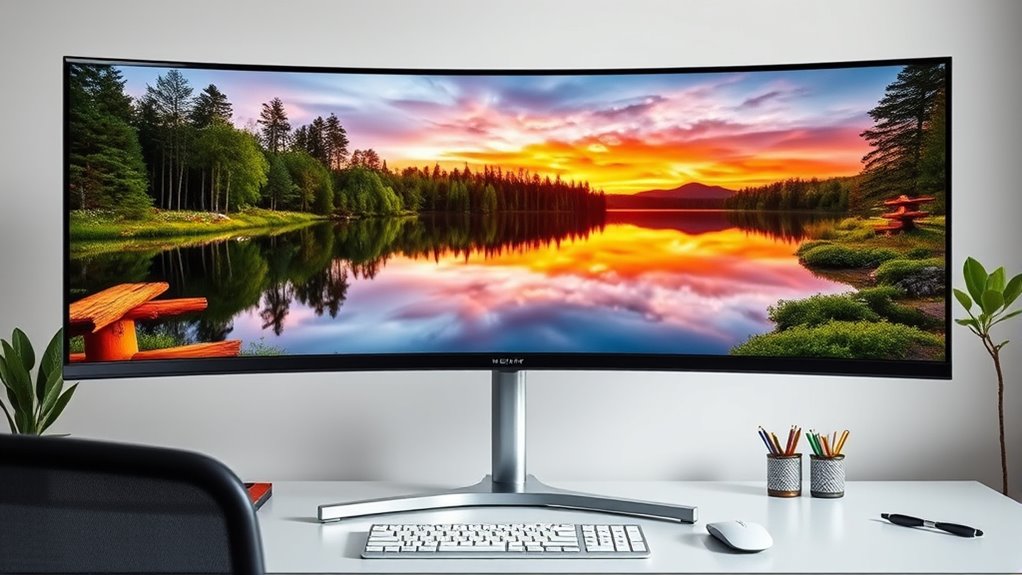

For immersive viewing, my best overall pick is the Samsung Odyssey Ark 2nd Gen, whose 55-inch 4K curved screen makes games and media feel expansive, while the Samsung Odyssey OLED G9 stands out for vivid contrast and the Dell S3425DW offers a more manageable ultrawide format. The main choice is between a wide field of view and a screen that fits comfortably on your desk, with resolution, refresh rate, and graphics hardware shaping the experience. Larger, faster, higher-resolution displays can deepen immersion but demand more space and computing power. Smaller curved monitors are easier to accommodate, though they cannot match the scale of super-ultrawide models. Read on for the full comparison and guidance on which tradeoffs matter for your setup.

Get kitchen staples and gadgets delivered free with Prime
- Fast, free delivery on millions of items
- Prime Video, Amazon Music and more included
- Member-only deals all year
Key Takeaways
- The Samsung Odyssey Ark 2nd Gen takes the top spot for buyers who want the biggest single-screen viewing experience, but its 55-inch footprint calls for a roomy setup.
- The Odyssey OLED G9 and Neo G9 serve different premium priorities: the OLED G9 emphasizes contrast, while the 57-inch Neo G9 pairs a huge 32:9 canvas with dual-4K resolution and demanding hardware needs.
- 34-inch ultrawides are the practical middle ground. Models such as the Dell S3425DW and Alienware AW3425DWM offer a broader view without the desk commitment of a 49-inch or 57-inch display.
- Refresh rates alone do not define immersion. Screen format, resolution, contrast, and the ability of a PC or console to drive the display all affect the experience.
- The roundup spans more than gaming. The Samsung 49-inch business ultrawide and LG 34SR60QC-W add productivity and streaming features, while compact 27- and 32-inch options suit tighter desks.




| curved monitors for immersive viewing | Resolution | Refresh rate | Response time | Screen size |
|---|---|---|---|---|
| Samsung Odyssey Ark 2nd Gen 55 | 4K UHD | 165Hz | 1ms | 55 inches |
| SANSUI 34-Inch Curved Gaming M | 3440 x 1440 | 200Hz | 1ms | 34 inches |
| Dell 34 Monitor S3425DW | 3440 x 1440 | 120Hz | — | — |
| Samsung 49” Business Curved Ul | Dual QHD | 120Hz | — | 49 inches |
| Alienware 34 Curved Gaming Mon | 3440 x 1440 (WQHD) | 180Hz | 1ms (gray to gray) | 34 inches |
| SANSUI 32-Inch Curved Gaming M | 2560 x 1440 (QHD) | 180Hz | 1 ms (OD) | — |
| Samsung 34′ Odyssey G5 Ultra-W | WQHD | 165Hz | 1 ms (MPRT) | 34 inches |
| Samsung 49-inch Odyssey G9 | DQHD | 144Hz | 1 ms | 49 inches |
| Samsung 40” Odyssey G7 | WUHD 4K | 180Hz | 1 ms (GtG) | — |
| Samsung 49" Odyssey OLED G9 | 5120 x 1440 (Dual QHD) | 144Hz | 0.03 ms | 49 inches |
| Z-Edge 27 inch Curved Gaming M | 2560 x 1440 (QHD) | 165Hz | 1ms | — |
| Deco Gear 49-Inch Super Ultraw | 5120 x 1440 | 120Hz | 1ms MPRT | 49 inches |
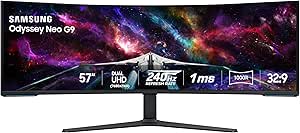
| Samsung 57" Odyssey Neo G9 | 7680 x 2160 (Dual UHD) | 240Hz | 1ms GTG | 57 inches |
| LG 34SR60QC-W 34-inch QHD Curv | 3440 x 1440 (QHD) | 100Hz | — | 34 inches |
| Samsung 32" Odyssey G55C Serie | 2560 x 1440 (QHD) | 165Hz | 1ms MPRT | 32 inches |
More Details on Our Top Picks
Samsung Odyssey Ark 2nd Gen 55″ 4K UHD Curved Gaming Monitor
For a buyer who wants the screen to dominate their field of view, the 55-inch Odyssey Ark offers a very different kind of immersion from the 34-inch ultrawides here. Its 1000R curve wraps a 4K image around a close seating position, while Quantum Mini-LED and HDR10+ support add a more advanced display setup than the Dell S3425DW’s VA panel. The 165Hz refresh rate also keeps fast gameplay fluid, and Cockpit Mode lets the display rotate for a vertical layout. That scale comes with real compromises: this needs substantially more room than a desk-focused ultrawide, and rotating it takes deliberate setup. Multi View also limits external inputs to 120Hz and disables some gaming features. I’d choose it for a dedicated gaming space, not a compact workstation.
Pros:- 55-inch 1000R screen creates a much larger, more enveloping view than the 34-inch ultrawides
- 4K UHD resolution and Quantum Mini-LED provide a detailed display with HDR10+ support
- 165Hz refresh rate and 1ms response time suit fast-paced gaming
- Cockpit Mode, four-input Multi View, and Dolby Atmos audio add setup flexibility
Cons:- The large display demands substantially more desk and room space than a conventional ultrawide
- Multi View limits external inputs to 120Hz and disables some gaming features
- Cockpit Mode requires manual rotation and specific positioning
Best for: PC or console gamers with a large, sturdy setup who want an enveloping screen, flexible viewing modes, and built-in immersive audio.
Not ideal for: Small-desk users or buyers who regularly need full refresh-rate gaming while viewing multiple inputs at once.
- Screen size:55 inches
- Resolution:4K UHD
- Curvature:1000R
- Refresh rate:165Hz
- Response time:1ms
- Panel technology:Quantum Mini-LED
- Sync technology:AMD FreeSync Premium Pro
- HDR support:HDR10+
- Audio:60W 2.2.2-channel system with Dolby Atmos
Our verdict“Choose the Odyssey Ark if you have room for a giant, configurable gaming display; skip it if you need a practical desk-sized ultrawide.”
SANSUI 34-Inch Curved Gaming Monitor UWQHD 3440 x 1440P 200Hz Ultrawide
The SANSUI makes the strongest case for buyers who want 21:9 immersion and a 200Hz refresh rate without moving to an oversized 49- or 55-inch screen. Its 3440 x 1440 resolution gives games and wide-format video more horizontal space than a standard 16:9 display, while the VA panel’s 3000:1 contrast ratio supports deeper-looking dark scenes. Against the Dell S3425DW, the SANSUI prioritizes speed, offering 200Hz rather than 120Hz; Dell counters with USB connectivity and stated eye-comfort features. The SANSUI’s tradeoffs are practical: its stand adjusts only for tilt, it has no built-in speakers, and the listed brightness is 300 cd/m². I’d pair it with a VESA arm and separate audio if smooth gaming matters more than ergonomic extras.
Pros:- 200Hz refresh rate supports fluid motion in fast games
- 3440 x 1440 resolution and 21:9 aspect ratio widen the view for gaming and video
- VA panel with a 3000:1 contrast ratio suits darker scenes
- HDMI 2.1 and DisplayPort 1.4 provide multiple connection options
Cons:- Stand offers tilt adjustment only, so height positioning calls for a VESA mount
- No built-in speakers are specified
- 300 cd/m² brightness may be limiting in bright rooms
Best for: PC gamers seeking a 34-inch 3440 x 1440 ultrawide with a very high refresh rate who already have speakers or a headset.
Not ideal for: Buyers who need height adjustment out of the box, integrated audio, or a monitor primarily for USB-C desk docking.
- Screen size:34 inches
- Resolution:3440 x 1440
- Aspect ratio:21:9
- Refresh rate:200Hz
- Response time:1ms
- Panel technology:VA LED
- Brightness:300 cd/m²
- Contrast ratio:3000:1
- Connectivity:DisplayPort 1.4, 2 HDMI 2.1, 3.5mm audio
Our verdict“Pick the SANSUI if high-refresh ultrawide gaming is your priority and you can supply your own ergonomic setup and audio.”
Dell 34 Monitor S3425DW, WQHD VA, 120Hz, FreeSync Premium, Eye Comfort
The Dell S3425DW is the balanced choice for buyers who want a curved ultrawide for gaming and everyday desk work, rather than chasing the highest refresh rate. Its 34-inch, 3440 x 1440 screen gives side-by-side windows room to breathe, while 120Hz and FreeSync Premium make motion smoother than on a basic office monitor. The stated 99% sRGB and 95% DCI-P3 coverage also give it a broader color profile than the SANSUI’s stated sRGB coverage, though the SANSUI reaches 200Hz for gaming. Dell’s eye-comfort technology and USB-C connectivity suit long desk sessions, but the supplied details don’t specify stand adjustments or built-in speakers. Its 120Hz ceiling also makes it less compelling for high-frame-rate play than the 180Hz Alienware AW3425DWM.
Pros:- 3440 x 1440 resolution and 21:9 format support immersive games and side-by-side work
- 120Hz refresh rate with AMD FreeSync Premium supports smoother motion
- 99% sRGB and 95% DCI-P3 coverage suit color-rich viewing
- USB-C connectivity and eye-comfort technology are useful for extended desk sessions
Cons:- 120Hz is below the 180Hz Alienware and 200Hz SANSUI gaming options
- Stand adjustment details and built-in audio are not specified
- Its 31.78-inch width may not fit smaller desks comfortably
Best for: Hybrid workers and casual-to-regular gamers who want a 34-inch curved workspace, wide color coverage, and USB-C connectivity.
Not ideal for: Competitive players targeting very high refresh rates, or buyers who need confirmed built-in speakers and a small footprint.
- Display size:34 inches
- Resolution:3440 x 1440
- Aspect ratio:21:9
- Refresh rate:120Hz
- Panel type:VA
- Contrast ratio:3000:1
- Color gamut:99% sRGB, 95% DCI-P3
- Brightness:300 nits
- Ports:2 HDMI, 4 USB
Our verdict“Choose the Dell for a work-and-gaming desk where USB-C, eye comfort, and wide color coverage matter more than peak refresh rate.”
Samsung 49” Business Curved Ultrawide Dual QHD Monitor with USB-C, HDMI, DisplayPort, 120Hz, VESA DisplayHDR 400, Built-in Speakers, Height Adjustable Stand
For buyers who want one curved display to replace a multi-monitor desk, Samsung’s 49-inch 32:9 Dual QHD screen is the productivity specialist in this group. Its panoramic width gives windows room to sit side by side without a center bezel, and the 120Hz refresh rate keeps scrolling and compatible games smoother than a typical office display. Compared with the 34-inch Dell S3425DW, this Samsung offers far more workspace and a height-adjustable stand, while Dell’s smaller footprint is easier to fit on an ordinary desk. USB-C with 90W power delivery can also reduce cable clutter for a compatible laptop, and built-in speakers cover basic audio needs. The tradeoff is its substantial width: measure your desk and viewing distance before choosing this over a conventional 21:9 model.
Pros:- 49-inch 32:9 Dual QHD display creates broad, bezel-free workspace for multiple windows
- USB-C delivers up to 90W of power to compatible devices
- Height-adjustable stand supports a more flexible desk position
- 120Hz, DisplayHDR 400, and built-in speakers serve work and entertainment
Cons:- Its wide footprint requires considerably more desk space than the 34-inch Dell or Alienware
- The 32:9 format may leave unused space with content designed for narrower screens
- HDR support is VESA DisplayHDR 400 rather than a higher-tier specification
Best for: Laptop-based professionals who want a single panoramic workspace for several windows, USB-C charging, and occasional gaming.
Not ideal for: People with narrow desks, short viewing distances, or games and video sources that don’t make good use of a 32:9 screen.
- Screen size:49 inches
- Aspect ratio:32:9
- Resolution:Dual QHD
- Refresh rate:120Hz
- HDR:VESA DisplayHDR 400
- Connectivity:DisplayPort, HDMI, USB-C, USB
- USB-C power delivery:90W
- Stand:Height adjustable
- Built-in speakers:Yes
Our verdict“Choose this Samsung if you want a single screen for expansive multitasking and have the desk space to accommodate its 49-inch width.”
Alienware 34 Curved Gaming Monitor (AW3425DWM)
The Alienware AW3425DWM suits players who want a fast 34-inch ultrawide without the SANSUI’s 200Hz being the only deciding factor. Its 180Hz refresh rate, 1ms response time, and support for AMD FreeSync Premium and VESA AdaptiveSync target responsive gameplay, while the 1500R curve pulls the screen edges into a closer viewing arc. At 3440 x 1440, it shares the immersive 21:9 format of the Dell S3425DW, but raises the refresh ceiling from Dell’s 120Hz and adds a dedicated console mode. The stated 95% DCI-P3 coverage and DisplayHDR 400 support add color range, though 400-nit brightness is modest beside higher-end HDR displays such as the Odyssey Ark’s Mini-LED setup. Its 21-pound weight also calls for a sturdy support.
Pros:- 180Hz refresh rate and 1ms response time suit responsive gaming
- 1500R curvature and 21:9 WQHD format create an enveloping view
- FreeSync Premium and VESA AdaptiveSync support smoother gameplay
- 95% DCI-P3 coverage, DisplayHDR 400, and console mode broaden its gaming appeal
Cons:- 400-nit brightness and DisplayHDR 400 offer less HDR headroom than the Mini-LED Odyssey Ark
- At 21 pounds, it needs sturdy desk support or a suitable monitor arm
- Its gaming focus offers fewer stated productivity conveniences than the USB-C-equipped Dell
Best for: PC and console gamers who want a responsive 34-inch curved ultrawide with a higher refresh rate than the Dell and a dedicated console mode.
Not ideal for: Buyers seeking strong HDR impact, a lightweight monitor for frequent repositioning, or a workspace-focused USB-C display.
- Screen size:34 inches
- Resolution:3440 x 1440 (WQHD)
- Aspect ratio:21:9
- Panel curvature:1500R
- Refresh rate:180Hz
- Response time:1ms (gray to gray)
- Color gamut:95% DCI-P3
- HDR certification:VESA DisplayHDR 400
- Brightness:400 nits
Our verdict“Pick the Alienware for fast, curved 21:9 gaming at a more manageable size than the 49-inch Samsung, but not for high-impact HDR.”
SANSUI 32-Inch Curved Gaming Monitor WQHD 2560 x 1440 180Hz
I’d pick this SANSUI when I want a curved screen and fast gaming without moving up to an ultrawide setup. Its 32-inch QHD panel gives games more room to fill the view than a compact 27-inch screen, while the 1500R curve adds a noticeable wraparound effect without the stronger bend of Samsung’s 34-inch Odyssey G5. The 180Hz refresh rate also edges that model’s 165Hz spec, a useful advantage for fast play if the computer can drive it.
The tradeoff is a tilt-only stand, so I’d plan for a monitor arm if height adjustment matters. Its VA panel and stated brightness are less compelling for bright rooms than the premium HDR options here, and HDR support alone doesn’t promise dramatic highlights. With multiple HDMI and DisplayPort inputs, it’s flexible for a gaming PC and console, but no built-in speakers means separate audio is needed.
Pros:- 32-inch QHD screen balances broad game coverage with a familiar aspect ratio
- 180Hz refresh rate supports fluid motion in fast-paced games
- 1500R curvature adds immersion without an especially aggressive bend
- Two HDMI and two DisplayPort inputs allow several devices to stay connected
Cons:- Stand adjusts only by tilt, limiting ergonomic positioning without a separate arm
- No built-in speakers, so audio requires external equipment
- 300-nit brightness may limit the impact of HDR in bright rooms
Best for: PC gamers who want a large curved QHD display with a high refresh rate but don’t need an ultrawide aspect ratio.
Not ideal for: Buyers who need an adjustable stand, built-in audio, or a wide panoramic field of view for racing and flight games.
- Display size:32 inches
- Resolution:2560 x 1440 (QHD)
- Refresh rate:180Hz
- Response time:1 ms (OD)
- Panel type:VA
- Curvature:1500R
- Brightness:300 nits
- Ports:2 HDMI, 2 DisplayPort
- VESA compatibility:100 x 100 mm
Our verdict“Choose this SANSUI for a large, fast QHD curved screen in a standard-format setup, and skip it if you want ultrawide immersion or flexible stand adjustment.”
Samsung 34′ Odyssey G5 Ultra-Wide Gaming Monitor with 1000R Curved Screen
The Odyssey G5 makes sense if the curve itself is a priority. Its 34-inch ultrawide screen and pronounced 1000R curvature pull the sides closer to the viewer, creating a more enveloping view than the gentler 1500R SANSUI 32-inch. The 165Hz refresh rate and FreeSync Premium support also suit responsive PC gaming, while HDR10 adds basic HDR compatibility.
That strong bend and wider aspect ratio are not universal upgrades: some games may not support ultrawide properly, and the large footprint can crowd a shallow or narrow desk. Compared with the 49-inch Odyssey G9, this is a more manageable step into panoramic gaming, but it offers less horizontal space. The supplied details don’t specify its ports or stand adjustments, so I wouldn’t choose it when a particular connection setup or ergonomic range is a requirement.
Pros:- 1000R curve creates a stronger wraparound effect than the SANSUI 32-inch’s 1500R curve
- 34-inch ultrawide layout expands the horizontal game view
- 165Hz refresh rate and FreeSync Premium support smooth gaming
- HDR10 support provides compatibility with HDR content
Cons:- Some games may not display correctly or make full use of the ultrawide aspect ratio
- Large screen can overwhelm a compact desk
- Port selection and stand adjustment details are not specified
Best for: PC gamers with enough desk width who want a strongly curved ultrawide for supported games and a more enveloping view than a standard-format monitor provides.
Not ideal for: Players who mainly use games with poor ultrawide support, have a small desk, or need confirmed port and stand specifications before buying.
- Screen size:34 inches
- Resolution:WQHD
- Curvature:1000R
- Refresh rate:165Hz
- Response time:1 ms (MPRT)
- Adaptive sync:AMD FreeSync Premium
- HDR:HDR10
Our verdict“Pick the Odyssey G5 if you want a pronounced 1000R curve in a more manageable ultrawide size, but check game compatibility and your desk space first.”
I’d choose this Odyssey G9 for a panoramic setup where one screen should span a broad field of view and leave room for side-by-side tasks. Its 49-inch, 32:9 DQHD display offers far more horizontal space than the 34-inch Odyssey G5, and the 1000R curve helps bring that width around the viewer rather than leaving distant-looking edges. DisplayHDR 600 and FreeSync Premium Pro add a stronger feature set for gaming than the G5’s HDR10 and FreeSync Premium support.
The scale is the defining tradeoff: this monitor needs substantial desk width and can be excessive for games or work that don’t use a super-ultrawide canvas. Its 144Hz refresh rate is lower than the SANSUI 32-inch’s 180Hz, though still suited to smooth play. The OLED G9 offers deeper blacks and a much faster stated response time, but this G9 avoids the OLED panel type and remains the more straightforward choice for buyers focused on expansive screen space.
Pros:- 49-inch 32:9 DQHD layout creates an expansive panoramic view
- 1000R curve helps the wide display feel more enveloping
- DisplayHDR 600 and FreeSync Premium Pro suit demanding gaming setups
- Split-screen and Picture-in-Picture features support multitasking
Cons:- Requires substantial desk width and a considered viewing distance
- 144Hz refresh rate is lower than the SANSUI 32-inch’s 180Hz
- Super-ultrawide format may be poorly supported by some games and workflows
Best for: Gamers and multitaskers with a wide desk who want a single 32:9 display for panoramic play and multiple open windows.
Not ideal for: Buyers with limited desk space, players who prefer standard aspect ratios, or those prioritizing OLED black levels and the fastest response specification.
- Screen size:49 inches
- Resolution:DQHD
- Aspect ratio:32:9
- Curvature:1000R
- Refresh rate:144Hz
- Response time:1 ms
- HDR:DisplayHDR 600
- Adaptive sync:AMD FreeSync Premium Pro
- Stand:Ergonomic
Our verdict“Choose this G9 when panoramic 32:9 space matters more than compactness or maximum refresh rate.”
Samsung 40” Odyssey G7 (G75F) Series WUHD Curved Gaming Monitor
The 40-inch Odyssey G7 is the pick for buyers who want an ultrawide view without stepping up to a 49-inch, 32:9 display. Its 21:9 WUHD resolution gives more horizontal room than the 32-inch SANSUI, while retaining a less extreme shape than the Odyssey G9 models. A 1000R curve draws the edges inward, and the combination of 180Hz refresh rate and 1ms GtG response is built for fast gaming. DisplayHDR 600 also gives it a stronger HDR specification than the Odyssey G5’s HDR10 support.
This is still a large monitor, so desk depth and viewing distance matter; the 49-inch G9 is wider, but the G7 may fit a setup that can’t accommodate a 32:9 panel. Its high-resolution, high-refresh focus can also demand capable graphics hardware, and the provided specifications don’t list connectivity or stand adjustments. I’d favor it for a high-performance gaming PC, not as a compact, general-purpose screen.
Pros:- 40-inch 21:9 display offers an expansive view without the 32:9 width of the 49-inch G9
- WUHD resolution provides a detailed ultrawide gaming canvas
- 180Hz refresh rate and 1ms GtG response target fluid, responsive play
- DisplayHDR 600 is a higher-tier HDR specification than HDR10 alone
Cons:- Large footprint can be difficult to accommodate on smaller desks
- Driving WUHD at high refresh rates can call for powerful graphics hardware
- Port and stand-adjustment details are not provided
Best for: PC gamers seeking a large, high-resolution 21:9 screen with a strong curve and fast refresh, but who don’t need a 49-inch super-ultrawide.
Not ideal for: Buyers with small desks, modest graphics hardware, or a need for clearly specified ports and ergonomic adjustments.
- Display size:40 inches
- Resolution:WUHD 4K
- Aspect ratio:21:9
- Curvature:1000R
- Refresh rate:180Hz
- Response time:1 ms (GtG)
- HDR:VESA DisplayHDR 600
Our verdict“Pick the Odyssey G7 for high-resolution 21:9 gaming at 180Hz if your desk and graphics hardware can handle the demands.”
Samsung 49″ Odyssey OLED G9 (G91SD) Dual QHD Curved Gaming Monitor
For buyers who want a huge curved view with OLED contrast, I’d put the Odyssey OLED G9 ahead of the standard Odyssey G9 when image character matters more than avoiding OLED-specific care. Its 49-inch Dual QHD panel fills the same broad 32:9 role, while QD-OLED brings deep blacks and a wider stated color spectrum for scenes that benefit from richer contrast. The listed 0.03ms response time is also far quicker than the standard G9’s 1ms figure, though that model refreshes at 144Hz too.
The OLED G9 is not automatically the better fit for every gaming desk. It still needs substantial space, and static interface elements can raise burn-in concerns over time. Its 144Hz refresh rate is below the 180Hz Odyssey G7, so I’d choose the G7 for a narrower high-refresh gaming focus. Height and tilt adjustment, Picture-in-Picture, and support for both G-Sync and FreeSync Premium Pro make this OLED model more appealing for buyers who want a versatile, panoramic centerpiece.
Pros:- QD-OLED panel delivers deep black levels and a wide stated color spectrum
- 49-inch Dual QHD canvas creates an expansive 32:9 viewing area
- 0.03ms response time and 144Hz refresh rate support responsive gaming
- Height and tilt adjustments, Picture-in-Picture, G-Sync, and FreeSync Premium Pro add flexibility
Cons:- Static on-screen content can raise burn-in concerns
- Large 49-inch format requires ample desk space
- 144Hz refresh rate is lower than the Odyssey G7’s 180Hz
Best for: Enthusiast gamers who want a panoramic 49-inch OLED screen, deep blacks, vivid color, and a very fast stated response time.
Not ideal for: Buyers who keep static content on screen for long periods, have limited desk space, or prioritize a higher refresh rate over OLED contrast.
- Screen size:49 inches
- Resolution:5120 x 1440 (Dual QHD)
- Panel type:QD-OLED
- Response time:0.03 ms
- Refresh rate:144Hz
- Stand adjustments:Tilt and height adjustable
- Adaptive sync:G-Sync and AMD FreeSync Premium Pro
Our verdict“Choose the OLED G9 if deep blacks and panoramic OLED immersion matter more to you than burn-in precautions, desk space, or a 180Hz refresh rate.”
Z-Edge 27 inch Curved Gaming Monitor, QHD 1440P, 165Hz
The Z-Edge 27-inch makes curved gaming more desk-friendly than the larger Samsung Odyssey G55C, while keeping the same QHD resolution and 165Hz refresh rate. Its 27-inch, 16:9 panel is a practical fit for a focused view rather than the sweeping peripheral coverage of an ultrawide. The 3000:1 contrast ratio and VA panel can give game scenes more depth, while 165Hz motion support suits fast play when paired with a system that can drive it. The tradeoff is that this is a narrower, less enveloping experience than the 32-inch Samsung, and its listed 1ms response time alone does not establish how it performs across every game or setting. There are no built-in speakers, and the stated dimensions may still crowd a small desk. I’d choose it for a compact QHD gaming setup, not for cinematic ultrawide immersion.
Pros:- QHD resolution keeps game details sharp on a 27-inch display.
- 165Hz refresh rate supports fluid motion in compatible games.
- VA panel and 3000:1 contrast ratio can add depth to darker scenes.
- HDMI and DisplayPort connections offer flexibility for a gaming setup.
Cons:- The 16:9 screen feels much less enveloping than the 34-inch and larger ultrawide options.
- No built-in speakers are listed.
- The product data does not clarify performance across different response-time settings.
Best for: PC gamers who want a curved QHD screen with a high refresh rate but have limited desk width.
Not ideal for: Buyers seeking a broad cinematic field of view, built-in audio, or a larger screen for split-screen work.
- Display size:27 inches
- Resolution:2560 x 1440 (QHD)
- Refresh rate:165Hz
- Response time:1ms
- Panel technology:LED, VA
- Contrast ratio:3000:1
- Aspect ratio:16:9
- Connectivity:2x HDMI, 1x DisplayPort
Our verdict“Pick the Z-Edge if you want a relatively compact curved QHD gaming display, and choose the Samsung Odyssey G55C if you want a bigger, more strongly curved screen.”
Deco Gear 49-Inch Super Ultrawide Curved Monitor, 5120×1440, 5K2K, 120Hz, 32:9
The Deco Gear 49-inch is the lineup’s workspace-first panoramic pick: its 32:9 screen gives you room for several side-by-side windows, while the curve helps keep the far edges within a more natural viewing sweep. Compared with the LG 34SR60QC-W, it offers substantially more horizontal workspace and USB-C power delivery, but demands far more desk space and gives up some refresh rate, at 120Hz rather than 165Hz. Its 5120×1440 resolution preserves a QHD-height desktop across the extra width, and the adjustable stand helps adapt the large panel to a seated position. USB-C with up to 65W delivery and a USB hub can simplify a laptop setup. This breadth is less compelling for basic browsing or a small desk, and 1ms MPRT should not be treated as a universal measure of pixel response.
Pros:- 49-inch 32:9 layout creates extensive room for parallel windows.
- 5120×1440 resolution provides QHD vertical workspace across the panoramic screen.
- USB-C supports up to 65W power delivery, alongside a USB hub.
- Stand offers height, tilt, and swivel adjustments.
Cons:- The wide screen needs substantial desk space and may not fit compact setups.
- 120Hz is lower than the 165Hz options from Z-Edge and Samsung Odyssey G55C.
- Its many features and connections may be unnecessary for simple everyday use.
Best for: Laptop-based professionals, streamers, and multitaskers who want one curved screen for multiple windows and USB-C connectivity.
Not ideal for: Buyers with shallow or narrow desks, people who mainly play high-refresh competitive games, or anyone wanting a simple plug-and-play display.
- Screen size:49 inches
- Resolution:5120 x 1440
- Aspect ratio:32:9
- Refresh rate:120Hz
- Response time:1ms MPRT
- Color coverage:100% sRGB, 91% DCI-P3, 85% NTSC
- USB-C power delivery:Up to 65W
- Adjustments:-5° to +15° tilt, ±30° swivel, 130mm height
Our verdict“Choose the Deco Gear for a desk-spanning multitasking display with USB-C, but favor the LG 34SR60QC-W if you need a more manageable ultrawide with built-in streaming.”
Samsung 57″ Odyssey Neo G9 (G95NC) Dual 4K UHD 1000R Curved Gaming Monitor
For buyers who want the most expansive, high-spec gaming view in this group, the Samsung 57-inch Odyssey Neo G9 is the clear premium outlier. Its 7680 x 2160 resolution spans a 32:9 screen, while the 1000R curve wraps the image toward the viewer more strongly than the 1800R curve listed for the LG 34SR60QC-W. The 240Hz refresh rate, DisplayPort 2.1, and FreeSync Premium Pro target demanding gaming systems; driving the full resolution at high refresh rates requires compatible graphics hardware, so the monitor’s headline capability is not automatic. Quantum Mini LED local dimming and DisplayHDR 1000 add tools for bright highlights and contrast, though those features do not make every game or scene equally suited to the panel. Its size, weight, and power draw are substantial, and it is excessive for a modest desk or everyday office use.
Pros:- Dual-UHD 7680 x 2160 resolution delivers a very wide, detailed gaming canvas.
- 1000R curvature creates a pronounced wraparound viewing position.
- 240Hz refresh rate and DisplayPort 2.1 suit high-performance gaming setups.
- Quantum Mini LED local dimming and DisplayHDR 1000 support high-contrast imagery.
Cons:- The 57-inch screen requires substantial desk space and a suitable viewing distance.
- Full-resolution, high-refresh gaming depends on compatible graphics hardware and connection support.
- At 140W listed power consumption and 41.9 pounds, it is a demanding display to place and run.
Best for: Enthusiast PC gamers with a large desk and graphics hardware capable of driving dual-UHD gaming at high refresh rates.
Not ideal for: Buyers with limited space, mainstream graphics cards, or a preference for a modestly sized all-purpose monitor.
- Screen size:57 inches
- Resolution:7680 x 2160 (Dual UHD)
- Aspect ratio:32:9
- Curvature:1000R
- Refresh rate:240Hz
- Response time:1ms GTG
- Display technology:VA with Quantum Mini LED
- HDR:DisplayHDR 1000
- Connectivity:DisplayPort 2.1, HDMI 2.1, USB
Our verdict“Choose the Neo G9 for a large, powerful gaming setup built around dual-UHD immersion, not for a compact desk or a system that cannot drive its resolution.”
LG 34SR60QC-W 34-inch QHD Curved Smart Monitor with Streaming, webOS, HDR10, 100Hz, Built-in Speaker, AirPlay2, Screen Share, Bluetooth, ThinQ App
The LG 34SR60QC-W blends a cinematic 21:9 curved screen with built-in webOS, making it the most self-contained entertainment option here. Streaming apps and built-in speakers mean you can watch without connecting a computer, a useful distinction from gaming-oriented choices such as the Samsung Odyssey G55C. Its 3440 x 1440 resolution offers a wider movie and desktop view than a standard 16:9 monitor, while 100Hz is suited to casual play and everyday scrolling rather than the faster gaming focus of the Samsung’s 165Hz. AirPlay 2, Bluetooth, and screen sharing add flexible ways to send content, though wireless features depend on compatible devices, and streaming services may need an internet connection or separate subscriptions. The provided specs do not list stand adjustments, so buyers who need ergonomic positioning should check the setup before choosing it.
Pros:- 34-inch 21:9 QHD screen gives movies and multitasking more horizontal room.
- webOS provides access to built-in streaming apps without requiring a computer.
- Built-in speakers support an all-in-one entertainment setup.
- AirPlay 2, Bluetooth, and HomeKit support add wireless options for compatible devices.
Cons:- 100Hz is below the 165Hz refresh rate of the Samsung Odyssey G55C and Z-Edge.
- Streaming services may require internet access and separate subscriptions.
- Stand adjustability is not specified in the supplied product details.
Best for: Viewers who want one curved ultrawide for streaming, movies, casual gaming, and wireless sharing from compatible devices.
Not ideal for: Competitive gamers who want a high refresh rate, or buyers who need confirmed height and swivel adjustment for a specific desk setup.
- Screen size:34 inches
- Resolution:3440 x 1440 (QHD)
- Aspect ratio:21:9
- Curvature:1800R
- Refresh rate:100Hz
- Color gamut:99% sRGB
- HDR:HDR10
- Built-in platform and connectivity:webOS 23, Bluetooth, AirPlay 2, HomeKit
- Ports and audio:2 HDMI, 3 USB, built-in speakers
Our verdict“Pick the LG if streaming and wireless convenience matter as much as curved-screen viewing, and choose a faster gaming monitor if competitive play is your priority.”
Samsung 32″ Odyssey G55C Series QHD Curved Gaming Monitor
The Samsung Odyssey G55C is the gaming pick for buyers who want a more enveloping curve without stepping up to a desk-dominating ultrawide. Its 32-inch QHD panel keeps the familiar 16:9 format, while the 1000R curve bends more sharply around the viewing position than the Z-Edge’s unspecified curve. That makes the Samsung a more pronounced curved-screen choice, though the Z-Edge’s 27-inch size may fit tighter setups more easily. Both list 165Hz and QHD, so the Samsung’s main distinction is its larger panel and stated curvature, not a higher refresh rate. HDR10 and AMD FreeSync add gaming-focused features, but the supplied details do not specify brightness or HDR performance, and the 1ms figure is MPRT. This is less suited to panoramic productivity than the 34-inch LG or 49-inch Deco Gear.
Pros:- 1000R curvature brings the screen edges closer into the viewing arc.
- QHD resolution and 165Hz refresh rate suit detailed, fast-moving gameplay.
- 32-inch screen offers more viewing area than the 27-inch Z-Edge.
- AMD FreeSync and HDR10 support are included.
Cons:- 16:9 format provides less panoramic workspace than the LG 34SR60QC-W and Deco Gear 49-inch.
- The pronounced curve may be less suitable for buyers who prefer a flatter viewing surface.
- HDR brightness and stand adjustments are not specified in the supplied data.
Best for: Gamers who prefer a 32-inch QHD screen and pronounced 1000R curve for a focused, immersive 16:9 setup.
Not ideal for: Multitaskers who need ultrawide workspace, buyers with limited desk depth, or users seeking a monitor with built-in streaming and speakers.
- Screen size:32 inches
- Resolution:2560 x 1440 (QHD)
- Refresh rate:165Hz
- Response time:1ms MPRT
- Curvature:1000R
- HDR:HDR10
- Adaptive sync:AMD FreeSync
Our verdict“Choose the Odyssey G55C for a large, strongly curved QHD gaming view; choose the LG 34SR60QC-W for ultrawide viewing and built-in entertainment features.”
How We Picked
I ranked these monitors around the promise of immersive viewing, weighing screen size and curvature alongside resolution, panel characteristics, refresh rate, and aspect ratio. A wide screen can fill more of a viewer’s field of vision, but that benefit only counts when the resolution keeps content clear and the display fits the room and desk. I also considered practical details such as connectivity, adjustability, built-in speakers, and smart features, since a monitor may need to serve work, gaming, or streaming as well as entertainment.
The order reflects immersive impact balanced against usability, not a single specification. Large premium screens rise when their scale and image detail create a distinctive experience, while more accessible ultrawides earn their place through a useful balance of viewing area and everyday fit. Smaller monitors rank lower for sheer spectacle but remain credible choices for buyers with limited space. Each pick has a tradeoff: the larger and more demanding the display, the more carefully a buyer should check desk depth, viewing distance, ports, and graphics capability.
Factors to Consider When Choosing Curved Monitors For Immersive Viewing
Curvature is only one part of an immersive setup. I would match the monitor to the distance I sit from it, the content I watch, and the computer or console driving it before choosing based on screen size alone.
Match Screen Width to Your Viewing Distance
A curved display feels enveloping when its edges remain within a comfortable viewing angle from your chair. A 34-inch ultrawide can suit a typical desk, while 49-inch and 57-inch formats need more room and often work best when you sit farther back. Measure both the desk width and depth, then check the stand’s footprint rather than relying on screen dimensions alone. An oversized monitor placed too close may make you turn your head or shift your gaze constantly. Buyers choosing a 55-inch screen such as the Odyssey Ark should plan the viewing position before purchase. A compact 27- or 32-inch model can be the better immersive choice if it lets you sit at a natural distance.
Choose an Aspect Ratio for the Content You Watch
Ultrawide and super-ultrawide screens widen games and desktop layouts, but they do not make every source wider. Some films and videos use different formats and may show black bars, while certain games do not support 32:9 cleanly. Before buying a 49-inch or 57-inch monitor, check support for the games and applications you use most. A 21:9 screen often offers a useful middle ground between extra peripheral view and broad compatibility. A standard 16:9 curved monitor may suit console players or people who frequently share screens. Think about your regular content mix, not just the most dramatic demo footage.
Balance Resolution Against Graphics Hardware
More pixels can keep a large curved screen sharp, but they also make games harder for a graphics card to render at high frame rates. The dual-4K Neo G9, for example, asks considerably more of a computer than a QHD display. A high refresh rate is most useful when your system can deliver enough frames to take advantage of it. If you mainly play demanding single-player games, image detail may matter more than chasing the highest refresh figure. For competitive gaming, check the full combination of resolution, refresh rate, and graphics capability. Buyers should also confirm that their cables and ports support the display’s intended resolution and refresh settings.
Understand What Curvature Can and Cannot Do
Curvature can help the edges of a wide display sit more naturally within your field of view, but a stronger curve is not automatically better for every task. A pronounced curve can suit games and films while making straight lines look less natural for some design, drafting, or document work. The effect depends on screen width, viewing distance, and personal preference. If you split the screen between spreadsheets and creative applications, give panel shape and workspace layout as much attention as gaming features. A curved screen also does not replace good positioning: keep the display centered and set its height to reduce neck strain. Buyers who share a monitor with others should consider whether the curved view works from off-center seats.
Decide Which Features Deserve the Extra Space
Built-in speakers, USB-C, smart TV functions, and adjustable stands can reduce desk clutter or make a monitor more useful outside gaming. They are most valuable when they replace equipment you would otherwise need, such as a separate streaming device or docking setup. A business ultrawide with USB-C may simplify connecting a laptop, while a smart monitor can serve as a standalone media screen. These extras do not automatically improve the core viewing experience, so avoid letting them outweigh panel size, clarity, or compatibility. Check whether the stand offers the height and tilt adjustment your seating position requires; VESA mounting can help when the supplied stand is too large. Choose convenience features to match your daily routine rather than collecting specifications you will rarely use.
Frequently Asked Questions
Is a 49-inch super-ultrawide monitor a good fit for a typical desk?
It can work on a typical desk, but width is only part of the fit: screen depth, stand footprint, and your distance from the display matter too. A 49-inch 32:9 screen places a lot of content across your field of view, which can be useful for multitasking and supported games. It may feel overwhelming if you sit close or have limited room to move the screen back. Measure the usable desk area and check the monitor’s stand dimensions before deciding. If the setup feels cramped, a 34-inch ultrawide may provide a more comfortable balance.
Should I choose an OLED ultrawide or a larger non-OLED curved monitor?
Choose based on whether image contrast or sheer screen area matters more to you. The Samsung Odyssey OLED G9 offers OLED’s strong contrast in a 49-inch ultrawide format, while larger options such as the 57-inch Neo G9 or 55-inch Odyssey Ark prioritize scale and viewing area. Consider the types of games and video you watch, your lighting, and how long static desktop elements remain on screen. Also confirm that your system can drive the resolution and refresh rate you want. A larger screen is not automatically a more satisfying choice if it pushes you too close or strains your graphics hardware.
Will my computer run games well on a dual-4K curved monitor?
That depends on your graphics card, the games you play, and the frame rate you expect. A dual-4K display such as the Samsung Odyssey Neo G9 has far more pixels to render than a QHD 34-inch ultrawide, so high settings and fast frame rates can require powerful hardware. Check the monitor’s supported resolution and refresh combinations, then compare them with your computer’s output capabilities. You can reduce game resolution or detail settings, but doing so may undercut the reason for choosing such a detailed screen. Buyers with midrange systems may prefer a lower-resolution ultrawide that is easier to drive smoothly.
Are curved monitors a good choice for office work as well as gaming?
Yes, particularly when the extra width helps you keep documents or applications visible side by side. The Dell S3425DW and Samsung 49-inch business ultrawide represent more work-friendly approaches than a display chosen chiefly for gaming spectacle. For text-heavy tasks, consider resolution, text clarity, screen height, and laptop connectivity alongside curvature. Strong curves can take some adjustment for straight-line design work, so creative professionals should weigh how often they handle geometry-sensitive tasks. A USB-C connection, height-adjustable stand, or built-in speakers may make a monitor easier to use throughout the workday.
Should I buy a 144Hz-or-faster monitor if I mostly watch films and shows?
Not necessarily. A high refresh rate mainly benefits games and other content that can supply high frame rates; it does not make ordinary films play at the monitor’s maximum refresh rate. For mostly streaming, prioritize screen size, resolution, contrast, smart features, and sound options instead. The LG 34SR60QC-W is a different kind of pick from gaming-focused ultrawides because it includes webOS and streaming features. If you also play fast-paced games, a higher refresh rate can still be useful, but it should not outweigh your main viewing priorities.
Conclusion
My best overall recommendation is the Samsung Odyssey Ark 2nd Gen for buyers with the space and hardware to make its huge 4K screen worthwhile. For best value in a practical format, the SANSUI 34-inch UWQHD ultrawide pairs a broad view with a high refresh rate; buyers focused on everyday comfort may prefer the Dell S3425DW. The best premium choice depends on the experience you want: the OLED G9 favors rich contrast, while the Neo G9 offers extreme size and resolution. For beginners, a 27- or 32-inch QHD curved monitor is easier to fit and drive than a super-ultrawide. For specific needs, choose the Samsung 49-inch business model for laptop-centered work, the LG smart monitor for streaming, or a 34-inch ultrawide when you want immersion without a giant desk commitment.
NFL season / tailgating Picks
team gear
As an affiliate, we earn on qualifying purchases.