
If you’re looking to improve your mono camera astrophotography in 2025, I recommend considering top filter wheels like the Astromania 2-Position or 5-Position models for quick filter swaps, plus versatile sets like the NEEWER 9PCS Full Color Filter set for creative imaging. Make sure to pick one compatible with your camera’s size and thread type for easy installation. Keep exploring—there’s more to discover to optimize your setup even further.
Key Takeaways
- Compatibility with standard 2-inch filters and support for multiple filter slots enhance versatility for mono astrophotography.
- High-quality, durable build materials like aluminum or stainless steel ensure longevity and stability during imaging.
- Filter sets with UV, CPL, ND, and FLD options expand creative control and imaging possibilities.
- Easy, tool-free filter insertion and quick swap mechanisms streamline workflow and save imaging time.
- Compatibility with automation systems and proper focus adjustments are essential for optimal performance in 2025.
NEEWER 58mm ND Lens Filter Kit for DSLR Cameras
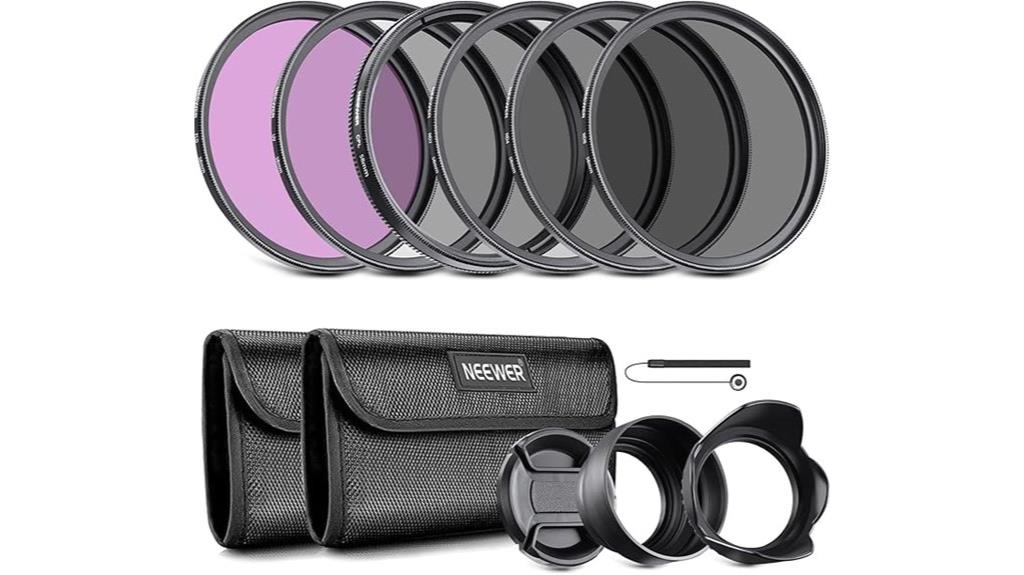
If you’re starting out with DSLR photography and want an affordable, all-in-one filter kit, the NEEWER 58mm ND Lens Filter Kit is an excellent choice. It includes essential filters like UV, CPL, FLD, and ND2, ND4, ND8, along with handy accessories such as a collapsible rubber lens hood, snap-on lens cap, and a convenient carrying pouch. Compatible with various camera brands, these filters help control light, reduce reflections, and protect your lens. Many users find it versatile and easy to use, making it perfect for beginners and hobbyists looking to enhance their photos with better exposure, color, and clarity.
Best For: beginners and hobbyists seeking an affordable, comprehensive filter kit to improve their DSLR photography with light control, lens protection, and color correction.
Pros:
- Includes a wide range of essential filters (UV, CPL, FLD, ND2, ND4, ND8) for versatile shooting options
- Comes with useful accessories such as a collapsible rubber lens hood, snap-on lens cap, and carrying pouch for convenience
- Compatible with various camera brands and easy to install, making it suitable for beginners and experienced photographers alike
Cons:
- Some users may need online tutorials to properly utilize complex filters like CPL and FLD
- Shipping costs can be high, especially for international buyers, despite fast delivery times
- As an entry-level kit, the filters may not offer the same premium quality as professional-grade filters
NEEWER 9PCS Full Color Lens Filter Set for Camera

The NEEWER 9PCS Full Color Lens Filter Set is an excellent choice for amateur photographers and hobbyists looking to expand their creative options without breaking the bank. This set includes nine vibrant resin filters in red, orange, blue, yellow, green, brown, purple, pink, and gray, all compatible with 58mm lenses. The filters are lightweight, durable, and easy to screw on or off, with organized pouches and a cleaning cloth for convenience. They help enhance contrast, mood, and color effects—perfect for outdoor portraits, artistic shots, or experimenting with color layering. Overall, it’s a versatile, budget-friendly set that boosts your creative versatility.
Best For: amateur photographers and hobbyists seeking an affordable, versatile set of color filters to enhance their creative photography.
Pros:
- Wide variety of vibrant colors for diverse creative effects
- Lightweight, durable, and easy to attach or remove from 58mm lenses
- Comes with organized pouches and cleaning cloth for convenience and protection
Cons:
- Colors may have less intense saturation than expected by some users
- Filters are lightweight, which might affect their feel and stability on certain lenses
- Not suitable for professional-grade photography requiring high-end filters
Neewer 58mm UV CPL FLD Filter Kit & ND Set for Canon Rebel & EOS Cameras
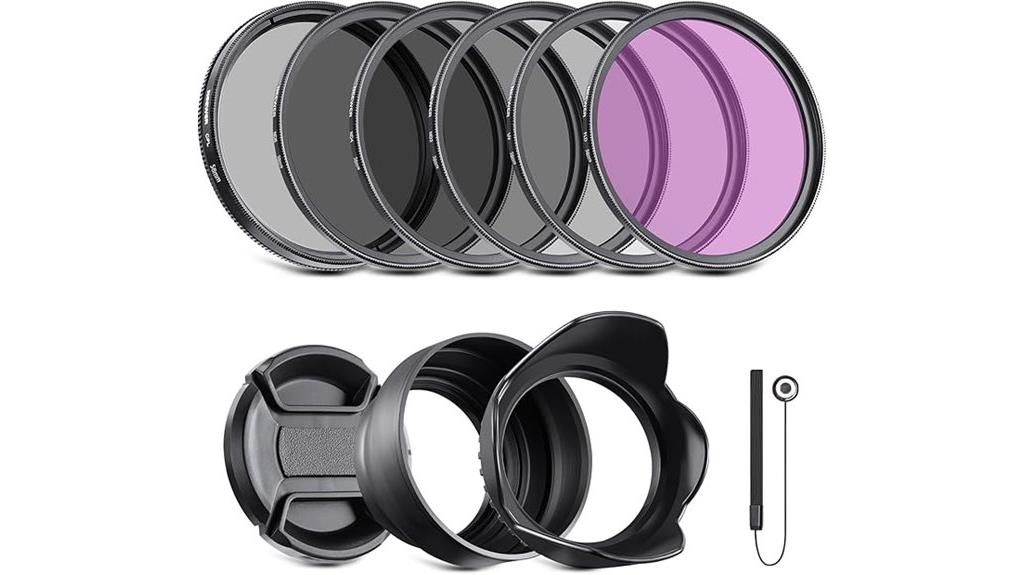
Looking for a versatile filter kit that offers all-encompassing protection and creative options for your Canon Rebel or EOS camera? The Neewer 58mm UV CPL FLD Filter Kit & ND Set is perfect. It includes nine essential accessories: UV, CPL, FLD filters, ND2, ND4, ND8 filters, sun visors, lens caps, a cleaning wipe, and a carrying pouch—all compatible with 58mm lenses. The ND filters help manage exposure and enable long exposures, while the CPL reduces reflections. The FLD filter corrects color tones, and the UV filters protect your lens. Plus, the sun shades and protective accessories make this kit a comprehensive solution for varied shooting conditions.
Best For: photographers using Canon Rebel or EOS cameras seeking a comprehensive filter kit for protection, exposure control, and creative effects.
Pros:
- Includes a full set of filters and accessories compatible with all 58mm lenses, offering versatile functionality.
- Enables precise light management and long exposure shots with ND filters, while reducing reflections with CPL filters.
- Protects lens surfaces and enhances image quality with UV, FLD filters, sun visors, and protective caps.
Cons:
- Designed specifically for 58mm lens threads, limiting compatibility with lenses of different sizes.
- The variety of filters and accessories may be overwhelming for beginners unfamiliar with their uses.
- The quality of filters and accessories may vary, potentially requiring upgrades for professional-grade results.
Astromania 2 Multiple 5-Position Filter Wheel for Telescope

Designed for dedicated astrophotographers who need quick and reliable filter changes, the Astromania 2 Multiple 5-Position Filter Wheel stands out with its five independently switchable filter slots. Compatible with standard 2-inch filters and featuring accessory side T2 and M48 threads, it’s built with a sturdy aluminum housing that supports heavy cameras. Its light-tight interior prevents reflections, ensuring clear imaging. The compact design suits telescopes with short back focus, like Newton or Dobson models. Filters can stay mounted for protection, and swapping takes seconds. Just remember to use a wrench for installation and adjust focus to account for the filter wheel’s thickness.
Best For: dedicated astrophotographers seeking quick, reliable filter changes and compatibility with various telescope setups.
Pros:
- Supports five independently switchable 2-inch filters for versatile imaging.
- Light-tight, reflection-free interior ensures high-quality, clear astrophotography images.
- Compact, sturdy aluminum housing suitable for heavy cameras and short back focus telescopes.
Cons:
- Installation requires using a wrench and proper focus adjustments for optimal performance.
- Thickness of the filter wheel may necessitate focusing distance adjustments, potentially complicating setup.
- Limited to standard 2-inch filters, which may not accommodate specialized filter sizes or types.
49mm UV Filter for Canon EOS Cameras
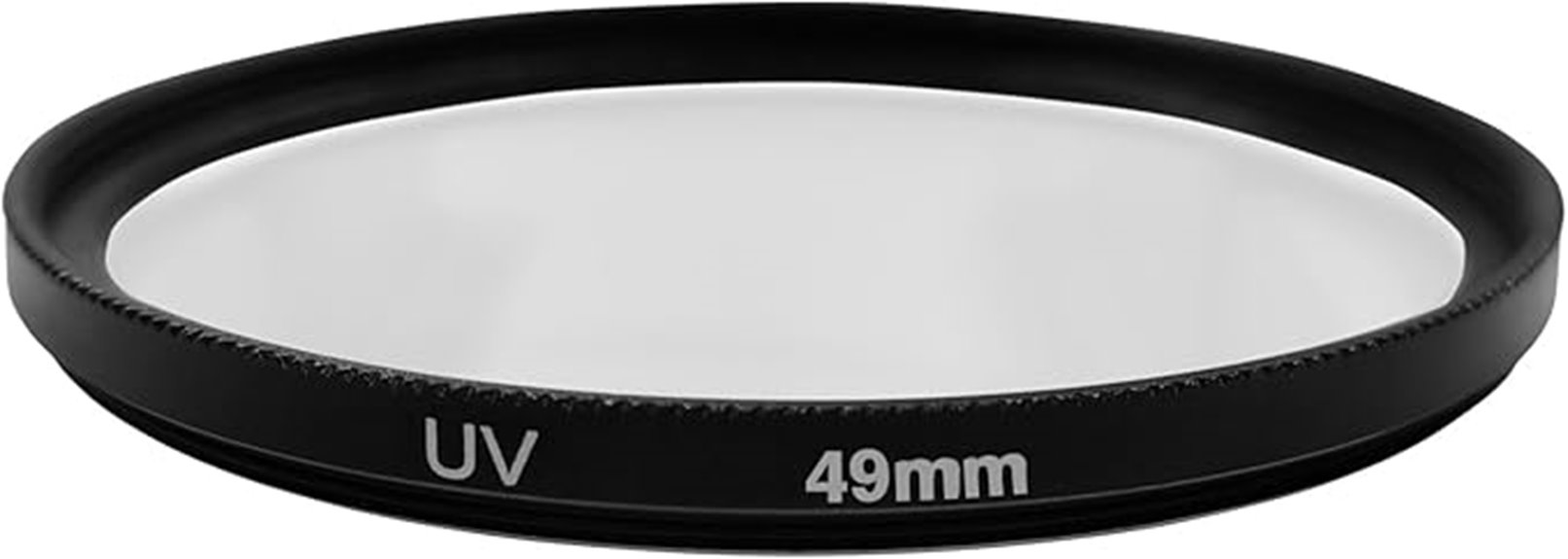
Are you searching for a reliable UV filter that delivers crisp, clear images while protecting your Canon EOS lenses? The 49mm UV filter is designed for various Canon models, including EOS R100, R50, R10, M50, M5, M6, and M200, with compatible 49mm filter threads. It absorbs ultraviolet light, reduces blue haze, and enhances color accuracy, making it perfect for outdoor shooting in mountain, snow, or seaside environments. Its ultra-slim design prevents vignetting on wide-angle lenses, and the multi-resistant coating minimizes reflections and ghosting. Plus, it doubles as a sturdy lens protector against dust, scratches, and moisture, ensuring your equipment stays in top condition.
Best For: photographers using Canon EOS cameras with 49mm filter threads seeking to protect their lenses and enhance image clarity in outdoor environments.
Pros:
- Absorbs UV light to reduce bluish haze and improve color accuracy.
- Ultra-slim design prevents vignetting on wide-angle lenses.
- Multi-resistant coating minimizes reflections, ghosting, and provides protection against dust and scratches.
Cons:
- Compatibility limited to lenses with 49mm filter thread size.
- Does not include additional lens accessories or filters.
- May require careful handling to avoid fingerprints or smudges on the coated surfaces.
Factors to Consider When Choosing Filter Wheels and Filter Sets for Mono Cameras

When choosing filter wheels and sets for mono cameras, I consider key factors like compatibility with my equipment and the number of filter slots I need. I also look at build quality to guarantee durability, the types of filters offered, and how easily I can install everything. These points help me select gear that fits my imaging setup and yields the best results.
Compatibility With Equipment
Choosing the right filter wheel for your mono camera hinges on compatibility with your existing equipment. First, verify the filter wheel’s diameter matches your telescope’s focuser opening—common sizes are 2 inches or 1.25 inches—and supports standard fittings. Next, confirm that the threaded connection (like T2 or M48) aligns with your camera or adapter threads for a secure fit. It’s also important to confirm the wheel can hold the filters you plan to use, whether 2-inch or 1.25-inch, to prevent fitting issues. Don’t forget to check the maximum weight capacity to support your camera’s size and weight without affecting performance. Finally, verify the control interface—manual or motorized—is compatible with your automation system for seamless operation.
Number of Filter Slots
The number of filter slots in a filter wheel directly affects how many filters you can access during your imaging sessions, making it a key factor to contemplate. Common configurations include 3, 5, and 7 slots, with higher counts offering greater versatility. More slots mean you can mount and switch between multiple filters without manually changing them, saving you time and streamlining your workflow. However, larger filter wheels tend to be heavier and bulkier, which could impact compatibility with your telescope setup. If you plan to use a variety of filters or want quick access to different wavelength bands, opting for a wheel with more slots makes sense. Ultimately, choosing the right number depends on your specific imaging needs and system compatibility.
Build Quality and Durability
Building a durable filter wheel is essential because it guarantees reliable performance over time, even with frequent use and challenging conditions. High-quality models are made from sturdy materials like aluminum or stainless steel, which resist wear and environmental damage. The interior must be completely light-tight to prevent stray light from contaminating images. Precise machining and tight tolerances in the filter slots ensure filters stay securely mounted, avoiding slipping or damage during rotation. Robust locking mechanisms or locking screws help keep filters aligned and prevent accidental dislodging during imaging. Additionally, weatherproof or sealed designs protect internal components from dust, moisture, and other environmental factors. These features collectively ensure your filter wheel remains reliable, maintaining optimal performance throughout its lifespan.
Filter Types and Effects
When selecting filter wheels and sets for mono cameras, understanding the variety of filter types and their effects is essential to achieving your imaging goals. Different filters serve specific purposes: UV filters protect your sensor, CPL filters reduce glare, FLD filters enhance specific wavelengths, ND filters control exposure, and color filters help with color correction or artistic effects. Using multiple filters together can boost contrast, minimize reflections, and create unique visual results. Filter wheels with multiple positions make switching quick and easy, saving time during imaging sessions. It’s important to choose filters that are compatible in thickness to avoid focus issues and vignetting. Ultimately, your choice depends on whether you’re aiming to reduce atmospheric interference, target particular wavelengths, or experiment with creative color layering.
Ease of Installation
Choosing a filter wheel that’s easy to install can save you time and frustration during setup. First, verify it’s compatible with your telescope’s focus and back focus requirements—most need about 22.5mm inward focusing distance. Check if it uses standard 2-inch filters and comes with the right adapters or threads like T2 or M48 for secure attachment. A mounting mechanism that allows quick, tool-free insertion and removal of filters is essential for efficiency. Additionally, look for a light-tight interior to prevent reflections and stray light, which can cause imaging issues. User-friendly features like clearly numbered filter positions and compatibility with wrench tools make installation straightforward. Prioritizing these factors will ensure your filter wheel is both easy to install and reliable during your astrophotography sessions.
Budget and Value
Budget and value are key factors when selecting filter wheels and filter sets for mono cameras, as they directly impact your imaging quality and overall experience. A tighter budget might lead you to choose basic filter sets or a simpler filter wheel with fewer positions, but these options can sometimes compromise image quality or durability. Investing in a higher-quality filter wheel can streamline your workflow with faster filter changes and better compatibility, saving you time and frustration. Comparing price-to-performance ratios ensures you get essential features without overspending. For beginners or hobbyists, budget-friendly options are often enough, but professionals should prioritize durability and precision, even if it means paying more. Ultimately, balancing cost and features helps you make an informed, satisfying choice.
Frequently Asked Questions
How Do Filter Wheels Improve Astrophotography With Mono Cameras?
Filter wheels improve my astrophotography with mono cameras by allowing quick, precise changes between filters, which saves time and reduces vibrations. They enable me to capture specific wavelengths of light, like hydrogen-alpha or oxygen-III, enhancing detail and contrast in my images. With filter wheels, I can automate and streamline my imaging process, resulting in sharper, more vibrant astrophotos that reveal the universe’s hidden beauty.
What Are the Compatibility Considerations for Filter Sets Across Different Camera Brands?
Ever wondered if your filter set will work with your camera? Compatibility depends on the filter thread size, mounting type, and whether the filter is designed for your camera’s sensor or optical setup. Always check your camera’s specifications and the filter set details. Will it fit seamlessly? If you’re unsure, consulting manufacturer guidelines or asking fellow astrophotographers can save you from costly mistakes.
Can I Use Color Filters With Monochrome Cameras Effectively?
Yes, you can use color filters with monochrome cameras effectively. I love how they enhance contrast and detail in specific wavelengths, making imaging more versatile. Since monochrome sensors capture all light without color, applying color filters allows me to isolate particular features, like nebulae or galaxies, and improve image quality. Just verify your filter set matches your astrophotography goals, and you’ll get stunning, detailed results.
How Do I Maintain and Calibrate Filter Wheels for Optimal Performance?
Did you know that properly maintaining your filter wheel can improve its lifespan by up to 30%? I regularly clean my filters with lens cleaning solution and a soft cloth, ensuring no dust or smudges interfere. Calibrating my filter wheel every few months using calibration tools guarantees precise filter positioning. This routine keeps my astrophotography sharp and consistent, preventing misalignments that could degrade image quality.
Are There Specific Filters Best Suited for Deep-Sky Versus Planetary Imaging?
Yes, I find that narrowband filters like H-alpha and OIII work best for deep-sky imaging, as they highlight emission nebulae and faint details. For planetary imaging, I prefer broadband filters such as red, green, and blue, which enhance planetary surface and atmospheric features. Choosing the right filters depends on your target, but matching filter bandwidths to your imaging goals always yields better results.
Conclusion
Imagine your astrophotography journey as a starry night sky, each filter a shimmering star guiding your way. With the right filter wheel and sets, you’ll uncover cosmic secrets and paint the universe in breathtaking detail. Whether you’re capturing nebulae or distant galaxies, these tools are your celestial compass. Embrace the magic, fine-tune your gear, and watch your images transform into a mesmerizing tapestry of the cosmos. Let your passion shine brighter than ever.