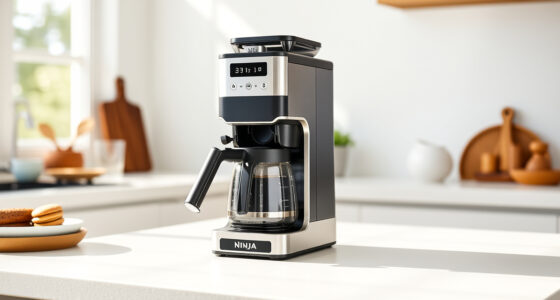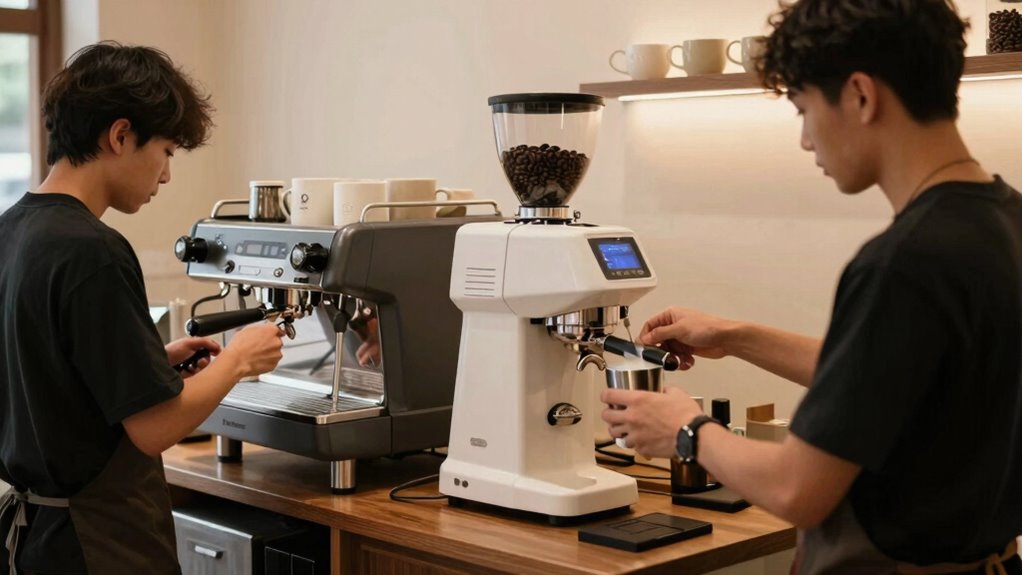

Using twin and satellite brewers together helps you match coffee volume to your service style. Twin brewers handle high demand during busy times, ensuring quick, consistent quality for large crowds. Satellite brewers offer flexibility for specialty drinks or smaller groups, fitting seamlessly into your setup. Combining these options keeps lines short and service smooth without sacrificing flavor. Want to discover how to optimize your coffee operations further? Keep going for more tips.

Get kitchen staples and gadgets delivered free with Prime
- Fast, free delivery on millions of items
- Prime Video, Amazon Music and more included
- Member-only deals all year
Key Takeaways
- Twin brewers are ideal for high-volume periods, ensuring quick, consistent coffee production during busy times.
- Satellite brewers provide flexibility for specialty drinks and smaller groups, enhancing service customization.
- Modern brewing tech ensures precise control for both twin and satellite setups, maintaining quality across service styles.
- Combining twin and satellite brewers optimizes efficiency by balancing large-volume needs with specialized offerings.
- Matching equipment to service flow reduces wait times and improves customer satisfaction with tailored coffee experiences.
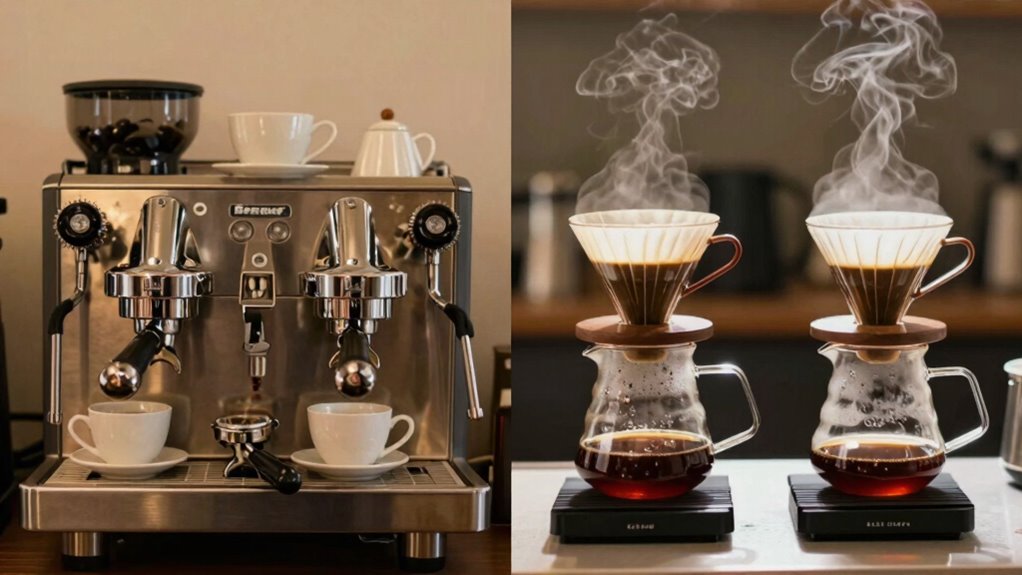
Have you ever wondered how coffee shops efficiently serve large crowds without sacrificing quality? One key to their success lies in the strategic use of twin brewers and satellite brewers. These systems enable shops to handle high volume while maintaining the consistency that customers expect. When managing a busy environment, you need solutions that balance speed with quality, and that’s where twin brewers shine. They allow you to brew multiple pots simultaneously, guaranteeing that fresh coffee is always available without long wait times. This setup is especially useful during peak hours when customer flow is at its highest.
Twin brewers help coffee shops serve large crowds quickly while maintaining consistent, fresh quality.
Satellite brewers complement twin systems by offering flexibility. They’re perfect for serving specific areas or catering to individual preferences without slowing down the overall service. You might use a satellite brewer in a separate lounge or a specialty station, giving customers access to different roasts or brewing styles. This approach helps you manage different volume demands efficiently, reducing bottlenecks and keeping service smooth. Plus, satellite brewers are portable and easy to set up, making them ideal for events or busy sections within your shop. Understanding brewing technology can also help you optimize your equipment for better performance and taste. Additionally, selecting appropriate brewing methods can enhance the flavor profiles you wish to offer and improve overall customer satisfaction. Incorporating modern brewing technology can further boost consistency and efficiency in your process.
Matching coffee volume to your service style is essential. If your shop experiences frequent high traffic, investing in twin brewers ensures you can produce enough coffee quickly, keeping lines short and customers satisfied. But it’s not just about quantity—brewing consistency is equally important. Whether you’re serving single serve cups or larger pots, you want each cup to taste just as good as the last. Modern brewing technology offers precise control over temperature and brewing time, so you can achieve reliable, high-quality results every time. This consistency reassures your customers that they’re getting the same great taste, no matter when they visit or how busy it gets.
In settings with varied demands, combining twin and satellite brewers allows you to tailor your setup to your specific service style. For instance, during morning rush hours, twin brewers can handle large volumes efficiently. As the day progresses and traffic slows, satellite brewers can serve specialty drinks or smaller groups without tying up the main system. This flexibility ensures you can meet diverse customer needs while maintaining the efficiency and brewing consistency that keep your coffee shop running smoothly. Additionally, considering brewing methods helps you select the right equipment to match your desired coffee profiles.
Ultimately, the right combination of twin and satellite brewers empowers you to match coffee volume to your service style seamlessly. It’s about balancing speed with quality, ensuring every cup is delicious and that your customers leave happy, whether they’re grabbing a quick coffee or enjoying a leisurely break.
As an affiliate, we earn on qualifying purchases.
Frequently Asked Questions
How Do Twin and Satellite Brewers Impact Overall Energy Consumption?
Twin and satellite brewers influence your overall energy consumption by affecting power usage and energy efficiency. Twin brewers, with two brewing units, often consume more power, but they can be more efficient during high-volume service, reducing waste. Satellite brewers, used for smaller loads, save energy when demand is low. By matching the brewing method to your service style, you optimize energy efficiency and manage power consumption effectively.
Can Satellite Brewers Be Easily Integrated Into Existing Coffee Stations?
Imagine fitting a new piece into a puzzle—satellite brewers can be easily integrated into your existing coffee station if your layout is flexible. You’ll want to check equipment compatibility to guarantee seamless operation. With thoughtful station layout adjustments, satellite brewers can nestle comfortably alongside your current setup, enhancing service without chaos. Their modular design makes integration smooth, turning your coffee corner into a well-orchestrated symphony of brewing efficiency.
What Maintenance Differences Exist Between Twin and Satellite Brewing Systems?
You’ll find that maintenance differs mainly in cleaning frequency and spare parts availability. Twin systems often require more frequent cleaning because of their larger capacity and complex components, while satellite brewers need less frequent cleaning but may need more spare parts due to their smaller, modular parts. Stocking spare parts for both guarantees minimal downtime; however, satellite brewers typically have easier access to replacement parts, simplifying maintenance.
Are There Specific Brands or Models Recommended for Small Cafes?
For small cafes, you should consider brands like Bunn and Fetco, which offer reliable, compact models suited for limited space. Look into Fetco’s CBS series and Bunn’s batch brewers for their ease of use, durability, and consistent quality. When comparing models, focus on capacity, brewing time, and maintenance needs. These brand recommendations and model comparisons help you choose equipment that balances efficiency, quality, and affordability for your cafe’s specific volume.
How Do Cost Considerations Compare Between Twin and Satellite Brewing Setups?
You’ll find that twin brewing setups often have higher startup expenses but can offer better cost efficiency over time, especially with large volumes. Satellite brewers usually need lower initial investments, making them ideal for smaller cafes. Consider your service style and expected coffee volume to balance startup costs with ongoing operational expenses. This way, you’ll choose a setup that maximizes cost efficiency while meeting your cafe’s needs.
Conclusion
So, next time you’re faced with a twin or satellite brewer conundrum, remember: it’s all about matching your coffee volume to your service style. Because nothing says “professional” like running out of coffee during a morning rush or wasting beans on a quiet afternoon. Choose wisely, and your caffeine game will be as flawless as your barista skills — or at least, as flawless as your coffee machine’s capacity. Cheers to perfect brews and fewer empty cups!
Columbus Day / Indigenous Peoples' Day Picks
long weekend sales
As an affiliate, we earn on qualifying purchases.