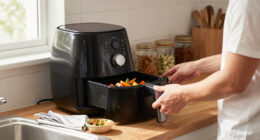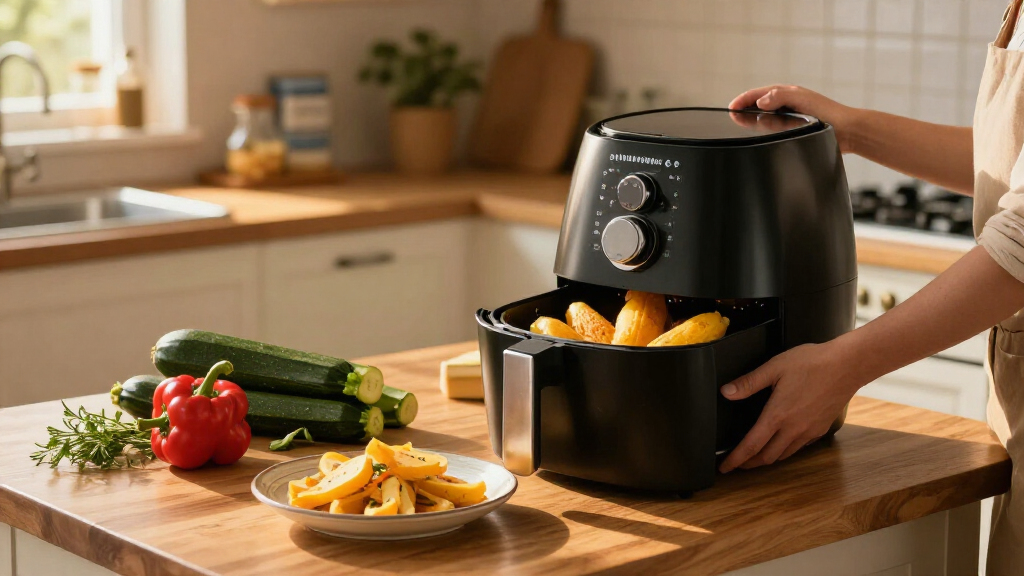
For healthier cooking, the main choice is usually between a basket-style air fryer and an oven-style air fryer. Both circulate hot air to brown food with much less added oil than deep frying, but they serve different kitchens: a basket model prioritizes quick meals and a small footprint, while an oven model gives you racks and room to cook more kinds of food at once. The healthy result depends more on what you cook and how much oil, salt, and breading you use than on the appliance shape. Choose a basket if you mainly prepare portions for one to three people; consider an oven if you need more capacity or want one countertop appliance to handle several cooking jobs.

Get kitchen staples and gadgets delivered free with Prime
- Fast, free delivery on millions of items
- Prime Video, Amazon Music and more included
- Member-only deals all year

Cosori TurboBlaze 9-in-1 Air Fryer, 6 Qt, PFAS-Free Ceramic Coating
- ✔ Capacity: 6 qt / 5.7 L
- ✔ Temperature range: 90°F–450°F
- ✔ Fan speeds: 5

Ninja Air Fryer XL with MaxCrisp, 6.5 Qt, 6-in-1, Dark Grey, AF181
- ✔ Capacity: 6.5 qt
- ✔ Cooking functions: Max Crisp, Air Fry, Air Roast, Bake, Reheat, Dehydrate
- ✔ Maximum temperature: 450°F

Dash Compact Air Fryer, 2 Quart, Cool Grey
- ✔ Capacity: 2 qt
- ✔ Wattage: 1,650 W
- ✔ Voltage: 110 V
At a Glance
| Criteria | Basket-style air fryers | Oven-style air fryers | Winner |
|---|---|---|---|
| Oil reduction and cooking results | Can crisp many foods with a small amount of oil; results depend on recipe and portion size. | Can produce similar lower-oil results; racks may help separate foods and portions. | Tie |
| Capacity and batch cooking | Best for smaller batches; crowded food may cook unevenly. | More room and multiple levels, though racks may need rotating for even cooking. | B |
| Speed and convenience | Usually quick to preheat and straightforward to operate. | More space can mean longer preheating or cooking for small portions. | A |
| Cooking flexibility | Focused on air frying, with some models offering a few extra modes. | Often includes baking, roasting, toasting, or rotisserie functions. | B |
| Cleanup | A removable basket and crisper plate are often easy to wash. | Racks, trays, and doors can take more time to clean. | A |
| Counter space | Typically compact and easy to store. | Takes up more counter space and is less convenient to store. | A |
| Value | Often costs less and delivers strong value for routine small meals. | Higher cost can make sense if its added capacity and functions replace other appliances. | Depends |
Cosori TurboBlaze 9-in-1 Air Fryer, 6 Qt, PFAS-Free Ceramic Coating
The Cosori TurboBlaze earns our top spot by balancing a family-friendly 6-quart capacity with a cooking surface that is explicitly described as PFAS-free ceramic-coated. For shoppers choosing an air fryer partly to reduce reliance on added oil, that material detail may matter alongside the appliance’s ability to crisp food with circulating air. Its basket and crisper tray are dishwasher-safe, removing some of the friction that can make frequent home cooking less appealing.Control is the Cosori’s clearest advantage over the Ninja and Dash. Five fan speeds and a temperature range from 90°F to 450°F give us more room to adjust how food cooks; the Ninja also reaches 450°F but its supplied details do not list fan-speed control, and the Dash is the basic small-meal option. The customizable preheat function and included recipe book may also help newer air-fryer cooks get started, though neither changes the appliance’s capacity limits.There are practical drawbacks. At 6 quarts, it is a substantial countertop appliance, and it requires clearance behind and above it, so a tight cooking area may rule it out. Its usable basket space is also more constrained in height when the crisper plate is in place. Compared with the larger Ninja, it gives up half a quart of stated capacity; compared with the Dash, it takes up more room but handles more substantial batches. We’d choose it for a versatile daily cooker where the ceramic coating and flexible controls are priorities.
Pros:
- PFAS-free ceramic-coated basket and crisper tray
- Five fan speeds and 90°F–450°F temperature range
- Dishwasher-safe cooking parts
- 6-quart capacity with customizable preheat
Cons:
- Requires clearance behind and above the appliance
- Slightly smaller stated capacity than the Ninja XL
Best for: Households wanting a versatile mid-to-large air fryer with a specified PFAS-free ceramic cooking surface, adjustable airflow, and dishwasher-safe parts.
Not ideal for: People with very limited counter clearance or shoppers who need the largest batch capacity available in this lineup.
Bottom line: The Cosori is our best overall choice when we want flexible controls and a specified PFAS-free ceramic surface without moving up to the Ninja’s larger footprint.
“The Cosori is our best overall choice when we want flexible controls and a specified PFAS-free ceramic surface without moving up to the Ninja’s larger footprint.”
Ninja Air Fryer XL with MaxCrisp, 6.5 Qt, 6-in-1, Dark Grey, AF181
For households that cook more than a couple of portions at once, the Ninja Air Fryer XL offers the largest stated capacity in this comparison at 6.5 quarts. Its MaxCrisp mode circulates air at temperatures up to 450°F, and the product is described as making crisp results with little to no oil. That makes it a compelling option for preparing shared meals without defaulting to a deep fryer, though the ingredients and overall meal still determine how nutritious the food is.The Ninja’s six functions—Max Crisp, Air Fry, Air Roast, Bake, Reheat, and Dehydrate—make it more of a general-purpose counter appliance than the Dash. It also edges the Cosori in capacity, which may help when cooking for a family or making several servings in one batch. The Cosori counters with five fan speeds, a broader stated temperature range down to 90°F, and a specifically PFAS-free ceramic coating. The Ninja’s supplied specifications describe its parts as nonstick but do not identify the coating material.Its basket and crisper plate are dishwasher-safe, a useful advantage over the Dash’s hand-wash-only basket. The tradeoff is counter space: at nearly 15 inches long, this is a large appliance, and its extra capacity is less valuable if we usually cook one portion. The Ninja is also heavier than the Dash, though lighter than the Cosori as listed. We’d rank it second because its batch size and function range are excellent, but the Cosori’s cooking-surface specification and finer airflow controls make it the more balanced choice for this particular guide.
Pros:
- Largest stated capacity in this lineup at 6.5 quarts
- Six cooking functions, including Bake and Dehydrate
- Up to 450°F MaxCrisp cooking with little to no oil
- Dishwasher-safe basket and crisper plate
Cons:
- Large countertop footprint
- Provided specs do not identify the nonstick coating material
Best for: Families and meal preppers who want a large air-frying basket, several cooking modes, and dishwasher-safe parts.
Not ideal for: Single cooks with limited counter space or shoppers who specifically want a documented PFAS-free ceramic coating and multiple fan speeds.
Bottom line: Choose the Ninja over the Cosori when batch capacity and multiple cooking modes matter more than specified ceramic coating and fan-speed adjustment.
“Choose the Ninja over the Cosori when batch capacity and multiple cooking modes matter more than specified ceramic coating and fan-speed adjustment.”
Dash Compact Air Fryer, 2 Quart, Cool Grey
The Dash Compact serves a different kind of healthy-cooking routine: one built around small portions and a small kitchen. Its 2-quart capacity is far below the Cosori and Ninja, but the compact footprint and 5.8-pound weight make it easier to fit on a crowded counter or move into storage. For one person making a side dish or a single serving, a smaller basket can be a better match than heating and cleaning a larger appliance.Dash describes its AirCrisp technology as cooking with up to 75% less added fat than traditional frying. That comparison is specific to traditional frying and should not be read as a guarantee about the nutrition of any recipe. The adjustable temperature and timer, auto shut-off, and cool-touch handle keep operation straightforward. By comparison, the Cosori offers more airflow settings and a much wider stated temperature range, while the Ninja adds cooking modes and enough capacity for family portions.The biggest limitation is not a small detail: 2 quarts restricts meal size. We may need to cook in batches for more than one person, which reduces the convenience advantage. Cleanup also takes more effort because the removable PTFE nonstick basket is hand-wash only; both larger picks have dishwasher-safe cooking parts. This is the right choice when space and single-serving scale come first, but it is the least adaptable option here for regular household meal prep.
Pros:
- Compact, lightweight design for small kitchens
- Adjustable temperature and timer
- Auto shut-off and cool-touch handle
- Removable basket for serving and cleaning
Cons:
- 2-quart capacity is too small for many shared meals
- Basket requires hand washing
- PTFE nonstick coating differs from the Cosori’s specified ceramic surface
Best for: Solo cooks, students, or anyone with limited counter space who primarily makes one small portion at a time.
Not ideal for: Families, batch cooks, or shoppers who want dishwasher-safe parts or a specified ceramic cooking surface.
Bottom line: The Dash makes the most sense for small kitchens and solo portions, but the Cosori or Ninja is a more practical choice for cooking multiple servings routinely.
“The Dash makes the most sense for small kitchens and solo portions, but the Cosori or Ninja is a more practical choice for cooking multiple servings routinely.”
As an Amazon Associate we earn from qualifying purchases.
Key Differences
Neither design automatically makes a meal healthy. Both can reduce the oil needed for crisping compared with deep frying, but a light coating of oil may still improve browning, and breaded or heavily salted foods remain what they are. The useful comparison is whether the appliance makes it easier to cook the foods and portions you want. Basket models are typically convenient for vegetables, potatoes, fish, and smaller servings. Their confined cooking area encourages a simple routine, though cooking too much at once can block airflow and leave food less evenly browned.
Oven-style models trade some of that simplicity for space and versatility. Racks can accommodate larger quantities or different foods, and extra modes may let the appliance handle tasks otherwise done in a toaster oven or small oven. The tradeoff is physical and practical: they occupy more counter space, may need more attention to rack positions, and often create more parts to wash. Paying more makes sense when those extra functions will see regular use. If healthy cooking means preparing uncomplicated meals for a small household, a basket model is usually the more sensible purchase.
Detailed Comparison
Oil reduction and cooking results (minor difference)
Tie; the difference is minor. Both types use circulating hot air and can crisp food with less oil than deep frying. Neither guarantees a nutritious meal: vegetables with modest seasoning and a measured amount of oil remain a different choice from salty, heavily breaded frozen snacks. For either design, leave space around food and follow a recipe suited to the appliance. Basket units can be easy to shake partway through cooking; oven racks can spread food out, but placement may affect browning.
Capacity and batch cooking (Oven-style air fryers wins — moderate)
Oven-style wins; the gap is moderate. Its racks and wider cooking area generally suit larger households, meal prep, or cooking several items at once. A basket can still feed a family if you cook in batches, but that adds time and can make a quick dinner less convenient. In either format, filling every available inch can impair airflow, so stated capacity does not always translate into evenly cooked food at maximum load.
Speed and convenience (Basket-style air fryers wins — moderate)
Basket-style wins; the gap is moderate for small meals. A smaller chamber is often ready quickly, and the basic routine is simple: add food, set time and temperature, and shake or turn it as needed. Oven models can take longer to heat and involve choosing a rack or tray. For a larger batch, though, the oven may save time by cooking more food in one round. The practical winner depends on whether your typical meal is a small serving or a full tray.
Cooking flexibility (Oven-style air fryers wins — moderate)
Oven-style wins; the gap is moderate. Many oven models include settings for baking, roasting, or toasting, and some add rotisserie functions. This can be useful if you want one appliance to cover several countertop tasks. Basket models are built around air frying, although some provide other modes. Extra buttons matter only if you will use them; buying an oven model for a long feature list that sits idle adds cost and cleaning without improving everyday meals.
Cleanup (Basket-style air fryers wins — moderate)
Basket-style wins; the gap is minor to moderate. Many basket models have just a basket and crisper plate to wash, though grease and stuck-on coating still need attention. Oven models may have several racks and trays, plus surfaces around the door that catch splatters. Removable parts and dishwasher guidance vary by product, so check the manual before buying. If cleanup is what stops you from cooking at home, fewer components can make the basket easier to use often.
Counter space (Basket-style air fryers wins — major)
Basket-style wins; the gap is major in a small kitchen. Its compact shape generally leaves more room for preparation and is easier to store between uses. Oven-style appliances can be bulky and may need a permanent countertop spot. Measure the appliance and allow the clearance its manufacturer specifies, including room for heat and ventilation. A larger model is a poor fit if it makes the cooking area harder to use every day.
Value (moderate difference)
Depends; the difference is moderate. Basket models often cost less and provide strong value when the job is making small, quick meals. An oven model can justify a higher price if you use its additional capacity and settings regularly, or if it replaces other appliances you would otherwise buy. Compare usable capacity, included accessories, warranty, and cleaning effort rather than relying on a feature count. Paying extra for functions you rarely use is poor value.
Basket-style air fryers: Pros and Cons
Pros:
- Compact footprint suits small kitchens.
- Simple setup works well for everyday portions.
- Often quick to heat and easy to clean.
- Usually less expensive than an oven-style model.
Cons:
- Limited room can require multiple batches.
- Overfilling the basket may reduce even browning.
- Usually offers fewer cooking functions.
Oven-style air fryers: Pros and Cons
Pros:
- More room for larger portions or multiple foods.
- Racks and trays support a wider range of cooking tasks.
- Extra functions may replace other countertop appliances.
Cons:
- Takes up more counter space.
- Multiple accessories can add cleanup.
- May cost more and take longer to heat for small meals.
Who Should Choose What
Choose Basket-style air fryers if:
- You cook for one to three people and value fast weeknight meals.
- Your counter space is limited or you want to store the appliance away.
- You mainly want to crisp vegetables, potatoes, fish, or smaller portions and prefer simple cleanup.
Choose Oven-style air fryers if:
- You regularly cook for several people or prepare multiple portions.
- You want racks and settings for jobs such as roasting, baking, or toasting.
- You have room for a permanent countertop appliance and will use its added capacity or functions often.
Skip both if: Skip both if your kitchen cannot accommodate either appliance safely, or if your preferred meals are better cooked in a pot, pan, or conventional oven and you would rarely use an air fryer.
Value for Money
A basket air fryer is usually the better value for a small household because it costs less, takes up less room, and covers the central job of crisping food with little added oil. The higher price of an oven-style model is worthwhile when its extra capacity prevents repeated batches or its cooking modes replace other appliances you use. Compare the full routine, including accessories and cleanup: a feature is worth paying for only when it makes a meal you actually cook easier. Neither style deserves a premium simply for the promise of healthier eating, since ingredients and cooking habits determine much of that outcome.
Final Verdict
For most people buying an air fryer mainly to cook smaller everyday meals with less oil, choose a basket-style model. It is compact, simple, and usually the easier value. Choose an oven-style model if you regularly cook larger quantities or will use its extra modes enough to justify the price and counter space. The biggest deciding factor is your usual batch size: small servings favor the basket; family-sized or multi-item cooking favors the oven. If you are unsure and have limited space, start with a basket model sized for your household.
Frequently Asked Questions
Which air fryer is better for healthy cooking?
Neither shape has a clear health advantage. Both can brown foods with less added oil than deep frying. Your ingredients, seasoning, portion size, and cooking method matter more than whether the appliance has a basket or racks.
Does an oven-style air fryer use less oil than a basket model?
Not by design. Both circulate hot air, and the amount of oil depends on the recipe and food. A light coating can help browning in either model; the oven format does not automatically make a meal lower in fat.
Is a basket air fryer large enough for a family?
It can be, depending on serving size and basket capacity. If food needs to be piled up or cooked in several rounds, an oven-style model may be more convenient. Check usable capacity and plan to leave room for air to circulate.
Is the more expensive oven-style model worth buying?
It is worth the extra cost if you will regularly use its larger cooking area or additional settings. If you mostly make quick, small portions, a basket model is likely better value because you pay for fewer functions and get simpler cleanup.