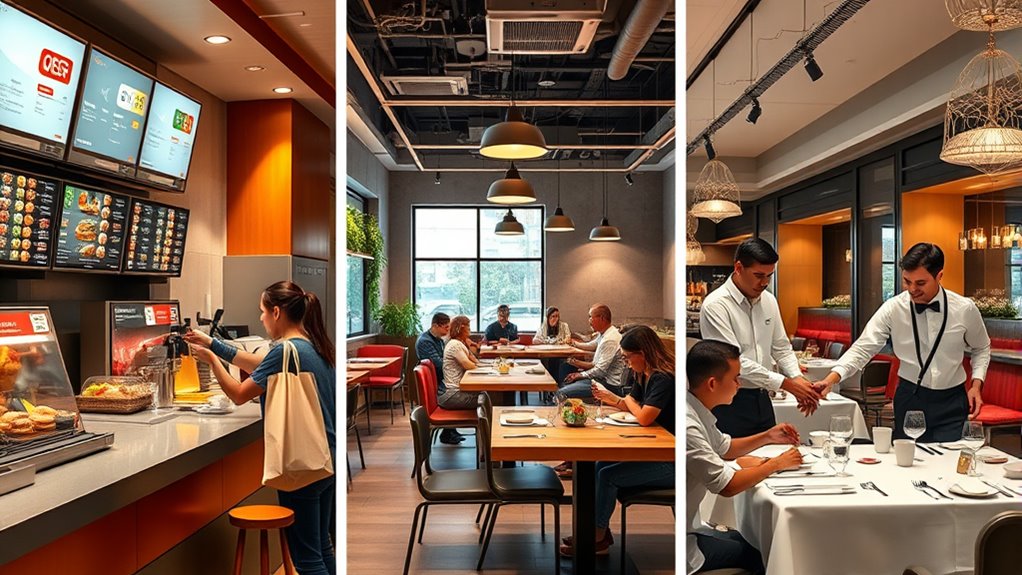

Quick-service restaurants (QSRs) focus on fast, convenient meals with minimal customization, serving you within minutes. Fast casual places offer a bit more variety, quality ingredients, and allow some customization, all while still keeping service relatively quick. Full-service restaurants provide a relaxed atmosphere with extensive menus, personalized service, and longer dining times. Understanding these differences helps you choose the right experience—if you want to learn more about what sets each apart, keep exploring.
Key Takeaways
- QSRs (Quick Service Restaurants) prioritize speed, limited options, and minimal customization for fast, convenient meals.
- Fast casual restaurants offer more menu variety, fresh ingredients, and moderate customization with quicker service than full-service.
- Full-service establishments feature extensive menus, personalized service, longer dining times, and a focus on ambiance and experience.
- Service speed decreases from QSR to full-service, with QSRs being the fastest and full-service offering a leisurely experience.
- Each restaurant type caters to different needs: QSRs for quick bites, fast casual for quality and speed, full-service for detailed, leisurely dining.
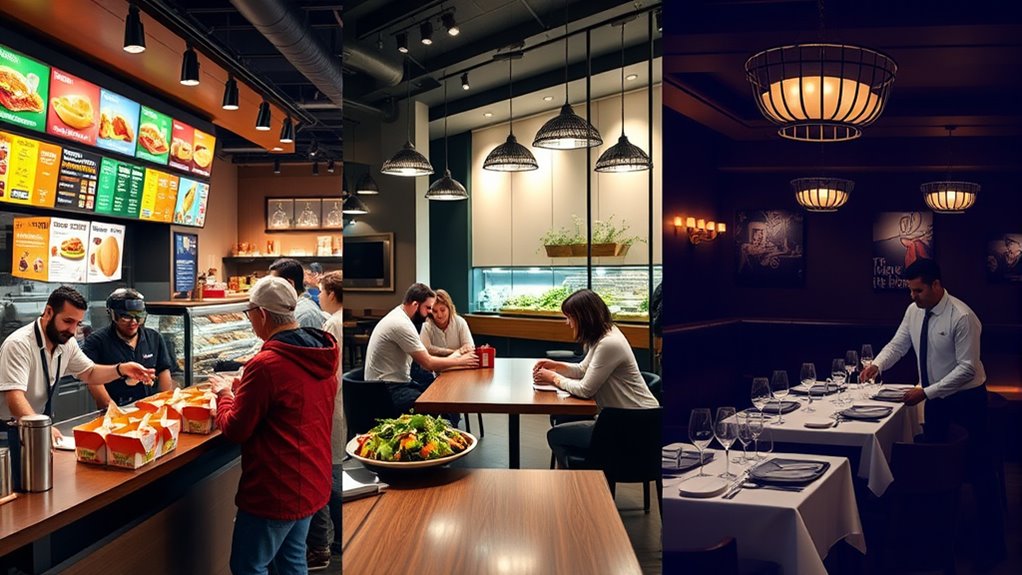
When choosing where to dine, understanding the differences between Quick Service Restaurants (QSR), fast casual, and full-service establishments can help you make better decisions. These types of restaurants vary noticeably in how they operate, the experience they offer, and what you can expect from your meal. One of the key distinctions is menu customization. In QSRs, menus tend to be straightforward, with limited options and little room for personalization. You typically select from pre-set items, and modifications are minimal or not available at all. Service speed is a top priority here, so you can expect your order to be prepared quickly—often within minutes—making these spots ideal for a fast, convenient meal. Think of places like McDonald’s or Burger King, where efficiency is king, and your focus is on grabbing a quick bite without much fuss.
Quick service restaurants focus on speed, with straightforward menus and minimal customization.
Fast casual restaurants strike a balance between speed and quality. Their menus usually offer more variety and flexibility, allowing you to customize your order to some extent. For example, at a place like Chipotle or Panera Bread, you can choose specific ingredients or toppings, tailoring your meal to your preferences. Service speed remains relatively fast, but it’s slightly slower than a typical QSR because of the additional preparation and customization involved. These restaurants often emphasize fresh ingredients and a more inviting atmosphere, making them suitable when you want a quick yet more satisfying dining experience. You might find yourself waiting a little longer, but the trade-off is a higher-quality meal that feels more personalized. Additionally, many fast casual spots utilize modern ordering systems to streamline the process and reduce wait times.
Full-service restaurants take the concept of menu customization and service to a whole new level. Here, you’re greeted by staff who take your order at your table, and they often offer recommendations or specializations. The menu is typically extensive, giving you a wide range of options, and you can usually request modifications or special preparations. Service speed is less of a concern because the focus is on the dining experience itself. You might spend 30 minutes or more enjoying your meal, but you gain a more relaxed and personalized environment. This setup is perfect for special occasions, business dinners, or when you’re craving a more refined, tailored experience. While the wait may be longer, the quality of service and menu customization makes it worth your while.
Each type of restaurant serves a different purpose, whether you’re rushing through lunch, seeking a quick but quality meal, or settling in for a leisurely dining experience. Knowing these differences can help you pick the right spot based on your needs, preferences, and how much time you want to spend.
Frequently Asked Questions
How Do Pricing Strategies Differ Among QSR, Fast Casual, and Full Service?
You’ll notice that pricing strategies differ across QSR, fast casual, and full service restaurants. QSRs often use competitive pricing models to attract quick, budget-conscious customers, emphasizing value perceptions. Fast casual places balance quality and affordability with moderate prices, appealing to those seeking better value. Full-service restaurants typically adopt premium pricing models, reflecting higher service levels and ambiance, which shape customer perceptions of exclusivity and quality.
What Are the Typical Staffing Requirements for Each Restaurant Type?
You’ll find staffing requirements vary by restaurant type. In QSRs, you need a lean team focusing on quick employee scheduling and efficient staff training to keep service fast. Fast casuals require more staff for order taking and table clearing, with ongoing staff training to maintain quality. Full-service restaurants demand the largest team, with extensive employee scheduling and all-encompassing staff training to provide personalized service and manage multiple roles seamlessly.
How Does Customer Service Quality Vary Across These Restaurant Categories?
Customer service quality varies like a spectrum across these categories. In quick-service restaurants, you’ll notice rapid service but sometimes less consistency, impacting the guest experience. Fast casual spots strike a balance, offering friendly, consistent service that enhances your visit. Full-service restaurants prioritize personalized attention, elevating the guest experience through attentive staff. Your overall satisfaction depends on how well each category maintains service consistency to meet your expectations and guarantee a memorable dining experience.
Which Restaurant Type Has the Highest Profit Margins?
You’ll find that fast casual restaurants typically have the highest profit margins. They benefit from lower labor costs and streamlined operations, allowing more focus on high-margin revenue streams like premium menu items. Quick Service Restaurants (QSRs) often generate steady revenue streams through high volume, but their profit margins are generally lower due to higher operational costs. Full service restaurants tend to have the lowest profit margins, balancing higher labor and overhead expenses.
How Does Menu Flexibility Compare Between QSR, Fast Casual, and Full Service?
You’ll find that full-service restaurants offer the most menu flexibility, allowing for extensive menu customization and ingredient flexibility to cater to diverse customer preferences. Fast casual places provide moderate flexibility, with some customization options but more streamlined menus. QSRs usually have limited menu customization, focusing on quick service and standardized ingredients. Your choice depends on how much menu flexibility and ingredient customization you want for your dining experience.
Conclusion
Understanding the differences between QSR, fast casual, and full service restaurants helps you choose the perfect dining experience. Did you know that the fast casual segment is growing at over 10% annually? This shows more people prefer quality and convenience without the full-service price tag. So, next time you’re deciding where to eat, remember these distinctions and trends—you might find yourself exploring new options that fit your mood and budget perfectly.