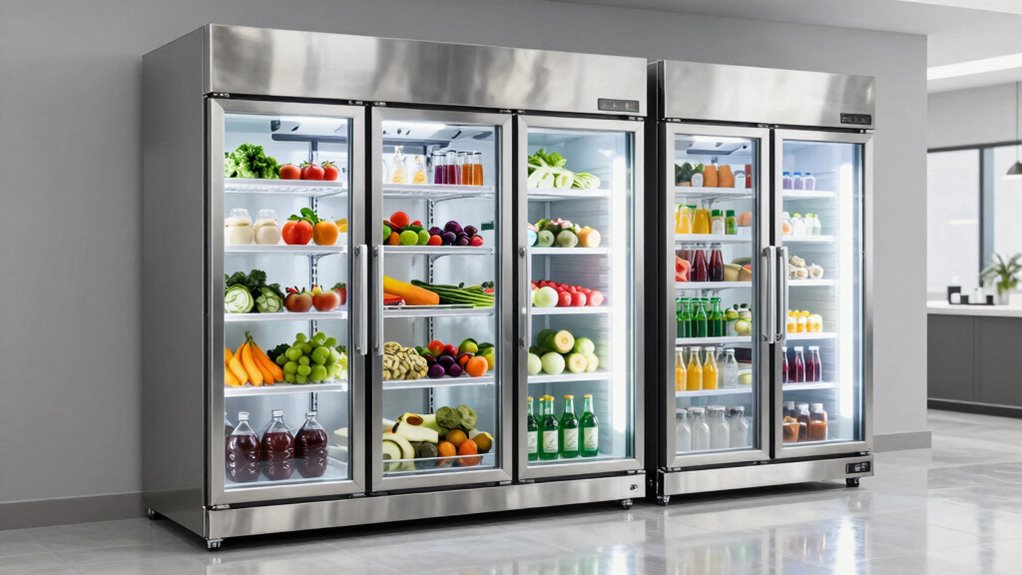

If you’re choosing between roll-in refrigerators and reach-ins, consider how your kitchen operates. Roll-ins are larger, with better insulation, making them ideal for bulk storage and routine deliveries, while reach-ins are compact and offer quick access to ingredients in busy prep areas. Your decision impacts energy use, workflow, and space. Want to discover more about how each unit can fit your specific needs? Keep going to find out which one suits you best.

Get kitchen staples and gadgets delivered free — and shop member deals
- Fast, free delivery on millions of items
- Access to Prime Big Deal Days deals on October 6–7
- Prime Video, Amazon Music and more included
Key Takeaways
- Roll-in refrigerators excel in bulk storage and facilitate easy loading/unloading of large carts, ideal for back-of-house operations.
- Reach-in units are more compact, offering quick access to ingredients, suitable for prep areas with limited space.
- Roll-ins provide better insulation and energy efficiency for large quantities, reducing cold air loss during frequent door openings.
- Reach-ins deliver precise temperature control and rapid ingredient retrieval, enhancing speed in high-volume service settings.
- The choice impacts workflow, storage capacity, and energy use, with roll-ins suited for bulk storage and reach-ins for quick access.
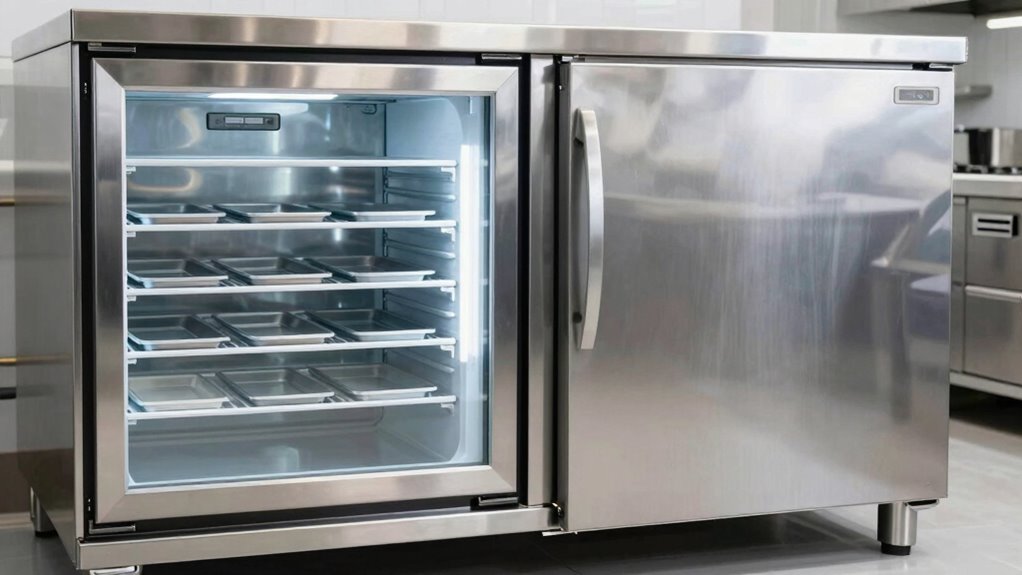
When choosing between roll-in and reach-in refrigerators, understanding their differences can considerably impact your kitchen’s efficiency and workflow. Both types serve essential roles, but their design and operational features influence how smoothly your kitchen runs. One of the key factors to weigh is energy efficiency. Roll-in refrigerators are generally more energy-efficient because they often have better insulation and tighter seals, reducing cold air loss when the door is opened. This can translate into lower electricity bills over time, especially in busy kitchens where doors are frequently accessed. Proper insulation properties of these units play a vital role in their overall energy performance. Additionally, their ability to maintain temperature with minimal fluctuations contributes to more sustainable operations. Energy conservation strategies can further enhance overall kitchen efficiency and reduce environmental impact.
Temperature consistency is another critical aspect that differentiates these units. Roll-in refrigerators tend to provide more uniform temperature control across the entire interior because they are built with larger, more insulated compartments. This makes them ideal for storing large quantities of perishable items that need to stay at a consistent temperature. The bulkiness of these units, however, means they often require more time to reach the desired temperature after being stocked or defrosted. Reach-in refrigerators are designed for rapid access, with smaller internal spaces and often more precise temperature controls, which help keep stored items uniformly chilled. They’re perfect for quick, frequent access to ingredients, but you need to monitor them closely to ensure temperature consistency isn’t compromised, especially during high-volume periods. An understanding of refrigeration technology can help optimize their operation and performance.
Your decision should also factor in workflow and space constraints. Roll-in refrigerators are larger and usually installed in back-of-house areas, making them suitable for bulk storage and long-term inventory. Their design allows multiple staff members to load and unload large carts or dollies directly into the unit, streamlining large deliveries. Reach-in refrigerators are more compact, fitting neatly into tighter spaces and making them ideal for front-of-house or prep areas where quick access is essential. They facilitate fast-paced operations where chefs or staff need to grab ingredients swiftly without disturbing the entire unit. Moreover, choosing the right type can also contribute to energy conservation and environmental sustainability in your kitchen. Additionally, selecting units with advanced refrigeration technology can further optimize efficiency and reduce environmental impact.
As an affiliate, we earn on qualifying purchases.
Frequently Asked Questions
Which Refrigerator Type Is More Energy-Efficient?
Reach-in refrigerators are generally more energy-efficient than roll-in refrigerators because they have better insulation and less door opening and closing. This reduces energy consumption and minimizes environmental impact. You’ll notice lower utility bills and a smaller carbon footprint when choosing a reach-in. Their design keeps cold air contained, making them a smarter, more sustainable option for your operation, especially if energy efficiency is a priority.
How Do Cleaning Requirements Differ Between Models?
You’ll find that roll-in refrigerators demand more frequent cleaning and stricter sanitization procedures due to their open access design, which exposes internal components to contaminants. Reach-ins, with their sealed doors, typically require less frequent cleaning, making maintenance easier. While both models need routine sanitation, roll-ins challenge you to keep up with their higher cleaning frequency to guarantee food safety, whereas reach-ins offer simpler, more straightforward cleaning routines.
Are There Size Limitations for Each Type?
You’ll find that both roll-in and reach-in refrigerators have size limitations based on storage capacity and installation space. Reach-ins typically fit well in smaller kitchens with limited space, offering a range of sizes but limited capacity. Roll-ins usually provide larger storage options, but require more installation space due to their design. Carefully measure your available area and storage needs to choose the model that best fits your operational requirements.
How Do Temperature Controls Compare?
You’ll find that temperature controls in both roll-in refrigerators and reach-ins aim for temperature consistency, but reach-ins often offer more precise adjustments. Reach-ins typically feature user-friendly controls accessible from the outside, making it easier for you to monitor and adjust temperatures quickly. Roll-ins might have more complex systems, requiring more effort to maintain consistent temperatures. Overall, reach-ins tend to provide better user accessibility for temperature management.
Which Is More Cost-Effective Long-Term?
Reach-ins are generally more cost-effective long-term because they offer better storage capacity without high installation complexity. They’re easier to maintain and tend to have lower initial costs, saving you money upfront. Roll-in refrigerators, while convenient for handling large quantities and flexible storage, often require more complex installation and maintenance, leading to higher costs over time. So, if budget is a concern, reach-ins are usually the smarter choice.
Conclusion
So, whether you prefer the sleek, fancy roll-in or the no-nonsense reach-in, remember—your choice says a lot about your kitchen style. Just don’t pretend one’s magically better; they’re both just cold boxes with a personality. Go ahead, pick your favorite, and enjoy the endless debate. After all, who needs practicality when you can have the perfect fridge to impress your friends—until they realize you’ve been arguing about refrigerators all along.
Halloween Picks
halloween
As an affiliate, we earn on qualifying purchases.