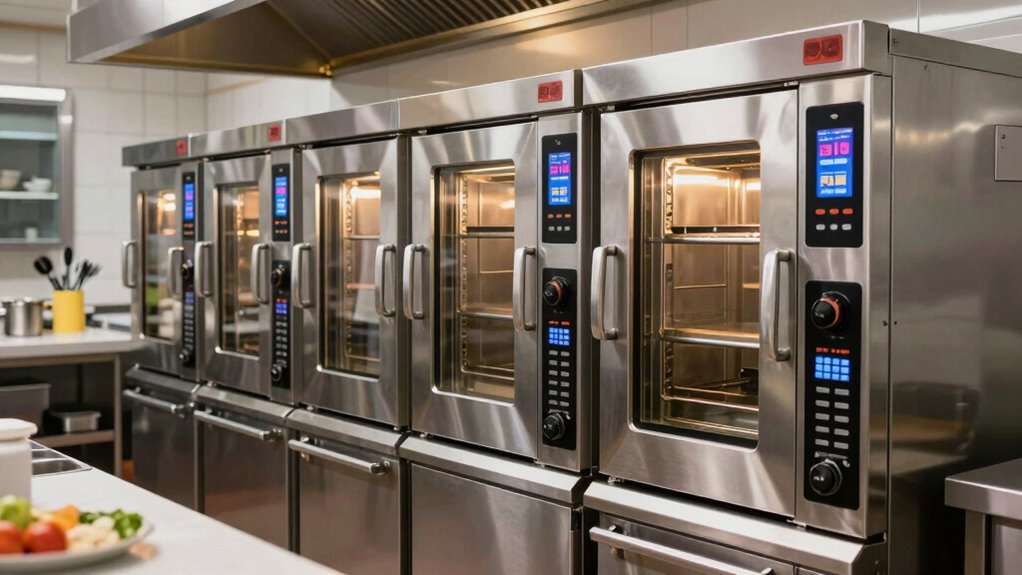
Choosing the right commercial holding oven for a restaurant involves balancing capacity, versatility, and operational efficiency. For high-volume baking and rapid heat distribution, the VEVOR Commercial Convection Oven stands out with its four-rack design and advanced convection system. Meanwhile, the Kratos Full Size Commercial Holding and Proofing Cabinet excels for managing large quantities of prepared food, offering flexible holding and proofing capabilities. Each has distinct strengths and tradeoffs, making it essential to match the oven to your restaurant’s specific needs.

Get kitchen staples and gadgets delivered free with Prime
- Fast, free delivery on millions of items
- Prime Video, Amazon Music and more included
- Member-only deals all year
Key Takeaways
- The VEVOR convection oven is ideal for high-volume baking with rapid, even heat distribution, but requires a powerful electrical setup.
- The Kratos holding and proofing cabinet offers large capacity and flexible temperature control for food prep and storage, though it lacks insulation for energy efficiency.
- Size and electrical requirements are the main tradeoffs—larger capacities often mean bigger power needs and more space considerations.
- Both options prioritize durability and ease of use, but their suitability depends heavily on whether baking or holding is the primary need.
- Understanding your kitchen’s workflow and electrical infrastructure is key to choosing the right commercial oven.
| VEVOR Commercial Convection Oven, 4.24 cu ft / 120L Countertop Electric Oven with 4 Racks, 208-240V 5000W |  | Best for High-Volume Baking | Capacity: 4.24 cu ft (120 L) | Rack Positions: 4 | Voltage: 208-240 V | VIEW ON AMAZON | See Our Full Breakdown |
| Kratos Full Size Commercial Non-Insulated Holding and Proofing Cabinet |  | Best for Food Holding and Proofing | Capacity: 36 full-size pans | Holding Temperature Range: 80°F to 185°F | Proofing Temperature Range: 85°F to 115°F | VIEW ON AMAZON | See Our Full Breakdown |
| commercial holding oven for restaurant | Capacity | Rack Positions | Voltage | Power |
|---|---|---|---|---|
| VEVOR Commercial Convection Ov | 4.24 cu ft (120 L) | 4 | 208-240 V | 3800-5000 W |
| Kratos Full Size Commercial No | 36 full-size pans | — | — | — |
More Details on Our Top Picks
VEVOR Commercial Convection Oven, 4.24 cu ft / 120L Countertop Electric Oven with 4 Racks, 208-240V 5000W
This VEVOR convection oven is tailored for restaurants needing rapid, consistent baking with a large capacity. The four-rack design supports multiple batches simultaneously, which is a clear advantage for bakeries or pizzerias with high throughput. Its dual convection fans and 360° hot air circulation ensure even heating, reducing bake times and improving product quality. Compared with smaller countertop units, this model’s size and power draw demand a robust electrical setup, and the large footprint may not suit tight kitchens. Still, its durability and flexible temperature range make it a strong choice for high-volume baking environments.
Pros:- Large four-tier capacity supports high-volume batch baking
- Dual convection fans provide rapid, even heat distribution
- Durable stainless steel construction is easy to clean
- Wide temperature range and 120-minute timer
Cons:- Requires a 208-240V electrical supply with high power capacity
- Large size may be unsuitable for compact kitchens
- High power consumption
Best for: Restaurants with high baking volume, such as bakeries, pizzerias, and busy cafes
Not ideal for: Small kitchens or operations primarily focused on holding prepared food without baking needs
- Capacity:4.24 cu ft (120 L)
- Rack Positions:4
- Voltage:208-240 V
- Power:3800-5000 W
- Temperature Range:86°F to 572°F (30°C to 300°C)
- Timer:120 minutes
Our verdict“This oven excels in high-volume baking environments where capacity and speed are priorities, but it demands a significant electrical setup.”
Kratos Full Size Commercial Non-Insulated Holding and Proofing Cabinet
The Kratos holding and proofing cabinet is designed for restaurants that need to store and proof large quantities of food efficiently. Its capacity for up to 36 full-size pans makes it suitable for busy kitchens managing prep and service flow. The adjustable temperature range supports both holding (80°F to 185°F) and proofing (85°F to 115°F), with an easy-to-read LED display for precise monitoring. The removable heating drawer simplifies cleaning, but the non-insulated design means it consumes more energy to maintain temperatures, which could impact operational costs over time. This model is ideal for kitchens prioritizing food management rather than baking or high-heat cooking.
Pros:- Large capacity for up to 36 full-size pans
- Flexible temperature control for holding and proofing
- Easy-to-read LED display
- Removable heating drawer simplifies maintenance
Cons:- Non-insulated design may lead to higher energy costs
- Limited to holding and proofing functions, not baking or cooking
- Warranty restrictions for residential use
Best for: Restaurants needing large-scale holding and proofing with flexible temperature control
Not ideal for: Kitchens focused solely on baking or those with limited space for full-size cabinets
- Capacity:36 full-size pans
- Holding Temperature Range:80°F to 185°F
- Proofing Temperature Range:85°F to 115°F
- Insulation:Non-insulated
- Display:LED
- Warranty:1-year limited
Our verdict“This cabinet provides ample capacity and versatile temperature control for large-scale food management, though energy efficiency is a concern.”
How We Picked
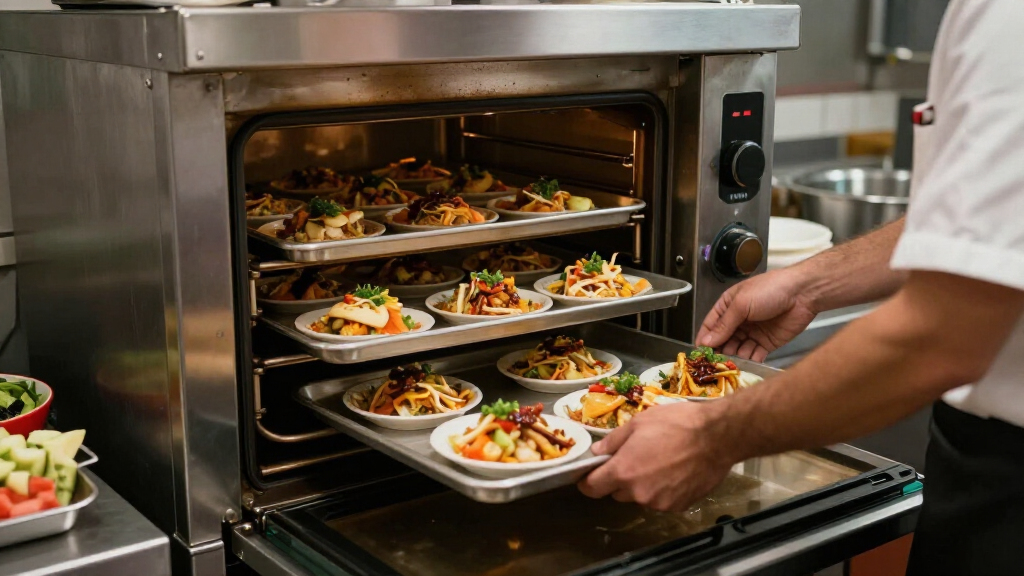
Our selection process focused on commercial-grade ovens that suit restaurant environments, emphasizing capacity, versatility, and operational efficiency. We compared products based on their core functions—baking versus holding and proofing—and evaluated their build quality, ease of use, power requirements, and size. The goal was to identify options that balance performance with practical considerations like installation and maintenance, ensuring each pick offers a clear advantage for different types of restaurant operations.
Factors to Consider When Choosing Commercial Holding Oven For Restaurant
Choosing between a convection oven and a holding/proofing cabinet depends on your restaurant’s primary needs. Capacity, versatility, electrical infrastructure, and space are key considerations. High-volume bakeries or pizzerias will benefit most from a convection oven with multiple racks, while kitchens that focus on managing prepped food will find large holding and proofing cabinets more suitable. Understanding the specific workflows and space constraints will help determine the best investment.
Capacity and Size
Ovens like the VEVOR model emphasize high baking capacity, ideal for busy kitchens that need to produce large quantities quickly. Conversely, holding and proofing cabinets like Kratos focus on large storage capacity, which is crucial for managing pre-cooked or pre-proofed items. Measure your available space carefully to ensure your chosen oven fits comfortably while meeting your volume demands.
Power and Electrical Requirements
High-capacity convection ovens often require robust electrical setups, such as 208-240V outlets capable of handling several thousand watts. If your kitchen’s electrical system is limited, this could mean additional upgrades. Holding cabinets typically consume less power but may impact energy bills if non-insulated. Balance your energy capacity with your operational needs.
Functionality and Use Cases
Consider whether your focus is on baking or food holding and proofing. Convection ovens excel at baking, roasting, and rapid heating, while holding cabinets are better for maintaining temperature and proofing dough. Some kitchens might benefit from combining both, but for most, choosing a specialized appliance will be more efficient.
Maintenance and Durability
Durability matters in a commercial setting. Stainless steel exteriors like in the VEVOR model resist corrosion and are easy to clean. For holding cabinets, removable drawers simplify cleaning routines. Think about long-term maintenance costs and how the design supports daily use.
Frequently Asked Questions
What is the main difference between a convection oven and a holding cabinet?
A convection oven is primarily designed for baking, roasting, and high-heat cooking, utilizing fans to circulate hot air for even results. A holding cabinet, on the other hand, is meant to keep prepared food at serving temperature, often with proofing capabilities. The choice depends on whether your kitchen needs rapid cooking or efficient food storage and management.
Can I use a convection oven for proofing dough?
While some convection ovens include a proofing mode, most are optimized for baking and may not provide the precise humidity and temperature stability required for proofing. For dedicated proofing, a specialized cabinet like the Kratos model offers more consistent results, especially when managing large quantities of dough.
What electrical considerations should I keep in mind?
High-capacity convection ovens typically demand a 208-240V supply with high wattage, potentially requiring electrical upgrades in smaller kitchens. Holding cabinets generally consume less power but might still impact your energy bills if they are non-insulated. Planning your electrical infrastructure beforehand ensures smooth installation and operation.
Is a non-insulated holding cabinet energy-efficient?
Non-insulated cabinets tend to consume more energy to maintain temperature, especially in cooler environments. While they can be more affordable upfront, the ongoing energy costs might offset initial savings. For energy efficiency, consider insulated models if your budget allows, but non-insulated options remain suitable for short-term or occasional use.
How do size and capacity impact my choice?
Size and capacity directly influence workflow and kitchen layout. Larger models like the Kratos holding cabinet are ideal for operations that need to manage large quantities of food, but require more space and power. Smaller, high-capacity ovens are better suited for kitchens with limited space but high baking demands. Matching capacity to your volume needs ensures efficiency without overcrowding.
Conclusion
If your restaurant’s focus is on high-volume baking, the VEVOR Commercial Convection Oven makes the most sense, especially if your electrical system can support its power needs. For operations centered around food prep, holding, and proofing, the Kratos full-size cabinet offers ample capacity and versatile temperature controls. Smaller venues or those with space constraints might prefer compact, dedicated ovens or holding units, while larger establishments should consider investing in equipment that scales with their volume and workflow demands.
Columbus Day / Indigenous Peoples' Day Picks
long weekend sales
As an affiliate, we earn on qualifying purchases.