
For most new AM5 gaming builds, I’d start with the ASUS ROG Strix B850-A Gaming WiFi: its four M.2 slots, Wi-Fi 7, and PCIe 5.0 support make it a strong feature-and-flexibility pick. The MSI MAG X870 Tomahawk WiFi stands out for newer connectivity, including USB 40Gbps and 5Gbps LAN, while the GIGABYTE B650 Eagle AX is a simpler route to an AM5 DDR5 system. The main tradeoffs are platform age, expansion and connectivity, board size, and whether premium features justify their extra complexity for your build. I compare all 15 options below so you can match the board to your processor, case, and upgrade plans.

Get kitchen staples and gadgets delivered free with Prime
- Fast, free delivery on millions of items
- Prime Video, Amazon Music and more included
- Member-only deals all year
Key Takeaways
- AM5 and AM4 are not interchangeable upgrade paths. The B850, B650, and X870 boards use AM5 with DDR5, while the B550 models use AM4 and DDR4; choose based on your processor and memory, not just the board’s gaming branding.
- The B850-A is the most balanced feature pick in this lineup. Four M.2 slots and Wi-Fi 7 make it more flexible than the B650 Eagle AX, which offers three M.2 slots and Wi-Fi 6E.
- The X870 boards trade affordability for newer I/O and expansion. The X870 Tomahawk adds USB 40Gbps, Wi-Fi 7, and 5Gbps LAN; the X870E-E adds five M.2 slots and extensive power and tuning features for more demanding builds.
- Compact builds have a distinct choice, not a smaller ATX substitute. The ROG Strix B850-G is micro-ATX, while the X870-I is Mini-ITX; case fit and limited expansion should guide the choice before feature lists do.
- Several B550 options still make sense for an existing AM4 system. They can suit a targeted CPU or board replacement, but buying one for a new build means accepting DDR4 and a different upgrade path from the AM5 choices.
| ASUS ROG Strix B850-G Gaming WiFi AMD AM5 mATX Motherboard |  | Best Compact AM5 Gaming Pick | Socket: AM5 | Chipset: AMD B850 | Processor support: AMD Ryzen 9000, 8000, and 7000 series | VIEW ON AMAZON | See Our Full Breakdown |
| MSI B550 Gaming WiFi 6E ATX Motherboard |  | Best for Reusing an AM4 Gaming Build | Socket: AM4 | Chipset: AMD B550 | Processor support: AMD Ryzen 5000, 4000 G-Series, and 3000 series | VIEW ON AMAZON | See Our Full Breakdown |
| ASUS ROG Strix B850-A Gaming WiFi AMD AM5 B850 ATX Motherboard |  | Best for Multi-Drive AM5 Gaming Builds | Socket: AM5 | Chipset: AMD B850 | Processor support: AMD Ryzen 9000, 8000, and 7000 series | VIEW ON AMAZON | See Our Full Breakdown |
| GIGABYTE B650 Eagle AX AM5 LGA 1718 ATX Motherboard |  | Best Value-Oriented AM5 Gaming Foundation | Socket: AM5 | Chipset: AMD B650 | Processor support: AMD Ryzen 9000, 8000, and 7000 series | VIEW ON AMAZON | See Our Full Breakdown |
| ASUS ROG Strix B550-F Gaming WiFi II AMD B550 ATX Motherboard |  | Best AM4 Networking and Expansion Pick | Socket: AM4 | Chipset: AMD B550 | Processor support: AMD Ryzen 3000 and 5000 series | VIEW ON AMAZON | See Our Full Breakdown |
| MSI MAG B850 Tomahawk MAX WiFi Motherboard |  | Best for Next-Gen Connectivity | Socket: AM5 | Chipset: AMD B850 | Compatible processors: AMD Ryzen 9000, 8000, and 7000 series | VIEW ON AMAZON | See Our Full Breakdown |
| ASUS TUF Gaming B650E-PLUS WiFi |  | Best for Easy DIY Builds | Socket: AM5 | Chipset: AMD B650 | Compatible processors: AMD Ryzen 9000, 8000, and 7000 series | VIEW ON AMAZON | See Our Full Breakdown |
| MSI MAG X870 Tomahawk WiFi Gaming Motherboard |  | Best for USB 4 and Modern I/O | Socket: AM5 | Chipset: AMD X870 | Compatible processors: AMD Ryzen 9000, 8000, and 7000 series | VIEW ON AMAZON | See Our Full Breakdown |
| MSI MPG X870E Carbon WiFi Gaming Motherboard |  | Best Premium Expansion Pick | Socket: AM5 | Listed chipset: AMD X870 | Compatible processors: AMD Ryzen 9000, 8000, and 7000 series | VIEW ON AMAZON | See Our Full Breakdown |
| ASUS ROG Strix B650-A Gaming WiFi |  | Best for a Balanced AM5 Gaming Build | Socket: AM5 | Chipset: AMD B650 | Compatible processors: AMD Ryzen 7000, 8000, and 9000 series | VIEW ON AMAZON | See Our Full Breakdown |
| MSI MPG B550 Gaming Plus V1 Gaming Motherboard |  | Best AM4 Gaming Pick | Socket: AM4 | Chipset: AMD B550 | Memory: Dual-channel DDR4, up to 128 GB; listed up to 4400 MHz | VIEW ON AMAZON | See Our Full Breakdown |
| ASUS ROG Strix X870-I Gaming WiFi AMD X870 AM5 DDR5 Motherboard |  | Best Compact AM5 Gaming Board | Socket: AM5 | Chipset: AMD X870 | Form factor: Mini-ITX | VIEW ON AMAZON | See Our Full Breakdown |
| GIGABYTE B550 Gaming X V2 AMD AM4 Motherboard |  | Best Straightforward AM4 Build | Socket: AM4 | Chipset: AMD B550 | Memory: DDR4; 4 slots; up to 128 GB | VIEW ON AMAZON | See Our Full Breakdown |
| ASUS ROG Strix X870E-E Gaming WiFi AMD AM5 X870 ATX Motherboard |  | Best for Feature-Heavy Premium Builds | Socket: AM5 | Chipset: AMD X870E | Form factor: ATX | VIEW ON AMAZON | See Our Full Breakdown |
| ASUS ROG Strix X870-A Gaming WiFi AMD AM5 X870 ATX Motherboard |  | Best Balanced Premium AM5 Pick | Socket: AM5 | Chipset: AMD X870 | Form factor: ATX | VIEW ON AMAZON | See Our Full Breakdown |
| premium amd motherboards for gaming | Socket | Memory | Chipset | Networking |
|---|---|---|---|---|
| ASUS ROG Strix B850-G Gaming W | AM5 | DDR5; 4 slots; up to 256 GB | AMD B850 | WiFi 7 |
| MSI B550 Gaming WiFi 6E ATX Mo | AM4 | 4 DDR4 DIMM slots; up to 4800+ MHz (overclocked) | AMD B550 | WiFi 6E, Bluetooth 5.3, and 1 Gbps LAN |
| ASUS ROG Strix B850-A Gaming W | AM5 | DDR5; 4 slots; up to 192 GB | AMD B850 | WiFi 7 and 2.5G LAN |
| GIGABYTE B650 Eagle AX AM5 LGA | AM5 | DDR5; 4 slots; up to 128 GB listed | AMD B650 | WiFi 6E and GbE LAN |
| ASUS ROG Strix B550-F Gaming W | AM4 | DDR4; up to 128 GB | AMD B550 | WiFi 6E and 2.5Gb LAN |
| MSI MAG B850 Tomahawk MAX WiFi | AM5 | DDR5, up to 8400+ MT/s (OC) | AMD B850 | Wi-Fi 7, Bluetooth 5.4, 5G LAN |
| ASUS TUF Gaming B650E-PLUS WiF | AM5 | DDR5 | AMD B650 | Wi-Fi 6E, Realtek 2.5Gb Ethernet |
| MSI MAG X870 Tomahawk WiFi Gam | AM5 | DDR5, listed up to 7800 MHz | AMD X870 | Wi-Fi 7, Bluetooth 5.4 |
| MSI MPG X870E Carbon WiFi Gami | AM5 | DDR5, listed up to 7800 MHz | — | Wi-Fi 7, Bluetooth 5.4, 2 Ethernet ports |
| ASUS ROG Strix B650-A Gaming W | AM5 | DDR5, listed up to 6400 MHz | AMD B650 | Wi-Fi 6E, 2.5G LAN |
| MSI MPG B550 Gaming Plus V1 Ga | AM4 | Dual-channel DDR4, up to 128 GB; listed up to 4400 MHz | AMD B550 | — |
| ASUS ROG Strix X870-I Gaming W | AM5 | DDR5; 2 slots; maximum listed capacity 96 GB | AMD X870 | WiFi 7, Bluetooth, 2.5 Gb Ethernet |
| GIGABYTE B550 Gaming X V2 AMD | AM4 | DDR4; 4 slots; up to 128 GB | AMD B550 | Ethernet; built-in Wi-Fi not specified |
| ASUS ROG Strix X870E-E Gaming | AM5 | DDR5; 4 slots; maximum listed capacity 192 GB | AMD X870E | WiFi 7 and 5 Gb Ethernet |
| ASUS ROG Strix X870-A Gaming W | AM5 | DDR5; 4 slots; maximum listed capacity 192 GB | AMD X870 | WiFi 7 and Ethernet |
More Details on Our Top Picks
ASUS ROG Strix B850-G Gaming WiFi AMD AM5 mATX Motherboard
The ROG Strix B850-G brings current AM5 features into a micro-ATX layout, making it a strong fit for a powerful gaming PC that needs less board space than a standard ATX build. Support for Ryzen 9000, 8000, and 7000 processors, DDR5, PCIe 5.0, and WiFi 7 gives it a broader upgrade path than the older AM4 ASUS ROG Strix B550-F Gaming WiFi II. Its four memory slots and stated 256 GB maximum also leave room to expand beyond a basic gaming configuration. The tradeoff is that the smaller format can make component placement and assembly less forgiving, particularly for first-time builders. Buyers should also check operating-system requirements for full WiFi 7 support. Compared with the ATX B850-A, this model prioritizes a smaller footprint over its sibling’s four M.2 slots and 2.5G LAN.
Pros:- Supports AMD Ryzen 9000, 8000, and 7000 series processors on AM5
- DDR5 memory support with four slots and a stated 256 GB maximum
- PCIe 5.0 and WiFi 7 provide current-generation expansion and wireless networking
- 14+2+1 power stages and multiple M.2 slots suit performance-focused builds
Cons:- Micro-ATX spacing can make installation and cable routing less comfortable than on an ATX board
- Full WiFi 7 support requires Windows 11 24H2 or later, according to the supplied information
- Its stated 256 GB memory ceiling is lower than the B850-A’s listed 192 GB only if specification data differs; verify exact memory support before purchase
Best for: AM5 gaming builders who want Ryzen 9000 support and modern connectivity in a micro-ATX case.
Not ideal for: First-time builders who want extra room around components, or storage-heavy users who prefer the B850-A’s specified four M.2 slots.
- Socket:AM5
- Chipset:AMD B850
- Processor support:AMD Ryzen 9000, 8000, and 7000 series
- Memory:DDR5; 4 slots; up to 256 GB
- Memory clock speed:Up to 8000 MHz
- Form factor:Micro-ATX
- Networking:WiFi 7
- Expansion:PCIe 5.0; 2 PCIe ports
- Storage:4 SATA ports; multiple M.2 slots
Our verdict“Choose the B850-G for a compact AM5 gaming system with modern connectivity, but pick a full-size board if you want more room for expansion.”
MSI B550 Gaming WiFi 6E ATX Motherboard
The MSI B550 Gaming WiFi 6E is the practical choice for a gamer keeping an AM4 processor and DDR4 memory rather than rebuilding around AM5. Its Ryzen 5000 support, PCIe 4.0 graphics slot, and two M.2 sockets give a familiar platform enough bandwidth for a capable gaming system, while WiFi 6E and Bluetooth 5.3 add modern wireless options. Against the newer ASUS ROG Strix B850-G, it gives up Ryzen 9000 compatibility, DDR5, and PCIe 5.0; that makes it a poor foundation for a fresh, long-term platform upgrade. Its ATX layout and heatsinked power delivery are more suitable for a conventional desktop build than a compact case. Choose it when retaining compatible AM4 parts is the point, not when chasing the newest AMD platform.
Pros:- Supports Ryzen 5000, 4000 G-Series, and 3000 processors on AM4
- PCIe 4.0 x16 graphics slot and one Gen4 plus one Gen3 M.2 slot
- WiFi 6E and Bluetooth 5.3 provide capable wireless connectivity
- 8+2+1 DrMOS 50A power delivery with an extended heatsink and thermal pads
Cons:- AM4 and DDR4 limit CPU and memory upgrades compared with the AM5 B850-G
- No PCIe 5.0 support is specified
- The supplied details do not state a SATA port count or confirm USB 3.2 Gen 2×2 support
Best for: AM4 owners with a compatible Ryzen 5000 processor and DDR4 memory who want to refresh the motherboard without changing platforms.
Not ideal for: New-build shoppers planning to use Ryzen 7000, 8000, or 9000 processors, or anyone seeking DDR5 and PCIe 5.0.
- Socket:AM4
- Chipset:AMD B550
- Processor support:AMD Ryzen 5000, 4000 G-Series, and 3000 series
- Form factor:ATX
- Memory:4 DDR4 DIMM slots; up to 4800+ MHz (overclocked)
- Graphics slot:1 PCIe 4.0 x16 with Steel Armor
- M.2 slots:1 Gen4 x4 and 1 Gen3 x4
- Networking:WiFi 6E, Bluetooth 5.3, and 1 Gbps LAN
- Power delivery:8+2+1 Duet Rail system with DrMOS 50A VRM
Our verdict“Pick this MSI when you are extending an existing AM4 gaming build, not when assembling a new AM5 system.”
ASUS ROG Strix B850-A Gaming WiFi AMD AM5 B850 ATX Motherboard
For a gaming PC that will hold several fast drives, the ROG Strix B850-A has a clear advantage: its four M.2 slots make storage expansion easier than on boards whose supplied details list fewer sockets. It also pairs AM5 support for Ryzen 9000, 8000, and 7000 processors with DDR5, PCIe 5.0, WiFi 7, and 2.5G LAN. Its 14+2+2 power stages, rated at 80A per stage, and substantial VRM heatsinks suit high-core-count processors, while ASUS AI Advisor and AEMP aim to simplify setup. Compared with the more compact B850-G, this ATX board offers more clearly specified storage and networking features, but needs a larger case. The listing gives only two SATA ports and a 192 GB memory ceiling, so legacy-drive and high-capacity memory plans deserve a check before buying.
Pros:- Four M.2 slots, including PCIe 5.0 storage support
- 14+2+2 power solution rated for 80A per stage with substantial VRM cooling
- WiFi 7 with Q-Antenna and 2.5G LAN provide flexible networking
- AM5 support for Ryzen 9000, 8000, and 7000 processors
Cons:- ATX size needs more case space than the micro-ATX B850-G
- The listed two SATA ports may constrain builds with multiple legacy drives
- The supplied specification lists a 192 GB maximum memory capacity
Best for: AM5 gaming builders who plan to install several M.2 drives and want WiFi 7 plus 2.5G wired networking.
Not ideal for: Compact-case builders, or users relying on several SATA drives or more than the listed 192 GB of memory.
- Socket:AM5
- Chipset:AMD B850
- Processor support:AMD Ryzen 9000, 8000, and 7000 series
- Form factor:ATX
- Memory:DDR5; 4 slots; up to 192 GB
- Power stages:14+2+2, rated 80A per stage
- Storage:4 M.2 slots; 2 SATA ports
- Networking:WiFi 7 and 2.5G LAN
- Connectivity:PCIe 5.0; USB Type-C up to 20 Gbps
Our verdict“Choose the B850-A if multiple M.2 drives and strong AM5 power delivery matter more than compact dimensions or extra SATA connections.”
GIGABYTE B650 Eagle AX AM5 LGA 1718 ATX Motherboard
The GIGABYTE B650 Eagle AX makes a sensible AM5 starting point for gamers who want current Ryzen support and useful storage options without stepping up to a B850 board. Its three M.2 slots include one PCIe 5.0 connection, leaving room for a fast system drive and additional game libraries; WiFi 6E and 2.5G LAN are not listed here, so its supplied GbE networking is more basic than the B850-A’s 2.5G LAN and WiFi 7. DDR5, four memory slots, and support for Ryzen 7000, 8000, and 9000 processors give it a flexible platform foundation. The 12+2+2 digital VRM and M.2 thermal guards add practical support for gaming loads and storage. Its main compromise is a less premium networking feature set and a listed 128 GB memory ceiling.
Pros:- Supports Ryzen 7000, 8000, and 9000 processors with DDR5 memory
- Three M.2 slots, including one PCIe 5.0 slot
- 12+2+2 digital VRM and M.2 thermal guards support sustained component use
- WiFi 6E and USB 3.2 Gen 2×2 Type-C are specified
Cons:- Listed 128 GB memory maximum is below the capacities stated for the ASUS B850 boards
- GbE LAN is less capable on paper than the B850-A’s 2.5G LAN
- WiFi 7 is not specified, unlike the newer B850 options
Best for: AM5 gamers who want Ryzen 9000 compatibility, three M.2 sockets, and a PCIe 5.0 drive option without requiring WiFi 7.
Not ideal for: Buyers who need WiFi 7, 2.5G LAN, extensive high-speed USB, or more than 128 GB of memory.
- Socket:AM5
- Chipset:AMD B650
- Processor support:AMD Ryzen 9000, 8000, and 7000 series
- Form factor:ATX
- Memory:DDR5; 4 slots; up to 128 GB listed
- M.2 slots:3 total: 1 PCIe 5.0 and 2 PCIe 4.0
- Networking:WiFi 6E and GbE LAN
- USB:USB 3.2 Gen 2×2 Type-C
- Power delivery:12+2+2 phases
Our verdict“The B650 Eagle AX suits gamers building an expandable AM5 system who can accept WiFi 6E and GbE instead of the newer boards’ faster networking.”
ASUS ROG Strix B550-F Gaming WiFi II AMD B550 ATX Motherboard
The ROG Strix B550-F Gaming WiFi II is aimed at AM4 gamers who want a feature-rich board for an existing Ryzen 3000 or 5000 processor. Its combination of WiFi 6E and 2.5Gb Ethernet is a stronger networking package on paper than the MSI B550 Gaming WiFi 6E’s listed 1 Gbps LAN, while PCIe 4.0 and six SATA ports give storage choices beyond M.2 drives. The board’s stated four M.2 slots also make it appealing for drive-heavy setups, though buyers should confirm how that figure applies to their intended configuration. Compared with the AM5 B850-G, this ASUS gives up DDR5 and support for newer Ryzen generations, so it makes more sense as an AM4 refresh than a new platform investment. The missing WiFi antenna in the supplied description is a practical wireless setup caveat.
Pros:- Supports AMD Ryzen 3000 and 5000 processors with PCIe 4.0
- WiFi 6E and 2.5Gb Ethernet offer stronger networking options than the MSI B550 board’s listed 1 Gbps LAN
- Six SATA ports and four listed M.2 slots give multiple storage choices
- ATX layout, robust power delivery, and user-friendly BIOS features suit gaming builds
Cons:- AM4 socket and DDR4 memory do not support the newer AM5 processors used by the B850-G
- The supplied description says a WiFi 6E antenna is not included
- The four-M.2 listing should be checked against the exact board configuration before planning storage
Best for: AM4 gamers using Ryzen 3000 or 5000 who want an ATX board with 2.5Gb Ethernet, WiFi 6E, and broad storage connectivity.
Not ideal for: New-build shoppers targeting AM5 processors and DDR5, or wireless users who expect an antenna to be included.
- Socket:AM4
- Chipset:AMD B550
- Processor support:AMD Ryzen 3000 and 5000 series
- Form factor:ATX
- Memory:DDR4; up to 128 GB
- Storage:4 M.2 slots listed; 6 SATA ports
- Networking:WiFi 6E and 2.5Gb LAN
- Expansion:PCIe 4.0; 5 PCIe slots listed
- Warranty:3 years
Our verdict“Choose this ASUS for a well-connected AM4 gaming upgrade, but start with an AM5 board if your build needs a newer processor platform.”
MSI MAG B850 Tomahawk MAX WiFi Motherboard
The MSI MAG B850 Tomahawk MAX WiFi is a strong fit for a Ryzen gaming build where wireless networking and fast wired transfers matter as much as graphics expansion. Its Wi-Fi 7, Bluetooth 5.4, and 5G LAN provide more network headroom than the ASUS TUF Gaming B650E-PLUS WiFi, which uses Wi-Fi 6E and 2.5Gb Ethernet. PCIe 5.0 x16 and shielded M.2 slots also give this board room for a current graphics card and fast storage. The tradeoff is a more complex setup and a reported limitation in USB connectivity, so check that its rear and internal connections suit your peripherals. I’d choose it over the MSI MAG X870 Tomahawk WiFi when network speed is the priority and the X870 board’s USB 4 is not needed.
Pros:- Supports Ryzen 9000, 8000, and 7000 processors on AM5.
- PCIe 5.0 x16 slot supports current and future graphics cards.
- Wi-Fi 7, Bluetooth 5.4, and 5G LAN offer fast networking options.
- Multiple M.2 slots with thermal shields help manage fast storage.
Cons:- Setup may be less approachable for novice builders.
- The supplied product data flags limited USB connectivity for peripheral-heavy systems.
- DDR5 memory is required; the listed top memory speed depends on overclocking.
Best for: Ryzen 7000, 8000, or 9000 gamers who want Wi-Fi 7 and 5G wired networking without prioritizing USB 4.
Not ideal for: First-time builders who want a simpler setup, or players with many USB peripherals who need more verified connections.
- Socket:AM5
- Chipset:AMD B850
- Compatible processors:AMD Ryzen 9000, 8000, and 7000 series
- Memory:DDR5, up to 8400+ MT/s (OC)
- Memory slots:4
- Graphics slot:PCIe 5.0 x16
- Networking:Wi-Fi 7, Bluetooth 5.4, 5G LAN
- SATA ports:6
Our verdict“Choose this B850 Tomahawk MAX if you want Wi-Fi 7 and 5G LAN on a gaming board with PCIe 5.0 graphics support.”
ASUS TUF Gaming B650E-PLUS WiFi
The ASUS TUF Gaming B650E-PLUS WiFi pairs substantial power delivery with practical build-friendly details, making it a sensible choice for gamers assembling or upgrading an AM5 system themselves. Its PCIe 5.0 graphics slot and one PCIe 5.0 M.2 slot provide next-generation expansion, while Q-Release, Q-Latch, Q-LED, BIOS FlashBack, and a pre-mounted I/O shield can simplify common setup tasks. Compared with the MSI MAG B850 Tomahawk MAX WiFi, it gives up Wi-Fi 7 and 5G LAN for Wi-Fi 6E and 2.5Gb Ethernet, but lists a broader set of USB connections. Its three M.2 slots are useful, though only one is PCIe 5.0. This board suits a feature-conscious builder who values hands-on convenience over the newest networking standard.
Pros:- Q-Release, Q-Latch, Q-LED, BIOS FlashBack, and pre-mounted I/O shield help with assembly and troubleshooting.
- 12+2+1 80A DrMOS power stages and an 8-layer PCB support a capable AM5 gaming build.
- Three M.2 slots include one PCIe 5.0 slot, with heatsinks for all three.
- USB Type-C includes rear 20Gbps and front 10Gbps connectivity.
Cons:- Networking is Wi-Fi 6E and 2.5Gb Ethernet rather than Wi-Fi 7 and 5G LAN.
- Only one of the three M.2 slots supports PCIe 5.0.
- The B650 chipset is a step below the newer B850 and X870 options in this roundup.
Best for: DIY gamers building a Ryzen 7000, 8000, or 9000 ATX PC who want useful installation aids and a mix of PCIe 5.0 and 4.0 storage.
Not ideal for: Buyers who specifically want Wi-Fi 7, 5G Ethernet, or PCIe 5.0 speeds across multiple M.2 drives.
- Socket:AM5
- Chipset:AMD B650
- Compatible processors:AMD Ryzen 9000, 8000, and 7000 series
- Memory:DDR5
- Power stages:12+2+1 80A DrMOS
- Storage:3 M.2 slots: 1 PCIe 5.0 and 2 PCIe 4.0
- Networking:Wi-Fi 6E, Realtek 2.5Gb Ethernet
- USB Type-C:Rear 20Gbps; front 10Gbps
- Form factor:ATX
Our verdict“Pick the TUF B650E-PLUS WiFi if build-friendly features and versatile storage matter more to you than Wi-Fi 7.”
MSI MAG X870 Tomahawk WiFi Gaming Motherboard
The MSI MAG X870 Tomahawk WiFi is the best fit here for a gaming PC that also needs fast, flexible connections for external drives and other devices. Its USB 4 at up to 40Gbps, Wi-Fi 7, Bluetooth 5.4, and multiple M.2 slots give it a stronger I/O story than the ASUS ROG Strix B650-A Gaming WiFi, whose listed features include Wi-Fi 6E and a PCIe 5.0 M.2 slot. It still supports Ryzen 9000, 8000, and 7000 processors and PCIe 5.0, so the gaming foundation is current. Compared with the MSI MAG B850 Tomahawk MAX WiFi, its standout is USB 4 rather than the B850 board’s stated 5G LAN. The X870 feature set may be more than a gaming-only build needs.
Pros:- USB 4 connectivity supports high-bandwidth external devices.
- Wi-Fi 7 and Bluetooth 5.4 provide current wireless connectivity.
- Supports Ryzen 9000, 8000, and 7000 processors with DDR5 memory.
- PCIe 5.0 and multiple M.2 slots support fast graphics and storage configurations.
Cons:- Its X870 connectivity features can go unused in a gaming-only setup.
- The supplied specs list a maximum RAM size of 256 GB but a memory storage capacity of 128 GB, so buyers should verify the intended configuration.
- The ATX board requires a compatible full-size case.
Best for: Gamers who connect high-speed external storage or other USB 4 devices and want Wi-Fi 7 on an AM5 ATX board.
Not ideal for: Gaming-only builders who will not use USB 4 and would rather choose a less feature-heavy B650 or B850 option.
- Socket:AM5
- Chipset:AMD X870
- Compatible processors:AMD Ryzen 9000, 8000, and 7000 series
- Memory:DDR5, listed up to 7800 MHz
- Maximum RAM:256 GB
- Networking:Wi-Fi 7, Bluetooth 5.4
- USB:USB 4, up to 40Gbps
- SATA ports:4
- Form factor:ATX
Our verdict“Choose the X870 Tomahawk if USB 4 and Wi-Fi 7 will serve real jobs in your gaming setup, not just pad the spec sheet.”
MSI MPG X870E Carbon WiFi Gaming Motherboard
The MSI MPG X870E Carbon WiFi is aimed at high-end gaming builds where expansion and networking flexibility justify choosing a more elaborate board. Its PCIe 5.0 support, Wi-Fi 7, and dual Ethernet ports give it a broader connectivity mix than the MSI MAG X870 Tomahawk WiFi, which lists one Ethernet port. The stated thermal design and Ryzen 9000, 8000, and 7000 support make it a capable base for a powerful AM5 system, while four memory slots allow up to 256 GB of DDR5. This is not automatically a faster gaming board than a simpler option: the extra connectivity matters most when the build uses it. Buyers should also note that the listed chipset is X870, despite the X870E name in the title, and confirm the exact board specification before purchase.
Pros:- Dual Ethernet ports offer more wired networking flexibility than the single-port X870 Tomahawk listing.
- Wi-Fi 7 and Bluetooth 5.4 provide modern wireless connectivity.
- PCIe 5.0 support and four memory slots suit an expandable gaming system.
- Thermal design is specified for demanding gaming and high-performance workloads.
Cons:- The dual-LAN and premium expansion features may be unnecessary for a typical gaming PC.
- The supplied chipset specification says AMD X870, while the product title says X870E; verify the exact model details.
- Requires an AM5 Ryzen processor and DDR5 memory.
Best for: Enthusiast gamers building an AM5 system with multiple wired network needs, PCIe 5.0 devices, and a preference for extensive connectivity.
Not ideal for: Casual gaming builds or buyers seeking a clearly documented X870E chipset without first confirming the product’s exact board specification.
- Socket:AM5
- Listed chipset:AMD X870
- Compatible processors:AMD Ryzen 9000, 8000, and 7000 series
- Memory:DDR5, listed up to 7800 MHz
- Maximum RAM:256 GB
- Networking:Wi-Fi 7, Bluetooth 5.4, 2 Ethernet ports
- Supported PCIe version:PCIe 5.0
- SATA ports:4
- Warranty:3 years
Our verdict“The Carbon WiFi makes sense for an enthusiast who will use its dual LAN and PCIe 5.0 expansion, but verify the chipset listing first.”
ASUS ROG Strix B650-A Gaming WiFi
The ASUS ROG Strix B650-A Gaming WiFi is a balanced choice for players who want a gaming-focused AM5 board without moving up to the broader connectivity packages of the X870 models. It supports Ryzen 7000, 8000, and 9000 processors, DDR5, and a PCIe 5.0 M.2 slot, so a fast system drive is on the table even though the listing does not specify a PCIe 5.0 graphics slot. Compared with the ASUS TUF Gaming B650E-PLUS WiFi, it has Wi-Fi 6E and three M.2 slots but fewer listed USB ports; the TUF adds build aids and a PCIe 5.0 graphics slot. The Strix’s 2.5G LAN and ATX layout suit a conventional tower build, though four SATA ports may constrain large collections of SATA drives.
Pros:- Supports Ryzen 7000, 8000, and 9000 processors.
- PCIe 5.0 M.2 support enables a high-speed system drive.
- Wi-Fi 6E and 2.5G LAN cover wireless and wired gaming connections.
- Three M.2 slots and four PCIe slots offer room for storage and expansion.
Cons:- Four SATA ports may limit systems with several SATA drives.
- Wi-Fi 6E is an older wireless standard than the Wi-Fi 7 on the MSI X870 boards.
- The listed USB count is lower than the ASUS TUF Gaming B650E-PLUS WiFi.
Best for: Gamers building a standard AM5 ATX tower who want DDR5, Wi-Fi 6E, 2.5G LAN, and a PCIe 5.0 M.2 drive.
Not ideal for: Builders who need Wi-Fi 7, USB 4, more than four SATA drives, or a clearly specified PCIe 5.0 graphics slot.
- Socket:AM5
- Chipset:AMD B650
- Compatible processors:AMD Ryzen 7000, 8000, and 9000 series
- Memory:DDR5, listed up to 6400 MHz
- Maximum RAM:128 GB
- Storage:3 M.2 slots, 4 SATA ports
- Networking:Wi-Fi 6E, 2.5G LAN
- Form factor:ATX
- Power connectors:8+4 pin
Our verdict“Choose the ROG Strix B650-A for a conventional AM5 gaming tower with PCIe 5.0 storage, but look elsewhere for Wi-Fi 7 or extensive SATA capacity.”
MSI MPG B550 Gaming Plus V1 Gaming Motherboard
The MSI MPG B550 Gaming Plus V1 makes the most sense for a gamer building around a Ryzen 5000 processor who wants useful gaming features without moving to a newer platform. Its PCIe 4.0 support and shielded Gen 4 M.2 slot provide a fast lane for a graphics card and primary SSD, while the extended heatsink and copper-heavy PCB are aimed at steady operation under load. Compared with the GIGABYTE B550 Gaming X V2, MSI calls out Mystic Light and a specific M.2 shield, giving this board a clearer focus on lighting and storage cooling. The tradeoff is AM4 with DDR4: it suits upgrades or value-conscious builds, not buyers seeking the newer CPU and memory platform offered by the AM5 boards here. BIOS updates may also be needed for processor compatibility.
Pros:- PCIe 4.0 and Gen 4 M.2 support suit fast gaming storage and graphics
- M.2 Shield Frozr helps manage SSD heat
- Extended heatsink and 2oz copper PCB are designed for thermal stability
- Mystic Light and extension headers support customizable RGB lighting
Cons:- AM4 and DDR4 limit compatibility with newer platform components
- Future processor support may require a BIOS update
- No built-in Wi-Fi is specified
Best for: AM4 builders pairing a supported Ryzen 3000- or 5000-series processor with DDR4 and a PCIe 4.0 graphics card or SSD
Not ideal for: New-build shoppers seeking AM5, DDR5, or a longer path to newer Ryzen processors
- Socket:AM4
- Chipset:AMD B550
- Memory:Dual-channel DDR4, up to 128 GB; listed up to 4400 MHz
- Form factor:ATX
- Graphics interface:PCIe 4.0
- Storage:M.2; SATA 6 Gb/s
- USB:USB 3.2 Gen 2
- Display outputs:HDMI and DisplayPort
Our verdict“Choose this board for a well-equipped DDR4 gaming build on AM4, but pick an AM5 model if platform longevity matters more.”
ASUS ROG Strix X870-I Gaming WiFi AMD X870 AM5 DDR5 Motherboard
The ASUS ROG Strix X870-I Gaming WiFi is the compact choice for an AM5 gaming PC: its mini-ITX layout lets a builder target a small case without giving up WiFi 7, 2.5 Gb Ethernet, or DDR5. It supports Ryzen 7000, 8000, and 9000 series processors, so it offers a newer platform than the AM4-based MSI MPG B550 Gaming Plus V1. That makes it a stronger fit for a fresh compact build, though the MSI is the more natural choice for someone reusing DDR4 components. The small footprint comes with real limits: only two memory slots and less room for expansion than the full ATX ASUS ROG Strix X870E-E. Its supplied data also lists PCIe 4.0 graphics support, so I would not choose it specifically for a PCIe 5.0 graphics slot.
Pros:- Mini-ITX size suits compact gaming cases
- Supports Ryzen 7000, 8000, and 9000 series CPUs on AM5
- DDR5 memory and WiFi 7 support a modern compact build
- Includes 2.5 Gb Ethernet and Bluetooth
Cons:- Two memory slots and mini-ITX dimensions restrict expansion
- Listed graphics interface is PCIe 4.0 rather than PCIe 5.0
- Compact layout can make component access and cooling planning more demanding
Best for: Small-form-factor builders using a Ryzen 7000-, 8000-, or 9000-series processor who want built-in WiFi 7 and wired 2.5 Gb networking
Not ideal for: Gamers who need multiple expansion cards, four memory slots, or a full-size board’s room for upgrades
- Socket:AM5
- Chipset:AMD X870
- Form factor:Mini-ITX
- Processor support:AMD Ryzen 7000, 8000, and 9000 series
- Memory:DDR5; 2 slots; maximum listed capacity 96 GB
- Graphics interface:PCIe 4.0, PCI-Express x16
- Networking:WiFi 7, Bluetooth, 2.5 Gb Ethernet
- USB ports:13 total
Our verdict“Pick this for a space-conscious AM5 gaming system, but choose the X870E-E if expansion and storage capacity matter more than size.”
GIGABYTE B550 Gaming X V2 AMD AM4 Motherboard
The GIGABYTE B550 Gaming X V2 is a straightforward foundation for an AM4 gaming system, with four DDR4 slots, PCIe 4.0 graphics support, and multiple M.2 slots for game libraries and system storage. Its Q-Flash Plus feature can simplify BIOS updates, a practical advantage for builders preparing a compatible Ryzen CPU. Compared with the MSI MPG B550 Gaming Plus V1, the GIGABYTE listing emphasizes multiple M.2 slots and a front USB-C connection, while MSI highlights its M.2 heat shield and RGB controls. Both remain DDR4 B550 choices rather than upgrades to the AM5 platform. This board is a better match for a simple, storage-conscious AM4 build than a feature-heavy premium system; it has no built-in Wi-Fi, and the supplied specs list just one PCIe port.
Pros:- Four memory slots support flexible DDR4 configurations
- Multiple M.2 slots provide room for fast SSD storage
- PCIe 4.0 supports compatible graphics and storage devices
- Q-Flash Plus can simplify BIOS updates
Cons:- No built-in Wi-Fi; wireless networking requires an added adapter
- AM4 and DDR4 restrict future platform upgrades
- Listed specs show only one PCIe port, limiting expansion options
Best for: AM4 gamers who want four DDR4 slots, multiple M.2 drives, and an easier BIOS-update route for a DIY build
Not ideal for: Buyers who need built-in Wi-Fi, broad expansion-card support, or an AM5 upgrade path
- Socket:AM4
- Chipset:AMD B550
- Memory:DDR4; 4 slots; up to 128 GB
- Listed memory clock:3200 MHz
- Graphics interface:PCIe 4.0
- Storage:Multiple M.2 slots; 4 SATA ports
- Networking:Ethernet; built-in Wi-Fi not specified
- Front-panel connectivity:USB-C front port
Our verdict“Choose it for a practical AM4 system with several SSDs, but favor an AM5 board or a Wi-Fi-equipped model if you need newer connectivity.”
ASUS ROG Strix X870E-E Gaming WiFi AMD AM5 X870 ATX Motherboard
The ASUS ROG Strix X870E-E Gaming WiFi is the most expansion-focused option in this group. Its five M.2 slots, including three PCIe 5.0 connections, let a storage-heavy gaming build add fast drives without relying on extra cards. The strong power design, extensive heatsinking, WiFi 7, 5 Gb Ethernet, and dual USB4 ports make it better suited to high-end systems than the compact ROG Strix X870-I. Compared with the less storage-rich ROG Strix X870-A, this model is the pick for builders who want more onboard drive options and premium connectivity. Those features also demand a full ATX case and a bigger build plan; it is excessive for a single-GPU system with one or two SSDs. The provided listing’s USB totals conflict, so I would verify port details before buying.
Pros:- Five M.2 slots, including three PCIe 5.0 slots, offer substantial storage flexibility
- 18+2+2 power stages and substantial heatsinks suit demanding processors
- WiFi 7 and 5 Gb Ethernet provide fast networking options
- Dual USB4 Type-C ports expand high-speed peripheral connectivity
Cons:- ATX dimensions rule it out for compact builds
- Feature set may be unnecessary for simpler gaming PCs
- Provided USB port totals are inconsistent, so buyers should confirm the exact rear and internal layout
Best for: Enthusiast gamers building a full-size AM5 PC who plan multiple M.2 drives, high-speed peripherals, and advanced CPU tuning
Not ideal for: Compact-case builders or gamers whose single graphics card and one SSD do not use its extensive storage and connectivity features
- Socket:AM5
- Chipset:AMD X870E
- Form factor:ATX
- Processor support:AMD Ryzen 7000, 8000, and 9000 series
- Power delivery:18+2+2 power stages, rated 110 A per stage
- Memory:DDR5; 4 slots; maximum listed capacity 192 GB
- M.2 storage:5 slots: 3 PCIe 5.0 and 2 PCIe 4.0
- Networking:WiFi 7 and 5 Gb Ethernet
- High-speed USB:Dual USB4 Type-C ports
Our verdict“Choose this premium ATX board when you will use its multiple Gen 5 SSD slots and advanced connectivity, not just for a basic gaming build.”
ASUS ROG Strix X870-A Gaming WiFi AMD AM5 X870 ATX Motherboard
The ASUS ROG Strix X870-A Gaming WiFi offers a current AM5 platform and premium gaming features in a more restrained package than the ROG Strix X870E-E. Ryzen 7000, 8000, and 9000 support, DDR5, PCIe 5.0, WiFi 7, and USB4 connectivity suit a modern build without the E model’s emphasis on five M.2 slots and a larger feature stack. That makes the X870-A a more sensible match for gamers who want newer connectivity but do not expect to populate several high-speed SSDs. Its stated 16+2+2 power stages support a capable CPU platform, though the supplied data lists only two SATA ports, which narrows options for builders reusing several older drives. The specs also do not clearly detail its M.2 count or USB4 configuration, so confirm the board’s exact layout against your parts list.
Pros:- Supports Ryzen 7000, 8000, and 9000 series processors
- DDR5 and PCIe 5.0 provide a current platform for gaming components
- WiFi 7 and USB4 are listed among its connectivity features
- 16+2+2 power stages are suited to a capable AM5 gaming build
Cons:- Only two SATA ports are listed, limiting reuse of multiple SATA drives
- Provided specs do not state the M.2 slot count
- Setup complexity may be less approachable for first-time builders
Best for: AM5 gaming builders seeking Ryzen 9000-series support, DDR5, WiFi 7, and PCIe 5.0 without the X870E-E’s extensive M.2 configuration
Not ideal for: Storage-heavy builders who need several SATA drives or want clearly specified M.2 expansion before purchase
- Socket:AM5
- Chipset:AMD X870
- Form factor:ATX
- Processor support:AMD Ryzen 7000, 8000, and 9000 series
- Memory:DDR5; 4 slots; maximum listed capacity 192 GB
- Power delivery:16+2+2 power stages
- Networking:WiFi 7 and Ethernet
- Storage:2 SATA ports; M.2 count not specified
- Listed connectivity:USB4; 21 total USB ports listed
Our verdict“Pick the X870-A for a modern, balanced AM5 gaming build, but choose the X870E-E if you need its explicitly listed five M.2 slots.”
How We Picked
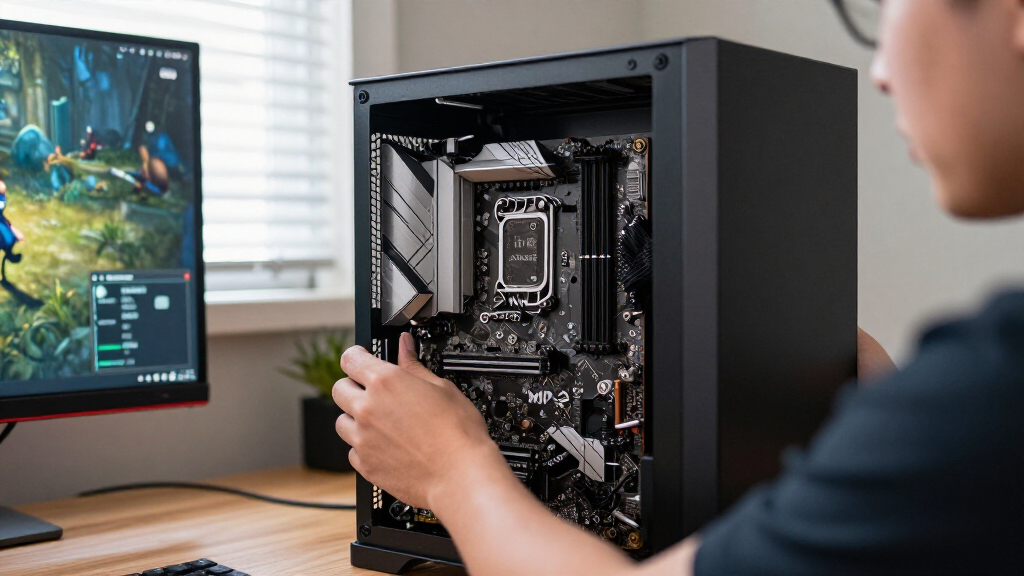
I ranked these boards by how well their features serve gaming builds, not by chipset label alone. My main criteria were socket and memory compatibility, power delivery and cooling potential for the intended class of CPU, graphics and storage expansion, networking and rear I/O, and practical fit for different cases. I also weighed whether a board’s added features solve a real build need or mainly add complexity.
The ordering favors balanced, current AM5 options with useful expansion and connectivity, followed by boards aimed at narrower needs such as high-end tuning or compact builds. AM4 boards remain in the roundup for buyers upgrading an existing system, but they rank lower for a new build because they use DDR4 and do not share the AM5 platform. A premium label alone does not put a board ahead: the right choice depends on your CPU, case, storage plans, and devices.
| premium amd motherboards for gaming | Socket | Chipset | Processor support | Form factor |
|---|---|---|---|---|
| ASUS ROG Strix B850-G Gaming W | AM5 | AMD B850 | AMD Ryzen 9000, 8000, and 7000 series | Micro-ATX |
| MSI B550 Gaming WiFi 6E ATX Mo | AM4 | AMD B550 | AMD Ryzen 5000, 4000 G-Series, and 3000 series | ATX |
| ASUS ROG Strix B850-A Gaming W | AM5 | AMD B850 | AMD Ryzen 9000, 8000, and 7000 series | ATX |
| GIGABYTE B650 Eagle AX AM5 LGA | AM5 | AMD B650 | AMD Ryzen 9000, 8000, and 7000 series | ATX |
| ASUS ROG Strix B550-F Gaming W | AM4 | AMD B550 | AMD Ryzen 3000 and 5000 series | ATX |
| MSI MAG B850 Tomahawk MAX WiFi | AM5 | AMD B850 | — | — |
| ASUS TUF Gaming B650E-PLUS WiF | AM5 | AMD B650 | — | ATX |
| MSI MAG X870 Tomahawk WiFi Gam | AM5 | AMD X870 | — | ATX |
| MSI MPG X870E Carbon WiFi Gami | AM5 | — | — | — |
| ASUS ROG Strix B650-A Gaming W | AM5 | AMD B650 | — | ATX |
| MSI MPG B550 Gaming Plus V1 Ga | AM4 | AMD B550 | — | ATX |
| ASUS ROG Strix X870-I Gaming W | AM5 | AMD X870 | AMD Ryzen 7000, 8000, and 9000 series | Mini-ITX |
| GIGABYTE B550 Gaming X V2 AMD | AM4 | AMD B550 | — | — |
| ASUS ROG Strix X870E-E Gaming | AM5 | AMD X870E | AMD Ryzen 7000, 8000, and 9000 series | ATX |
| ASUS ROG Strix X870-A Gaming W | AM5 | AMD X870 | AMD Ryzen 7000, 8000, and 9000 series | ATX |
Factors to Consider When Choosing Premium Amd Motherboards For Gaming
Before choosing a board, I’d work outward from the parts and constraints that shape the whole build. Socket, memory, case dimensions, and the devices you plan to connect matter more than a long feature list. These checks help separate useful headroom from features you may never use.
Match the Socket and Memory to Your CPU
Start by checking your processor’s socket and memory generation, then confirm support on the board’s specifications and CPU support list. The AM5 boards here use DDR5, while the B550 choices use AM4 and DDR4; the platforms cannot share processors or memory. A board purchase is a poor time to assume your existing RAM will carry over. If you already own a working AM4 system, a B550 replacement can keep a larger set of parts in service. For a new build, decide whether you want AM5’s platform and memory path before comparing chipset tiers. Also check BIOS support for the exact CPU, especially if the processor is newer than the board’s original release.
Choose a Chipset for the Connections You Will Use
Chipset names can suggest a simple ladder, but the practical difference is the board’s actual I/O, storage layout, and expansion. A gaming PC with one graphics card, a couple of SSDs, and ordinary peripherals may not benefit from every high-end connection. Features such as USB 40Gbps, several Gen5 M.2 slots, or 5Gbps wired networking matter more when your drives, docks, or network can use them. Count the rear USB ports you need and check where the board places internal headers for case USB-C. Premium connectivity can age well, but it should solve a foreseeable need rather than inflate the specification list. Compare the board manuals, since slot sharing can affect which ports remain available when multiple drives are installed.
Plan Storage Before Filling Every M.2 Slot
Count your current drives and likely additions, then check each M.2 slot’s generation, location, and lane-sharing notes. More slots give room to expand, but they do not always mean every drive can run without affecting another connector. Gen5 SSDs can run hot, so heatsink coverage and airflow around the slot matter as much as the slot count. A board with fewer M.2 slots may be the better fit if you use one or two drives and want to avoid paying for unused expansion. Check whether the graphics card will cover a slot or make installation awkward in your case. Keep a copy of the manual’s storage table before purchase; it can reveal compromises that a product headline does not.
Check Case Size and Build Access
Match the board’s form factor to the case’s supported sizes before choosing between ATX, micro-ATX, and Mini-ITX. A smaller board may open up compact case options, but it usually leaves less room for add-in cards and can make cable routing or upgrades tighter. Verify clearance around the graphics card, CPU cooler, memory, and front-panel connectors rather than relying on the case label alone. Look at where the main power connectors and M.2 heatsinks sit if you expect to assemble or service the PC yourself. Features such as tool-free release mechanisms can make routine changes easier, but they do not remove the need to check physical clearance. For a small build, plan all components together before selecting the motherboard.
Pay for Power Delivery and Tuning Only When They Fit the CPU
Power stages and tuning tools matter most when paired with a higher-demand processor, sustained workloads, or deliberate overclocking. A robust power design can offer steadier operation under sustained CPU load, but it does not directly raise gaming frame rates by itself. For a typical gaming configuration, cooling, a capable power supply, and a suitable CPU may matter more than advanced board tuning features. If you want to tune, check for the controls you will actually use and read how the board handles BIOS recovery and updates. Extra automation can be convenient, but beginners may prefer a simpler setup over a larger set of tuning options. Spend up only when the processor and planned use give those features a clear job.
Treat Networking as a Build-Specific Choice
Choose Wi-Fi, Bluetooth, and wired LAN based on your router, room layout, and peripherals rather than assuming the newest standard will improve every connection. Wi-Fi 7 can be useful with compatible network equipment, but an older router will limit the practical benefit. A wired connection may remain the better choice for a fixed gaming PC, while faster LAN can help only if the rest of the network supports it. Check whether the board includes an external antenna and whether it will be easy to position behind your case. If you rely on Bluetooth controllers or headsets, confirm the version and antenna arrangement. The best networking feature is the one that works with your existing setup, not the one with the largest number in its name.
Frequently Asked Questions
Should I choose an AM5 board or keep my existing AM4 system?
If your current AM4 processor and DDR4 memory still meet your needs, a B550 board can be a sensible replacement or platform extension. Moving to AM5 means changing both the motherboard and memory, and may also prompt a CPU upgrade. That added build cost can make an AM4 option attractive when you only need to replace a failed board or add a feature your current board lacks. For a fresh build, AM5 is the relevant group here if you want DDR5 and a newer platform path. Base the decision on the parts you already own and your intended CPU, not on socket age alone.
Will an X870 or X870E motherboard make games run faster?
A higher-end chipset does not by itself guarantee higher gaming performance. Frame rates depend much more on the CPU, graphics card, memory configuration, cooling, and game settings. X870 and X870E boards can make sense if you need their connectivity, storage expansion, or tuning controls, such as USB 40Gbps or several M.2 slots. If those features will sit unused, a more modest AM5 board may support the same gaming-class processor without the extra board capabilities. Choose the chipset for what you need to connect and expand, not as a substitute for a faster graphics card.
Is a B550 motherboard still a reasonable choice for a gaming build?
It can be reasonable when you already own compatible AM4 parts or are replacing a board in an existing system. The B550 models in this roundup use DDR4 and belong to a different platform from the AM5 options, so they are not a drop-in path to an AM5 processor. For a new system, compare the full cost of an AM4 CPU and memory against an AM5 build rather than treating the motherboard as the whole decision. A B550 board is easiest to justify when it saves you from replacing parts that are still useful. Check CPU compatibility and BIOS requirements before ordering.
Do I need Wi-Fi 7 or 5Gbps LAN for a gaming PC?
Not necessarily; those features are useful only when your network equipment and use can take advantage of them. A wired connection through a standard home router may already meet your gaming needs, while Wi-Fi 7 requires compatible equipment to deliver its newer capabilities. Faster LAN is more relevant if your local network, storage server, or broadband setup can use the added throughput. If your router is older, prioritize reliable placement, antenna access, and a stable connection over the latest wireless label. Treat networking specifications as a match for your setup, not a direct measure of gaming performance.
How do I know whether a compact motherboard will fit my gaming build?
Check the case’s supported motherboard form factors and confirm the exact board dimensions before buying. The micro-ATX B850-G and Mini-ITX X870-I serve different compact-build plans, and a smaller board can leave fewer expansion options than ATX. Confirm CPU cooler and graphics-card clearance, front-panel connections, and access to M.2 slots once the graphics card is installed. Also plan for the number of drives, add-in cards, and USB headers you need, since small cases can make later changes difficult. A parts list or case manual is more reliable than assuming any compact board fits any compact case.
Conclusion
For the broadest balance of current features and storage flexibility, I’d choose the ASUS ROG Strix B850-A Gaming WiFi as best overall. The GIGABYTE B650 Eagle AX is my value-oriented AM5 pick for buyers who want DDR5 and useful expansion without targeting the highest chipset tier. For a feature-heavy premium build, the ASUS ROG Strix X870E-E is the standout, while the MSI MAG X870 Tomahawk WiFi suits buyers who want newer I/O and networking in a more focused package. Beginners should start with a straightforward ATX AM5 choice such as the ASUS TUF Gaming B650E-PLUS WiFi and confirm CPU and BIOS compatibility before assembly. For specific needs, choose the ROG Strix B850-G for micro-ATX, the ROG Strix X870-I for Mini-ITX, or a B550 board when keeping an existing AM4 and DDR4 build makes more sense than moving platforms.
Halloween Picks
halloween
As an affiliate, we earn on qualifying purchases.