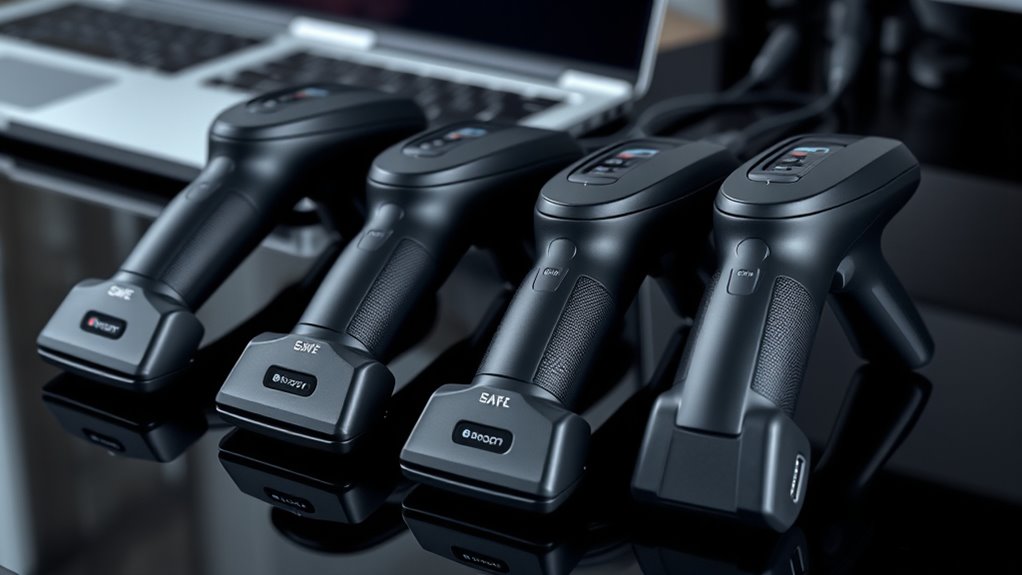

A wireless barcode scanner with USB can connect to a computer through a receiver or cable, while some models also pair over Bluetooth. My best overall pick is the Tera Wireless Barcode Scanner with Screen, which supports 1D and 2D codes and offers several connection modes. For simpler 1D workflows, the NADAMOO USB Receiver scanner keeps setup focused, while the Zebra DS2278-SR is a stronger fit for buyers prioritizing a recognized business-grade option. The main tradeoffs are code compatibility, wireless range, charging style, and whether you need a direct USB receiver or Bluetooth pairing. Read on for the full comparison and guidance on matching a scanner to your workspace.

Get kitchen staples and gadgets delivered free with Prime
- Fast, free delivery on millions of items
- Prime Video, Amazon Music and more included
- Member-only deals all year
Key Takeaways
- The Tera model with a screen stands out for shoppers who want 1D/2D reading and several connection options in one handheld scanner.
- NADAMOO and the Tera 1D model suit simpler linear-barcode tasks; choosing a 1D scanner can avoid paying for code formats your workflow never uses.
- USB means different things across this lineup: some scanners use a USB receiver, some support wired USB, and Bluetooth models may need a different pairing setup.
- Charging setups affect daily workflow: the Inateck BCST-36 and Eyoyo industrial model include cradles or stands, while compact handheld options favor portability.
- Business-focused choices differ from general-purpose models: Zebra and Honeywell are the picks to compare for established-brand workflows, while feature-rich multi-mode models offer more connection flexibility.
| NADAMOO Wireless Barcode Scanner with USB Receiver |  | Best for Long-Range Warehouse Work | Connectivity: USB receiver | Transmission distance: Up to 400 m open air / 100 m indoors | Battery capacity: 2600mAh | VIEW ON AMAZON | See Our Full Breakdown |
| NETUM NT-1228BC Bluetooth Barcode Scanner |  | Best for Multi-Device Flexibility | Model: NT-1228BC | Connectivity: Bluetooth, 2.4G wireless, and USB wired | Sensor: 2500-pixel high-resolution CCD | VIEW ON AMAZON | See Our Full Breakdown |
| Symcode Wireless Barcode Scanner 2-in-1 (2.4 GHz Wireless + USB 2.0 Wired), Handheld 1D Laser, 328-ft Transmission, Rechargeable |  | Best for Wireless-or-Wired Backup | Connectivity: 2.4GHz wireless and USB 2.0 cable | Compatible devices: Desktop, laptop, smartphone, and tablet | Battery: 2000mAh rechargeable lithium-polymer battery | VIEW ON AMAZON | See Our Full Breakdown |
| Inateck 1D Barcode Scanner, Wireless Bluetooth Handheld with 2000mAh Battery |  | Best for App-Assisted Setup | Connectivity: 2.4G wireless, Bluetooth, and USB cable | Compatible devices: Desktop, laptop, smartphone, and tablet | Battery capacity: 2000mAh lithium-ion | VIEW ON AMAZON | See Our Full Breakdown |
| Tera Wireless Barcode Scanner with Screen, Pro Version 1D/2D/QR, Bluetooth, 2.4G, USB, Wired, Handheld |  | Best for Mixed 1D and 2D Codes | Connection types: Bluetooth, 2.4G wireless, and USB wired | Wireless range: 328 ft barrier-free / 114 ft with obstacles | Battery capacity: 2500mAh | VIEW ON AMAZON | See Our Full Breakdown |
| Inateck BCST-36 Wireless Bluetooth 2D Barcode Scanner with Charging Cradle |  | Best for High-Volume Scanning | Model: BCST-36 | Connectivity: Bluetooth, 2.4G wireless, wired USB | Battery: 2600mAh | VIEW ON AMAZON | See Our Full Breakdown |
| PecuMecu Bluetooth 1D/2D Barcode Scanner – 3-in-1 Bluetooth, USB Wired & 2.4G Wireless QR Reader (TM-10B) |  | Best for Fast, Flexible Scanning | Model: TM-10B | Connectivity: Bluetooth, 2.4GHz wireless, USB cable | Battery: 2600mAh lithium-ion | VIEW ON AMAZON | See Our Full Breakdown |
| Tera Wireless 1D Laser Barcode Scanner with Battery Indicator |  | Best for Simple 1D USB Workflows | Connectivity: 2.4GHz wireless, USB 2.0 wired | Battery indicator: Yes | Wireless range: Up to 328 feet in barrier-free conditions | VIEW ON AMAZON | See Our Full Breakdown |
| Zebra Symbol DS2278-SR Wireless 2D/1D Bluetooth Barcode Scanner |  | Best for Ready-to-Use Bluetooth Checkout | Connectivity: Bluetooth | Scanning range: 0.5–14.5 inches (1.23–36.8 cm) | Scanning modes: Omni-directional scanning | VIEW ON AMAZON | See Our Full Breakdown |
| Eyoyo 2D QR Industrial Barcode Scanner with Wireless Charging Stand |  | Best for Harsh Industrial Environments | Connectivity: 2.4G wireless, Bluetooth 6.0, wired USB | Sealing: IP65 waterproof and dustproof | Drop resistance: 100 drops from 3 meters (10 feet) | VIEW ON AMAZON | See Our Full Breakdown |
| Eyoyo Mini 1D Bluetooth Barcode Scanner |  | Best Compact Pick | Weight: 35 g (1.2 oz) | Connection modes: 2.4G wireless, Bluetooth, USB wired | Transmission range: Up to 30 m (2.4G); up to 50 m (Bluetooth) | VIEW ON AMAZON | See Our Full Breakdown |
| ScanAvenger Wireless Portable 1D & 2D Barcode Scanner with Stand – Bluetooth, USB, Rechargeable Battery |  | Best for Mixed Barcode Workflows | Connectivity: Bluetooth and USB | Battery type: Rechargeable Li-Ion | Charging method: Lightning connector via smart stand; wireless transmission from stand | VIEW ON AMAZON | See Our Full Breakdown |
| Honeywell Voyager XP 1472g Wireless Barcode Scanner Kit |  | Best for Demanding Retail Counters | Model: Voyager XP 1472g | Connectivity: Bluetooth, USB, RS232 | Supported codes: 1D, 2D, PDF, Postal, DotCode | VIEW ON AMAZON | See Our Full Breakdown |
| Tera 2D Wireless Barcode Scanner with Battery Indicator, Orange, D5100 |  | Best for Long Wireless Runs | Battery capacity: 2,200mAh | Connectivity: 2.4 GHz wireless and USB wired | Wireless range: Up to 328 feet | VIEW ON AMAZON | See Our Full Breakdown |
| wireless barcode scanner usb | Connectivity |
|---|---|
| NADAMOO Wireless Barcode Scann | USB receiver |
| NETUM NT-1228BC Bluetooth Barc | Bluetooth, 2.4G wireless, and USB wired |
| Symcode Wireless Barcode Scann | 2.4GHz wireless and USB 2.0 cable |
| Inateck 1D Barcode Scanner | 2.4G wireless, Bluetooth, and USB cable |
| Tera Wireless Barcode Scanner | — |
| Inateck BCST-36 Wireless Bluet | Bluetooth, 2.4G wireless, wired USB |
| PecuMecu Bluetooth 1D/2D Barco | Bluetooth, 2.4GHz wireless, USB cable |
| Tera Wireless 1D Laser Barcode | 2.4GHz wireless, USB 2.0 wired |
| Zebra Symbol DS2278-SR Wireles | Bluetooth |
| Eyoyo 2D QR Industrial Barcode | 2.4G wireless, Bluetooth 6.0, wired USB |
| Eyoyo Mini 1D Bluetooth Barcod | — |
| ScanAvenger Wireless Portable | Bluetooth and USB |
| Honeywell Voyager XP 1472g Wir | Bluetooth, USB, RS232 |
| Tera 2D Wireless Barcode Scann | 2.4 GHz wireless and USB wired |
More Details on Our Top Picks
NADAMOO Wireless Barcode Scanner with USB Receiver
The NADAMOO is the strongest fit here when operators need to scan far from a workstation and keep working through a connection outage. Its USB receiver setup is straightforward for a computer, while the stated range—up to 400 m in open air—outdistances a typical small-shop workflow. Offline storage for 100,000 barcodes also suits inventory rounds where scans can be uploaded later. Compared with the NETUM NT-1228BC, it gives up Bluetooth and broader device flexibility in favor of a simpler receiver-based setup and a stated 30-working-day battery life at 2,000 scans per day. The tradeoff is clear: this is a 1D laser scanner, so it cannot handle QR codes or other 2D formats. Choose it for long-range 1D scanning, not mixed barcode needs.
Pros:- Long stated wireless range of up to 400 m in open air
- Offline storage holds up to 100,000 barcodes
- 2600mAh battery is rated for up to 30 working days at 2,000 scans per day
- One-to-one and more-to-one pairing modes support different scanner setups
Cons:- Reads 1D barcodes only
- Uses a USB receiver rather than Bluetooth, limiting direct connection options
- The maximum range is specified for open air and may be shorter indoors
Best for: Warehouse and stockroom teams scanning 1D labels far from a USB-equipped computer, especially when offline batch collection is useful.
Not ideal for: Retailers scanning QR codes or buyers who need Bluetooth pairing with phones and tablets.
- Connectivity:USB receiver
- Transmission distance:Up to 400 m open air / 100 m indoors
- Battery capacity:2600mAh
- Battery life:Up to 30 working days at 2,000 scans per day
- Offline storage:Up to 100,000 barcodes
- Pairing modes:One-to-one and more-to-one
- Working modes:Instant upload and storage
- Barcode type:1D laser
Our verdict“Choose the NADAMOO for long-range, offline 1D inventory work; skip it if you need Bluetooth or 2D scanning.”
NETUM NT-1228BC Bluetooth Barcode Scanner
The NETUM NT-1228BC is the most adaptable connection choice in this group: it supports Bluetooth, 2.4G wireless, and USB wired operation, making it a better match than the receiver-only NADAMOO when a scanner must move between a computer, tablet, and phone. Its CCD sensor reads 1D and stacked barcodes and can scan from screens or through glass, which helps with digital tickets and labels behind protective surfaces. The 100,000-code storage mode also supports scanning away from a live connection. The tradeoff is setup and compatibility: configuration uses scanned setting barcodes, and the supplied information lists exclusions for systems such as Square, DoorDash, and Lightspeed. Buyers should verify their POS workflow before choosing it; broad device compatibility does not mean every POS app is supported.
Pros:- Bluetooth, 2.4G wireless, and USB wired connection options
- Works with iOS, Android, Windows, and Mac devices
- CCD sensor reads 1D and stacked barcodes from screens or through glass
- Offline storage holds up to 100,000 barcodes
Cons:- Listed as incompatible with Square, Divalto, DoorDash, and Lightspeed
- Initial configuration requires scanning setting barcodes
- The supplied data does not specify a wireless range
Best for: Small retailers and mobile inventory teams that switch among Windows, Mac, iOS, and Android devices and need both wireless and wired connection options.
Not ideal for: Businesses committed to listed incompatible POS systems, or users who want a minimal setup without scanning configuration codes.
- Model:NT-1228BC
- Connectivity:Bluetooth, 2.4G wireless, and USB wired
- Sensor:2500-pixel high-resolution CCD
- Battery capacity:2600mAh
- Storage capacity:Up to 100,000 barcodes
- Dimensions:3.23 x 4.21 x 7.44 inches
- Operating voltage:2V
- Certifications:CE, ROHS, FCC
Our verdict“Pick the NETUM when connection flexibility and screen scanning matter more than simple setup or guaranteed POS compatibility.”
Symcode Wireless Barcode Scanner 2-in-1 (2.4 GHz Wireless + USB 2.0 Wired), Handheld 1D Laser, 328-ft Transmission, Rechargeable
Symcode’s main advantage is having a 2.4GHz receiver connection and USB cable in one 1D laser scanner. That gives a workstation a wired fallback if wireless use is inconvenient, while the stated 400 m open-air range and 100 m indoor range suit larger stock areas. Like the NADAMOO, it offers 100,000-code offline storage and long-range 1D scanning; its 2000mAh battery is smaller than the NADAMOO’s 2600mAh capacity. Unlike the Bluetooth-capable Inateck 1D scanner, this Symcode model’s listed connections do not include Bluetooth, so phone pairing flexibility is limited. It also is not compatible with Square, Shopify, or Clover POS software, a significant restriction for merchants using those systems.
Pros:- Offers 2.4GHz wireless and USB wired connections
- Stated range reaches up to 400 m open air and 100 m indoors
- Stores up to 100,000 barcodes for offline scanning
- Rechargeable 2000mAh battery
Cons:- Reads 1D barcodes only
- Not compatible with Square, Shopify, or Clover POS software
- No Bluetooth connection is listed
Best for: Warehouse or back-room teams using a computer who want wireless scanning with a USB cable option and offline batch storage.
Not ideal for: Retailers using Square, Shopify, or Clover, and buyers who need Bluetooth or 2D barcode support.
- Connectivity:2.4GHz wireless and USB 2.0 cable
- Compatible devices:Desktop, laptop, smartphone, and tablet
- Battery:2000mAh rechargeable lithium-polymer battery
- Transmission distance:Up to 400 m open air / 100 m indoors
- Offline storage:Up to 100,000 barcodes
- Scanning technology:1D laser
- Angle of view:30°
Our verdict“Choose Symcode for long-range 1D work with a wired fallback, provided your POS system is compatible.”
Inateck 1D Barcode Scanner, Wireless Bluetooth Handheld with 2000mAh Battery
For buyers who want Bluetooth without giving up a USB connection, the Inateck offers a useful three-way setup: Bluetooth, 2.4G wireless, and USB cable. Its Inateck Office app gives configuration a more approachable route than the NETUM’s barcode-based setting process, though that convenience depends on being comfortable using an app. The scanner is designed for common 1D barcodes, including damaged or dirty codes, and its listed 2000mAh battery is paired with a claim of up to three months per charge under some use patterns. That figure falls to about one month with frequent scanning, so heavy-use buyers should temper expectations. Compared with the more capable 2D Tera HW0009, this model is narrower in barcode support and lacks a stated storage capacity or wireless range.
Pros:- Bluetooth, 2.4G wireless, and USB cable connection options
- Inateck Office app supports configuration
- Designed to read common 1D barcodes, including damaged or dirty codes
- 2000mAh battery with a stated lifespan of up to three months under some usage patterns
Cons:- Supports 1D barcodes only
- Battery life is described as about one month under high-frequency use
- No wireless range or offline storage capacity is supplied
Best for: Libraries, retail counters, and logistics teams that scan common 1D labels and want Bluetooth plus app-based configuration.
Not ideal for: Teams scanning QR or other 2D codes, or high-volume operators who need a clearly specified offline storage capacity and range.
- Connectivity:2.4G wireless, Bluetooth, and USB cable
- Compatible devices:Desktop, laptop, smartphone, and tablet
- Battery capacity:2000mAh lithium-ion
- Barcode support:Common 1D barcodes
- Configuration:Inateck Office app
- Operating voltage:5 volts
- Dimensions:3.58 x 2.69 x 6.5 inches
- Maximum storage temperature:45 °C
Our verdict“Choose the Inateck for app-assisted, multi-connection 1D scanning, but opt for the Tera HW0009 if you need 2D codes.”
Tera Wireless Barcode Scanner with Screen, Pro Version 1D/2D/QR, Bluetooth, 2.4G, USB, Wired, Handheld
The Tera HW0009 is the broadest barcode reader in this five-product set. Its CMOS imaging supports 1D, 2D, QR, Data Matrix, and PDF417 formats, while Bluetooth, 2.4G wireless, and USB wired connections give it more device options than the 2.4G-and-USB-only Symcode. A customizable screen can make settings and scanner status easier to manage without relying only on host software, and the included charging cradle gives it a defined home between shifts. Those additions bring tradeoffs: the scanner and cradle take more room, and pairing through scanned setup codes may challenge buyers who want a simple plug-in workflow. Its stated range is 328 feet without barriers and 114 feet with obstacles, below the longer open-air claims of the NADAMOO and Symcode.
Pros:- Reads a wide selection of 1D and 2D formats, including QR, Data Matrix, and PDF417
- Bluetooth, 2.4G wireless, and USB wired connections
- Customizable screen supports on-device settings and status visibility
- Includes a charging cradle and 2500mAh battery
Cons:- Bulkier setup than simpler handheld scanners because of the screen and charging cradle
- Pairing requires scanning configuration barcodes
- Stated range drops from 328 feet without barriers to 114 feet with obstacles
Best for: Retail and inventory teams handling a mix of standard 1D labels, QR codes, and other supported 2D formats across computers and mobile devices.
Not ideal for: Buyers who only scan 1D labels, need the longest stated range, or want the smallest setup without a screen and cradle.
- Connection types:Bluetooth, 2.4G wireless, and USB wired
- Wireless range:328 ft barrier-free / 114 ft with obstacles
- Battery capacity:2500mAh
- Barcode formats:1D, 2D, QR, Data Matrix, PDF417, Aztec, Maxicode, Micro QR, Micro PDF417, UPC/EAN, Code 128, and others
- Compatibility:Windows, Mac OS, iOS, Android, and Linux
- Included accessories:Charging cradle, charging cable, and user manual
- Scanner type:CMOS imaging
Our verdict“Choose the Tera HW0009 when your workflow mixes 1D and 2D codes and its larger, setup-heavy design is acceptable.”
Inateck BCST-36 Wireless Bluetooth 2D Barcode Scanner with Charging Cradle
The BCST-36 is the strongest fit here for buyers who need to keep scanning when labels are worn or the workstation is far from the stockroom. Its 300,000-pixel 2D module is designed to read damaged, dirty, or distorted codes, while offline storage for up to 270,000 barcodes accommodates extended collection before syncing. That capacity is more than the PecuMecu TM-10B’s 130,000-code storage, making the Inateck better suited to larger batches. Bluetooth, 2.4G wireless, and USB wired connections also offer more ways to connect than the Bluetooth-only Zebra DS2278-SR. The tradeoff is setup: advanced configuration may call for app interaction, and Bluetooth’s stated range is shorter than 2.4G. I’d pick it for varied, high-volume work, not for buyers seeking the simplest plug-in-and-scan setup.
Pros:- Reads 1D and 2D codes, including damaged, dirty, or distorted labels
- Stores up to 270,000 barcodes for later transfer
- Bluetooth, 2.4G wireless, and wired USB connections
- Charging base supports charging and data transfer
Cons:- Advanced configuration may require app interaction
- Bluetooth range is shorter than the stated 2.4G range
Best for: Warehouse and inventory teams that collect large batches of mixed 1D and 2D codes, including labels that may be damaged or dirty.
Not ideal for: Small counters or first-time scanner buyers who want a minimal setup process and do not need large offline storage.
- Model:BCST-36
- Connectivity:Bluetooth, 2.4G wireless, wired USB
- Battery:2600mAh
- Image sensor:300,000-pixel 2D module
- Transmission range:Up to 100 meters (2.4G); 40 meters (Bluetooth)
- Storage capacity:Up to 270,000 barcodes
- Supported operating systems:Windows, Mac OS, Linux, Android, iOS
- Barcode types:1D, 2D, GS1-128, 2 OF 5, La Poste Code 128, USPS, FedEx
Our verdict“Choose the BCST-36 for large scan batches and difficult labels, but choose a simpler model if setup ease matters more than storage and connection flexibility.”
PecuMecu Bluetooth 1D/2D Barcode Scanner – 3-in-1 Bluetooth, USB Wired & 2.4G Wireless QR Reader (TM-10B)
The PecuMecu TM-10B offers a practical mix of connection options and fast decoding without the Inateck BCST-36’s larger storage emphasis. It handles 1D and 2D formats such as UPC, QR, DataMatrix, and PDF417, and its listed speed of up to 350 scans per second suits busy workflows where quick reads matter. Bluetooth, 2.4GHz wireless, and USB wired operation make it adaptable across mobile and fixed workstations; the 70-meter 2.4G range is shorter than the Inateck’s stated 100 meters. Its 130,000-code offline capacity is substantial, though half the Inateck’s listed maximum. One firm limitation: it is not compatible with Square POS. I’d shortlist it for mixed-device scanning outside Square-based checkout, but skip it if Square is central to your workflow.
Pros:- Reads a broad range of 1D and 2D formats
- Offers Bluetooth, 2.4GHz wireless, and USB wired connections
- Lists scanning speeds up to 350 scans per second
- Stores up to 130,000 barcodes offline
Cons:- Not compatible with Square POS software
- Its 70-meter 2.4G range is shorter than the Inateck BCST-36’s stated 100 meters
Best for: Small warehouse, back-office, or retail teams that need rapid 1D and 2D scanning across wired and wireless devices, without relying on Square POS.
Not ideal for: Square POS users or teams that need the longest stated wireless reach or the largest offline scan buffer.
- Model:TM-10B
- Connectivity:Bluetooth, 2.4GHz wireless, USB cable
- Battery:2600mAh lithium-ion
- Scanning speed:Up to 350 scans per second
- Transmission range:Up to 70 meters (2.4G); 20 meters (Bluetooth)
- Offline storage:Up to 130,000 barcodes
- Supported operating systems:Windows XP–11, macOS, Linux, Android, iOS
- Supported codes:1D and 2D, including UPC, Code 128, QR, DataMatrix, Micro PDF417, Aztec, and Hanxin
Our verdict“Pick the TM-10B for fast, flexible mixed-code scanning, unless Square compatibility or greater range is a requirement.”
Tera Wireless 1D Laser Barcode Scanner with Battery Indicator
This Tera is the straightforward choice for buyers who scan standard product labels and do not need QR or other 2D codes. It connects through 2.4GHz wireless or USB 2.0 wired, with plug-and-play setup that avoids driver installation. That makes it less connection-flexible than the Inateck BCST-36, which adds Bluetooth and 2D scanning, but the Tera’s visible battery indicator gives operators a quick way to check charge during a shift. Its IP54 protection and drop resistance up to 6.56 feet also suit rougher daily handling. The boundary is clear: it reads 1D barcodes only, unlike the PecuMecu TM-10B’s QR and DataMatrix support. I’d choose it for uncomplicated USB or 2.4GHz inventory tasks, not for modern 2D-code workflows.
Pros:- Plug-and-play USB 2.0 setup with no driver installation
- 2.4GHz wireless operation with a stated range up to 328 feet in open conditions
- Battery-level indicator makes charge status visible
- IP54 protection and drop resistance up to 6.56 feet
Cons:- Reads 1D barcodes only, unlike the 2D-capable PecuMecu TM-10B
- Does not list Bluetooth connectivity
- The stated wireless range can be reduced by barriers
Best for: Small shops, stockrooms, and packing stations that scan 1D product labels and value easy USB setup and a visible battery check.
Not ideal for: Teams that scan QR codes, DataMatrix, or other 2D formats, or need Bluetooth pairing with mobile devices.
- Connectivity:2.4GHz wireless, USB 2.0 wired
- Battery indicator:Yes
- Wireless range:Up to 328 feet in barrier-free conditions
- Supported codes:1D, including Code 128, Code 39, EAN-13, UPC-A, and ISBN
- Setup:Plug and play; no drivers required
- Ingress protection:IP54 dust protection
- Drop protection:Up to 6.56 feet
Our verdict“Choose this Tera for durable, simple 1D scanning over USB or 2.4GHz, but look elsewhere if your workflow includes QR or other 2D codes.”
Zebra Symbol DS2278-SR Wireless 2D/1D Bluetooth Barcode Scanner
The Zebra DS2278-SR is the simplest fit for buyers who want a 1D/2D scanner that arrives with pre-configured settings and a cradle, rather than a model built around large offline batches. Its omni-directional scan head means users do not have to carefully align each label, and the stated 0.5-to-14.5-inch range supports both close presentation and some distance. Compared with the Inateck BCST-36, the Zebra has a narrower connection profile: Bluetooth only, with no listed 2.4G or wired USB operating mode, though a USB cable is included. Wi-Fi Friendly Mode is a useful choice for workplaces concerned about Bluetooth and WLAN interference. The main uncertainty is battery life, which the supplied details do not specify. I’d favor it for quick setup, not for long-range or high-volume offline collection.
Pros:- Pre-configured settings support ready-to-use setup
- Omni-directional scanning reduces the need to align barcodes
- Stated scanning range runs from 0.5 to 14.5 inches
- Wi-Fi Friendly Mode is designed to reduce Bluetooth interference with WLAN
Cons:- Bluetooth is the only listed connectivity mode, unlike the Inateck BCST-36’s three options
- Battery-life details are not provided
- No offline storage capacity is specified
Best for: Retail counters and service desks that want an out-of-box Bluetooth scanner for mixed 1D and 2D codes with minimal configuration.
Not ideal for: Warehouse teams needing a stated long-range 2.4G link, substantial offline storage, or clearly documented battery capacity.
- Connectivity:Bluetooth
- Scanning range:0.5–14.5 inches (1.23–36.8 cm)
- Scanning modes:Omni-directional scanning
- Interference feature:Wi-Fi Friendly Mode
- Included items:Scanner, cradle, battery, USB cable, manual
- Settings:Pre-configured settings
- Supported code types:1D and 2D barcodes
Our verdict“Choose the DS2278-SR for a ready-to-use Bluetooth checkout setup, but select a multi-connection scanner for warehouse range or batch storage needs.”
Eyoyo 2D QR Industrial Barcode Scanner with Wireless Charging Stand
The Eyoyo EY-037 prioritizes survivability over the Zebra DS2278-SR’s ready-to-use checkout approach. Its IP65 sealing, stated resistance to 100 drops from 3 meters, and 7,000 tumbles from 1 meter make it the more appropriate pick for dusty floors, workshop stations, and frequent handling. It also supports 2.4G wireless, Bluetooth 6.0, and wired USB, plus manual, continuous, auto-sensing, and storage modes. Offline capacity reaches 100,000 barcodes, below the Inateck BCST-36’s 270,000 and the PecuMecu TM-10B’s 130,000, so it is not the lineup’s batch-storage leader. The supplied details give no battery life or charging time, and setup may need careful manual reading. I’d choose it when ruggedness leads; for a cleaner counter, the Zebra is a simpler match.
Pros:- IP65 waterproof and dustproof sealing
- Rated for 100 drops from 3 meters and 7,000 tumbles from 1 meter
- 2.4G wireless, Bluetooth 6.0, and wired USB connectivity
- Manual, continuous, auto-sensing, and storage scanning modes
Cons:- Battery life and charging time are not specified
- Offline storage of 100,000 codes is below the Inateck BCST-36 and PecuMecu TM-10B capacities
- Setup may require close attention to the manual
Best for: Warehouse, manufacturing, and outdoor operations that need a 2D-capable scanner with strong dust and water protection and multiple connection modes.
Not ideal for: Retail counters seeking the simplest ready-to-use setup, or teams that need documented battery endurance and high offline capacity.
- Connectivity:2.4G wireless, Bluetooth 6.0, wired USB
- Sealing:IP65 waterproof and dustproof
- Drop resistance:100 drops from 3 meters (10 feet)
- Tumble resistance:7,000 tumbles from 1 meter (3.3 feet)
- Storage capacity:Up to 100,000 barcodes
- Compatibility:Windows 7/8/10/XP, Mac OS, iOS, Android, Linux
- Scanning modes:Manual trigger, continuous, auto-sensing, storage mode
Our verdict“Pick the Eyoyo EY-037 for demanding, dusty work areas where durability matters more than documented battery life or maximum batch storage.”
Eyoyo Mini 1D Bluetooth Barcode Scanner
For buyers who prioritize portability in a wireless barcode scanner USB setup, the Eyoyo Mini’s 35 g weight and three connection modes make it the easiest model here to carry between workstations. Use Bluetooth for a mobile device, 2.4G wireless for a computer, or USB wired when you want a direct connection. Its support for common 1D codes, including damaged or reflective labels, suits stock counts and basic checkout tasks. Compared with the ScanAvenger, though, this is strictly a 1D option: it cannot read QR codes or scan barcodes from screens. The 650mAh battery is rated for up to eight hours, so it is portable rather than suited to uninterrupted long shifts. Skip it if your workflow depends on 2D codes or Square POS.
Pros:- Very light 35 g design is easy to carry during stock counts.
- Bluetooth, 2.4G wireless, and USB wired modes suit different devices and work areas.
- Reads common 1D formats, including damaged or reflective barcodes.
- Adjustable volume and vibration offer feedback options for quieter or busier workspaces.
Cons:- Cannot scan 2D codes such as QR codes or barcodes displayed on screens.
- Up to eight hours of working time may not cover a full extended shift.
- Not compatible with Square POS or Square Register.
Best for: Mobile inventory workers and small-shop staff who need a lightweight 1D scanner that can switch between Bluetooth, 2.4G wireless, and USB.
Not ideal for: Businesses scanning QR codes, phone screens, or using Square POS, since this model is limited to 1D codes and is listed as incompatible with Square.
- Weight:35 g (1.2 oz)
- Connection modes:2.4G wireless, Bluetooth, USB wired
- Transmission range:Up to 30 m (2.4G); up to 50 m (Bluetooth)
- Battery capacity:650mAh
- Working time:Up to 8 hours
- Standby time:Up to 10 days
- Supported barcode types:1D, including UPC/EAN, Code 39, and Code 128
- Compatibility:Windows, Mac OS, Linux, iOS, and Android
Our verdict“Choose the Eyoyo Mini if a tiny, flexible 1D scanner matters more than QR support or all-day battery life.”
ScanAvenger Wireless Portable 1D & 2D Barcode Scanner with Stand – Bluetooth, USB, Rechargeable Battery
The ScanAvenger earns its place for teams that handle both conventional labels and 2D codes without wanting separate scanners. Bluetooth and USB connectivity cover mobile and computer use, while its smart stand supports wireless charging and provides another practical way to keep the scanner ready between tasks. Its manual, continuous, and auto-sense modes let the operator choose between deliberate scans and hands-free-style presentation work. Compared with the Eyoyo Mini, it can read QR and other 2D formats, but it gives up that model’s clearly specified ultralight 35 g portability. The stand and broad code support are useful, yet the proprietary POS caveat limits its appeal for checkout systems that require dedicated integrations. It also does not support Maxicode.
Pros:- Reads a broad selection of both 1D and 2D barcode formats.
- Bluetooth and USB connectivity support mobile and computer workflows.
- Smart stand offers wireless charging and a convenient place to store the scanner.
- Three scan modes adapt to manual, continuous, and auto-sense use.
Cons:- Does not support Maxicode.
- May not work with POS systems that require proprietary hardware integration.
- The supplied information does not specify battery capacity or working time, making shift coverage harder to judge.
Best for: Small retailers and inventory teams that scan a mix of 1D labels and QR or other 2D codes across computers and mobile devices.
Not ideal for: Businesses using POS platforms that require proprietary scanner integration, or workflows that specifically rely on Maxicode.
- Connectivity:Bluetooth and USB
- Battery type:Rechargeable Li-Ion
- Charging method:Lightning connector via smart stand; wireless transmission from stand
- Scanning modes:Manual, Continuous, Auto Sense
- Supported platforms:Mac, Windows, Android, and iOS
- 1D barcode types:UPC, EAN, Code128, Code39, Code11, Codabar, and others
- 2D barcode types:PDF417, Aztec, Data Matrix, QR Code, Micro PDF, and others
Our verdict“Pick the ScanAvenger when you need 1D and 2D scanning with flexible modes and stand-based charging, provided your POS supports it.”
Honeywell Voyager XP 1472g Wireless Barcode Scanner Kit
The Honeywell Voyager XP 1472g is the strongest fit here for a busy retail counter where damaged labels, screen codes, and rough handling are routine. It reads 1D, 2D, PDF, postal, and DotCode formats, and its stated drop and tumble ratings point to a more rugged work tool than the portable Eyoyo Mini. The kit also includes a cradle plus USB and RS232 cables and adapters, which can simplify setup across different computer connections. That breadth comes with tradeoffs: it uses three AAA batteries, and the supplied description does not say they are included in the main kit. Wireless range can also vary with the environment. Compared with the ScanAvenger, the Honeywell emphasizes durability and connection accessories over a rechargeable battery and multiple scan modes.
Pros:- Reads 1D, 2D, PDF, postal, and DotCode formats, including damaged or poorly printed codes.
- Rated for 30 drops from 1.8 m and 1,000 tumbles from 0.5 m.
- Kit includes a charging cradle, power adapter, USB and RS232 cables, and adapters.
- Handles digital coupons and barcode images on smartphone screens.
Cons:- Uses three AAA batteries, which may not be included in the main kit.
- Bluetooth range can vary with the surrounding environment.
- More connection accessories and durability may be unnecessary for light-duty inventory work.
Best for: High-volume retailers that need a durable scanner for worn labels, digital coupons, and a mix of computer connection types.
Not ideal for: Buyers who want a rechargeable scanner with a stated long working time, or who do not want to manage AAA batteries.
- Model:Voyager XP 1472g
- Connectivity:Bluetooth, USB, RS232
- Supported codes:1D, 2D, PDF, Postal, DotCode
- Power source:3 AAA batteries
- Included accessories:Charging cradle, power adapter, USB cable, RS232 cable, USB-A to USB-C adapter, cleaning cloth
- Warranty:1 year
Our verdict“Choose the Honeywell for a hard-working retail counter that needs broad code support and rugged construction, not for a rechargeable-first setup.”
Tera 2D Wireless Barcode Scanner with Battery Indicator, Orange, D5100
The Tera D5100 suits warehouse and stockroom tasks where the operator needs to move well away from a computer. Its listed wireless range of up to 328 feet and 2,200mAh battery favor longer roaming sessions than the compact Eyoyo Mini, whose stated working time is up to eight hours. The battery indicator helps staff spot low charge before a scan run, while IP54 protection and an anti-shock silicone cover add practical resistance to dust and knocks. USB wired mode remains available when wireless use is not suitable. The tradeoff is that the supplied data does not spell out its full barcode-format list, so buyers with specialized codes should verify compatibility before choosing it. It also requires wireless setup and is not compatible with Square POS.
Pros:- Listed wireless range of up to 328 feet supports movement across larger work areas.
- 2,200mAh battery and indicator light help with longer scanning sessions and charge checks.
- IP54 protection and anti-shock silicone cover add resistance to dust and impacts.
- Offers both 2.4 GHz wireless and USB wired connections.
Cons:- Requires setup for wireless connection.
- Not compatible with Square POS.
- The supplied product data does not identify specific supported barcode symbologies.
Best for: Warehouse and stockroom staff who scan across a broad work area and want a high-capacity battery with visible charge status.
Not ideal for: Square POS users or buyers who need confirmed support for specific specialty barcode formats before purchase.
- Battery capacity:2,200mAh
- Connectivity:2.4 GHz wireless and USB wired
- Wireless range:Up to 328 feet
- Scan rate:200 scans/sec
- Weight:Approximately 6.6 oz
- Dimensions:2.5 in D x 3.9 in W x 6.6 in H
- Protection:IP54 dust and shock resistance; anti-shock silicone cover
- Compatible devices:Desktop and laptop
Our verdict“Choose the Tera D5100 for roaming warehouse work where range and battery capacity matter more than clearly documented code support.”

How We Picked
I compared these 14 scanners around the job implied by the search: reading barcodes wirelessly while connecting with USB when needed. The main criteria were 1D versus 2D support, connection options, practical charging and storage, portability, and how well each model’s stated features match a particular workflow. I also looked for differences that affect setup, such as a USB receiver, Bluetooth pairing, a wired USB mode, or a charging cradle.
The order gives priority to versatility and clear buyer fit, not to a single headline specification. Models offering broad code support and multiple connection paths rank ahead for mixed-device workplaces; simpler 1D scanners make more sense when the task is narrow and uncomplicated. Stand and cradle designs earn attention for fixed stations, while compact models suit mobile use. A feature list alone cannot confirm performance with every barcode, device, or software setup, so buyers should check compatibility and code requirements before choosing.
Factors to Consider When Choosing Wireless Barcode Scanner Usb
Before choosing a model, I would match the scanner to the way barcodes enter your workflow—not just to the word “wireless.” These checks can prevent common mismatches around USB setup, barcode type, and day-to-day charging.
Check What USB Connectivity Actually Means
“USB” may describe a receiver plugged into a computer, a cable used for wired scanning, or a charging connection; those are different functions. A 2.4 GHz receiver can be convenient for a computer that should not pair with Bluetooth, while Bluetooth can suit tablets and other compatible devices. Some scanners provide both wireless and wired modes, which can be useful if the battery runs low during a shift. Before buying, check whether the USB receiver is included and whether your operating system accepts the scanner as a keyboard-style input device. A common mistake is assuming that any USB port makes every wireless mode compatible. If more than one device type is involved, prioritize documented support for each connection method you plan to use.
Choose 1D or 2D Based on the Codes You Scan
Linear UPC and similar barcodes can be handled by a 1D scanner, while QR codes and many other two-dimensional codes call for a 2D imager. Paying for 2D support makes sense if your labels, tickets, or screens use QR or compact stacked codes; it adds little value to a workflow that scans only familiar linear labels. Check the codes on the actual items or screens you need to read rather than relying on the scanner’s general category label. Printed labels and codes displayed on phones can behave differently, so confirm that the scanner supports your intended source. If suppliers or inventory systems may change, 2D support can preserve flexibility. If the use case is stable and strictly 1D, a simpler model may be the clearer choice.
Treat Wireless Range as a Workspace Question
A long advertised range is useful only when the scanner can maintain a connection through the obstacles in your workspace. Walls, shelving, nearby wireless equipment, and the receiver’s placement can all affect practical coverage. A checkout counter or packing bench usually needs less range than a stockroom where workers move between shelves and a computer station. Think about where the receiver or host device will sit, then choose a connection style suited to that layout. For a fixed station, a charging cradle may matter more than maximum range because it gives the scanner a predictable home. For roaming work, test the planned distance and obstacles during the return window rather than assuming a clear-line specification reflects the whole site.
Plan Charging Around Shifts and Shared Use
Battery capacity is only part of the daily-use picture: charging access, battery indication, and where the scanner rests between tasks also shape reliability. A cradle or stand can reduce the chance of a handheld unit being misplaced or left uncharged at a shared station. A battery indicator helps staff notice a low charge before scanning stops, but it does not replace a charging routine. For a single user who carries the scanner, a lightweight unit may be easier to keep close than a stand-based setup. For several workers sharing one workstation, a dock can simplify handoff. Check whether the listed charging accessory is included and whether it occupies a USB port or outlet your setup needs for something else.
Match the Scanner to Your Software and Scanning Volume
Most buyers should confirm that scanned data lands in the correct application and field before focusing on extra features. Ask whether the scanner enters data as keyboard input, whether your software expects a suffix such as Enter, and whether configuration barcodes are available for changing that behavior. For occasional inventory counts, a basic handheld may be sufficient; repeated scanning over long shifts can make grip, trigger feel, and a stable charging location more relevant. Shared workstations also benefit from a pairing process that staff can repeat without specialized support. Do not assume that a scanner described as compatible with a computer will work with every point-of-sale or inventory program. Confirm the host device, operating system, and application requirements with the seller or manufacturer before committing.
Frequently Asked Questions
Will a wireless barcode scanner with USB work with my point-of-sale or inventory software?
It depends on how the software receives scanned data and how the scanner connects to the host device. Many USB scanners send data as keyboard input, but your application may also require a particular suffix, prefix, or barcode format. Check the software’s scanner documentation and the scanner’s supported connection modes before purchase. If you use a tablet, confirm that its USB port or Bluetooth setup supports the scanner. When compatibility is unclear, ask the software provider or scanner manufacturer for confirmation rather than relying on the word “USB” alone.
Should I choose a USB receiver or Bluetooth?
A USB receiver is often a straightforward choice for a computer with an available port and a dedicated scanning station. Bluetooth can be a better match when you need to pair with a compatible tablet, laptop, or other device without leaving a receiver plugged in. Some models offer both, which can help when the same scanner moves between a workstation and a mobile device. Check how many devices the scanner can pair with and whether switching connections takes extra steps. The best fit depends on your host devices and work layout, not on one connection type being universally better.
Is a 1D scanner enough for shipping labels and inventory?
A 1D scanner can be enough when every barcode you need to read is a linear format such as UPC or Code 128. Shipping and inventory workflows can also include QR codes or other 2D formats, so the labels in your process should guide the choice. Inspect a sample of the labels and screen-based codes you expect to scan, including those from suppliers or carriers. If even one routine task depends on a 2D code, a 2D-capable scanner may prevent a workflow gap. If all required codes are confirmed as 1D, a simpler scanner may be a more sensible match.
Can I keep scanning while the scanner is connected by USB for charging?
That depends on the individual model and whether its USB connection supports data, charging, or both at the same time. Some scanners offer a wired USB mode as well as wireless operation, while others use USB chiefly for charging or rely on a separate receiver. Read the product’s instructions for simultaneous charging and scanning rather than assuming the cable supports both. If uninterrupted use matters, a cradle or a spare charging plan may be more useful than a long battery-life claim alone. Confirm how the scanner behaves when its battery is low before putting it into a high-volume workflow.
When should I choose a charging cradle or stand instead of a compact scanner?
A cradle or stand is a good fit for a fixed checkout, packing bench, or shared workstation where the scanner should be easy to return and charge. It can support orderly handoffs, though it takes up desk space and may limit how you position the charging setup. A compact handheld model is more convenient when workers carry the scanner between shelves or work areas. Consider who uses the scanner, where it rests between scans, and whether a charging point is always available. The right form factor is the one that fits the movement and storage habits of the people doing the work.
Conclusion
For a flexible all-around choice, I would start with the Tera Wireless Barcode Scanner with Screen because it combines 1D/2D support with multiple connection options. For best value in a simple workflow, compare the NADAMOO USB-receiver model if your work uses 1D codes and a computer-based setup. Beginners may prefer a receiver-based scanner with a straightforward workstation role rather than a model whose extra modes they will not use. For a premium, established-brand shortlist, compare the Zebra DS2278-SR and Honeywell Voyager XP 1472g against your support and compatibility needs. Choose the Inateck BCST-36 or Eyoyo industrial model when a cradle or stand suits a fixed station, and consider the Eyoyo Mini when portability matters more than a charging dock. Before ordering, verify barcode formats, host compatibility, and whether the USB connection meets your actual setup.
Halloween Picks
halloween
As an affiliate, we earn on qualifying purchases.